In the South Seas

5%

Review and Herald Publishing Assn. · Takoma Park Station, Washington, D. C. · Dec 7, 1915

FromThe Youth’s Instructor, Vol. 63, No. 49.

Read the full edition

In the South Seas

LILY M. THORPE
Far away from the noise of battle and whirling cities, and the pushing, restless crowd of men and things, set like an emerald in the azure seas of the South Pacific, is a group of islands where the miracle of God is being performed, and where glittering bands of holy ones strive with the hordes of darkness for the supremacy in human hearts.
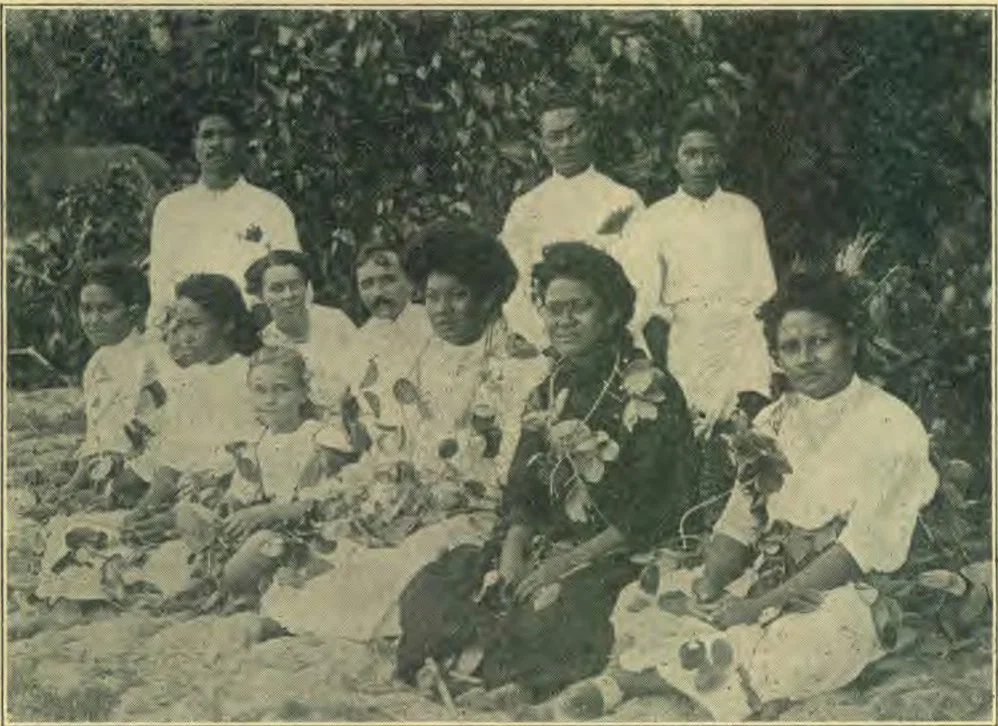
Did I say, far from the noise of battle? While this is indeed so as far as the greatest of all earthly wars is concerned, yet there is an unseen battle field here in the hearts of men, a place where battles are fought and won. Yes, thank God, they are won. Words are but tame instruments with which to convey to the mind’s eye those spiritual battles fought between powers seen and unseen—agonizing battles that leave their refining marks upon the features of our Tongan young men and young women. People say to us, “Your young women are different from others here.” Yes, they are different, and we are thankful.
There are many temptations to allure our boys and girls from the message and the church. Young men of pleasing mien but dissolute habits will attend our services with a great show of piety, in order to attract young women who live in our home. Others will sneak around in the dead of night and climb up to the girls’ windows and endeavor to get an invitation to go in. But our girls have proved stanch, and will not willingly bring dishonor upon the cause of God; and so their tempters content themselves in indulging in sneers and mockery. One of our girls, named Lusiane, a very sweet-tempered girl, which, by the way, is a wonderful thing, as the Tongans are fostered in passion and ill temper from their babyhood, was offered twelve dollars by a Free Church minister if she would attend his church. She excused herself, thanked him for his offer, and today stands stanchly for the truth.
We have Prince Tugi’s first cousin living with us, who takes her share in the work of the home, and loves the truth. Tugi (pronounced Tungi) offered her a head place in his household, but she begged that he would allow her to remain with us, much to the chagrin of the prince.
Another one of our girls received an offer of marriage from an American schoolmaster in Vavau, who says she is the cleverest and best-educated girl in Vavau. This girl’s father told her to make her own decision, and she decided by refusing the offer through her father. This is a signal victory, as the height of a Tongan woman’s ambition is to marry a white man. The sad part of this, however, is that some white men are not honorable enough to marry Tongan girls.
And now what shall I tell you about some of our boys? I call them boys, but in reality they are men; in other words, “boys grown tall.” Lasitani is a happy boy of twenty-one years, with a persuasive dimple in each cheek that gains him ready admittance into all hearts. To hear his great laugh and see his sometimes bantering ways, would not lead one to suppose that Lasitani knows what it is to strive with himself and agonize in prayer. But he has been shaken with emotion when he has poured out his heart to God for having given way to temptations that others had been strong enough to resist. He and his friend Famatau (a baptized member; Lasitani is not baptized) went to another part of the group to spend their Christmas holidays. Before they left, my husband admonished Lasitani, knowing his weakness, and Lasitani said, “Yes, I will try,” and went away with a new light in his eyes. He meant to try, and doubtless he did. But hear his own words when he came back: “Master, I am sorry I have fallen, and I hate my ways. Famatau is good, though; and when I saw him wave away the girls with the kara and the cigarettes and their allurements, I wondered how he could be so unmoved. But me? I am weak and bad.”
“SOME GIRLS CAN USE IN THIS WAY TEN ORANGES AT A TIME”
It is like cutting off the right hand and plucking out an eye for the boys and girls to give up smoking tobacco and drinking kara, the national drink. They are born and live in the fumes and dregs of these things. And then the old, established custom of friends and relatives meeting together almost every day of the week at kara parties, is inducive to the destruction of the young. But we thank the Master because Lasitani has now eschewed these things, and is living with us and entering heartily into the work. Famatau is teaching a school for the government, and out of his wages provides Lasitani’s food and clothes. We found this out by accident, as Famatau does not believe in letting his left hand know what his right one does. He is a silent man, but well liked . [[FIGURE]]
Then there is Finau, a baptized member of the church, who was formerly second head boy in the government hospital here. He has been connected with us for seven or eight years, and has clung to the truth in spite of opposition. This brings me to Lasikau, his bosom friend, who is one of our trusted boys. As I write, the voices of our little daughter and Lasikau reach me from the schoolhouse. She is explaining Matt. 5:38-48 to him. There is occasionally a heated argument when Lasikau fails to grasp such verses as verse 39, which she insists must literally mean what they say.
Lasikau carries in his face, and his heart, too, I ween, the marks of his tremendous struggle against tobacco and kara. It is likely that the majority of those who read these words have never known the craving for tobacco, and its soothing power. You do not know what it means to have every fiber of your being clamoring for the nicotine when you try to resist. You do not know what it means sternly to say No when the pungent fumes of the weed from one source or another float across your supersensitized senses, and the drumbeat in your temples is maddening, and your parched mouth refuses to be satisfied. You do not know what it means to agonize with your face pressed to the hard ground, and to rise up purged from the taste of the subtle curse. Lasikau knows all this, and his absolute happiness testifies to his emancipation.
Mate is head man in the Vavau government hospital, and is soon to be baptized. A deep sense of satisfaction steals over one when one looks at Mate’s large, expressive face, curling hair, and massive shoulders. His weight is nearly three hundred pounds. He is one of the most popular men in the whole of Vavau, chiefly because of his ministrations in his hospital capacity. But his popularity, as well as his being a big chief, has been his undoing, and the Christ stretched his hand very far into the miry clay in order to bring Mate up from the depths; and now where the truth is concerned, his mind is as the mind of a little child. His prayers and testimonies are expressive of a happy heart. He told my husband of a dream he had which decided him for the truth. He was standing on the doctor’s veranda, when his attention was directed to the sky, and he saw Christ with the angels descending to the earth. He described his terror as being abject until he saw Mr. Thorpe looking so happy, and then he (Mate) ran after him. The influence of this dream has never left Mate, and colors most of his actions. He bids fair to become a valuable worker. Pray for him.
Henele is a married man, and is greatly interested in the truth. It was not clear to him why we began the Sabbath at sunset, but when his questions were answered satisfactorily, his face beamed again, and he said, “I am so happy, because I now understand verses that before were dark to me.” He teaches our singing class, and accompanies the singing with his cornet. Remember Henele in your prayers, as his home affairs are very unhappy, and Satan is loath to let him go.
This would not be complete if I remained silent about George, David, and Fagalei, and their efforts to excel in school and in their industrial work.
Much could be written about the everyday trials and cares of our work, but they vanish in the shout of victory over Satan’s hosts, as the morning dew disappears in the light of the sun. Discouragements, disappointments—what are they? They are nothing when the streaming light from heaven lightens our pathway.
OUR TONGAN TRANSLATOR, VAI BUNA, AND HER FRIEND AT HER RIGHT
A YOUNG PEOPLE'S GATHERING BY THE SEASIDE