Crater Lake

8%

Review and Herald Publishing Company · Battle Creek, Mich. · May 2, 1901

FromThe Youth’s Instructor, Vol. 49, No. 18.

Read the full edition

Crater Lake

II

Its Discovery and Exploration
At the advent of white men in southern Oregon, Indian legends told of a great sunken lake in the top of a mountain, where evil spirits were wont to hold high carnival. Only the conjurers, or “medicine men,” had ever seen it; for its solitary island, so the legends said, was the abode of a great demon who was ever on the watch to seize and destroy the presuming brave who would dare to peep over the cliffs and look upon the deep blue water over which he ruled.
Who was the first white man to discover Crater Lake is a question over which there has been considerable dispute. Some claim that it was discovered by the soldiers of General Fremont’s exploring party in 1847; but there is no authentic record to substantiate this claim. Several prospectors and hunters claim to have seen the lake about that time, and in the early fifties; but as these claimants were silent until after a description of the lake had been given to the world by others, they are entitled to no credit for what they saw but failed to report.
In the early summer of 1853 a party of six California prospectors, who were in search of the mythological “Lost Cabin Mine,” lost their way in the mountains near the head of Rogue River, and were compelled to climb mountain peaks in search of some landmark by which they could ascertain their whereabouts. One day, after climbing a long gentle slope, they came suddenly upon the cliffs overhanging the lake. They were so struck with wonder and admiration that they forgot for a time their anxiety, and spent half a day tramping along the rim of the lake and deciding upon a name for it. They finally agreed to call it Deep Blue Lake, and when they returned to civilization, they gave this name, with a fairly good description of the lake, to the world. But they were unable to locate it with any degree of accuracy, and as there were no newspapers then published in that vicinity, the story was soon forgotten.
Nine years later another party of prospectors came upon the lake while looking for a camping place. There was then a paper published in Jacksonville, and when this party reached there, they published an account of their discovery with a description and the location of the lake.
In the next few years several different parties, who had never heard of the lake, accidentally discovered it, and gradually it came to be pretty well known in the surrounding country. But in those days the Oregonians spent half their time in hunting gold and the other half in fighting Indians; and it was not until 1869 that a wagon road was opened from the old military road between Jacksonville and Ft. Klamath up the steep mountain side to the rim of the lake.
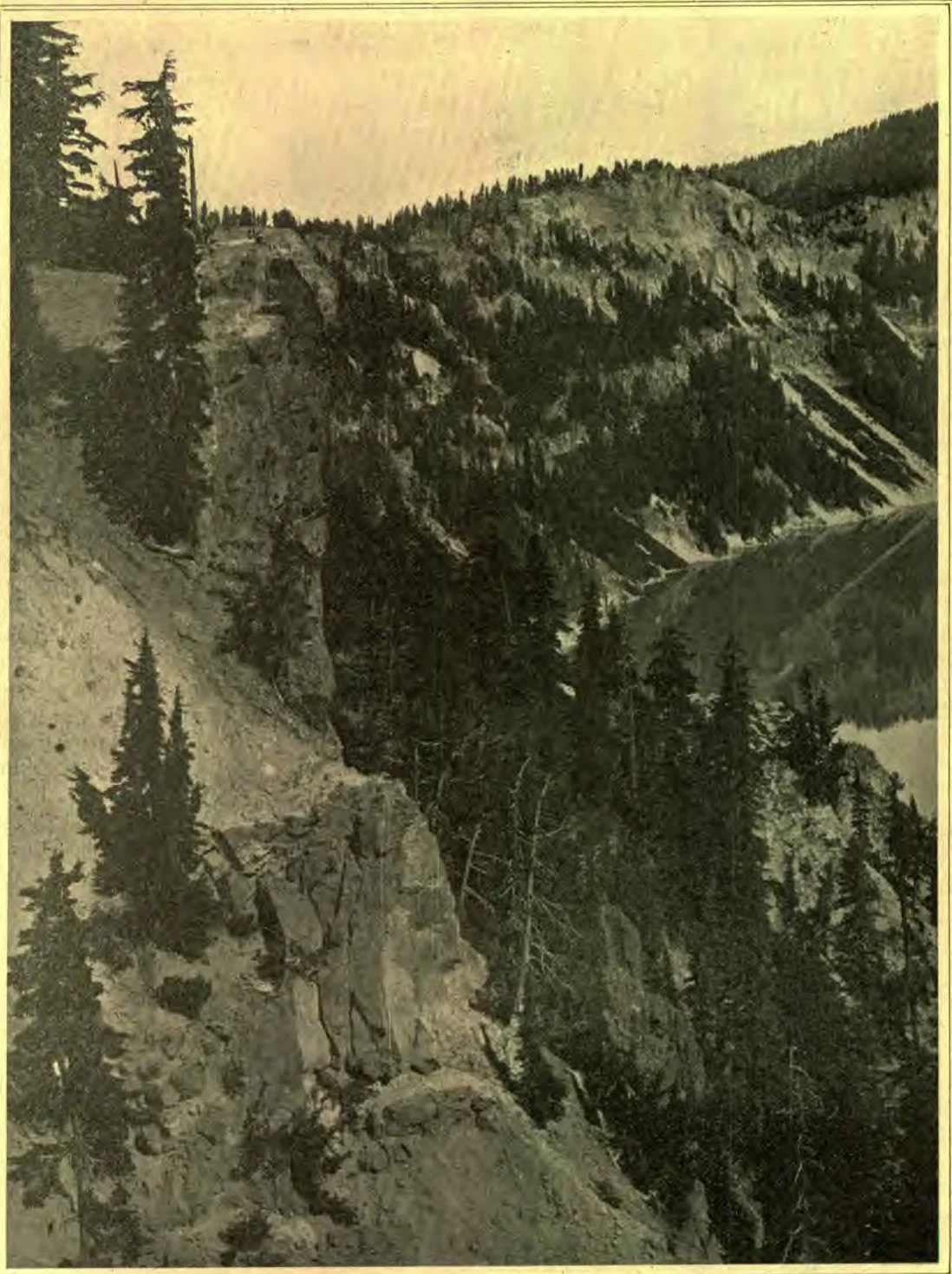
THE CLIFFS OVERHANGING THE LAKE
The party that opened the road took with them a boat in which they succeeded in reaching Wizard Island and several other points that were otherwise inaccessible. This was the first party to call it Crater Lake, and though they had not a shadow of a right to give it a name, it will no doubt be known as Crater Lake as long as the world stands.
In 1883 two men from the United States Geological Survey visited the lake, but did not remain long enough to explore it thoroughly. Two years later a party was specially detailed to this work by the Geological Survey. Nearly a month was spent in surveying and sounding the lake. During that time more than a hundred and fifty soundings were made, some of which showed a depth of over two thousand feet.
J. Edgar Ross.