The wide, treeless plain around Big Spring Gulch, hot and dry in summer and cold and bleak in winter, was just the place to develop a strong character. The gulch took its name from the large spring that came to the top of the ground near its head, and formed a small brooklet, which was soon swallowed up by the dry earth. Just above the spring, in one of the many little washouts, dry since the April freshets, one might have seen, that warm May morning, Jack and his sister Downy snugly tucked in their cozy nest—a little fuzzy mass of white and gray.
Brown-tips was the family name. It had been handed down from generation to generation. The mother of the little Brown-tips did not know that they were ugly looking babies, that their eyes and ears were much too large for the rest of their bodies, and that their hind legs were big and awkward. But perhaps she did know that these prominent features would some day develop into the strongest characteristics that mark the jack-rabbit family,—acute sight, keen sense of smell, and untiring strength and energy in the chase.
It was several weeks before Mother Brown-tips took her little family, one morning, to the spring. She stopped to nibble the green blades that tempted her appetite, and she was imitated by the funny little creatures that kept close behind her. Every time she sat up and washed her face with her paws, first one side and then the other, or scratched her right ear with her left hind foot; every time she laid her ears back and squatted at an unusual sound, they tried their best to do the same. These little jacks grew very fast, and it was not long before they became well acquainted with all the secret paths of Big Spring Gulch. Jack was very much puffed up over his increasing knowledge of rabbit ways. He could jump the little brook at its widest place, and, without his mother's consent, he had made several trips over the hill to the tree claim.
Early one morning their mother left them in the washout with strict orders to sit quite still until she returned. She had not been gone long when their sharp ears heard sounds of light footsteps coming nearer and nearer. Flat to the ground they lay, without the movement of a muscle. A moment of breathless silence. Pounce!—a little sharp squeal, and Jack was on his feet, and at the same time on the old cat’s back, jumping and kicking at such a rate that she retreated with the idea that all rabbits are not cotton-tails, and that she had better let jack-rabbits alone. Jack gained more confidence in himself. But his instinct taught him not to lead the attack, to make good use of his eyes and ears, and the better use of his legs when in more immediate danger.
Jack grew very strong and swift of foot. Before fall he could outrun the best wolf-hound on the divide. Many times he was chased, and each time his strong legs and native sagacity carried him to safety. Late in October he shed his gray coat for one of sleek white fur. Like his mother, he was a beautiful type of the western hare. His ears were long and tipped with reddish brown, which turned with his coat to a light gray in the spring. He spent much of his time alone, for rabbits are not social in their habits.
One day, as Jack stood erect on the hill, surveying the wide prairie and twitching his nose from side to side, and noting every sound with those large ears, he was not surprised to hear a familiar sound on his trail. He dropped to the ground, and angrily stamped the danger signal. Instinctively he flattened out like the wolf-skin rug on the floor. Jack thought it was Frank, the rancher’s wolf-hound, his old enemy, and he was right. Frank had the scent, and was fast coming on his trail. Jack had outwitted him too many times before to be caught now. He lay still until the hound was close. Frank caught sight of him, and his excitement grew into frenzy as he neared his prey. He made no more use of the trail. But Jack was enough for him. He leaped a few rods ahead, and suddenly dropped into a well-known washout, and escaped into the gulch, while Frank dashed madly on, only to strike an old trail that led him off in the opposite direction.
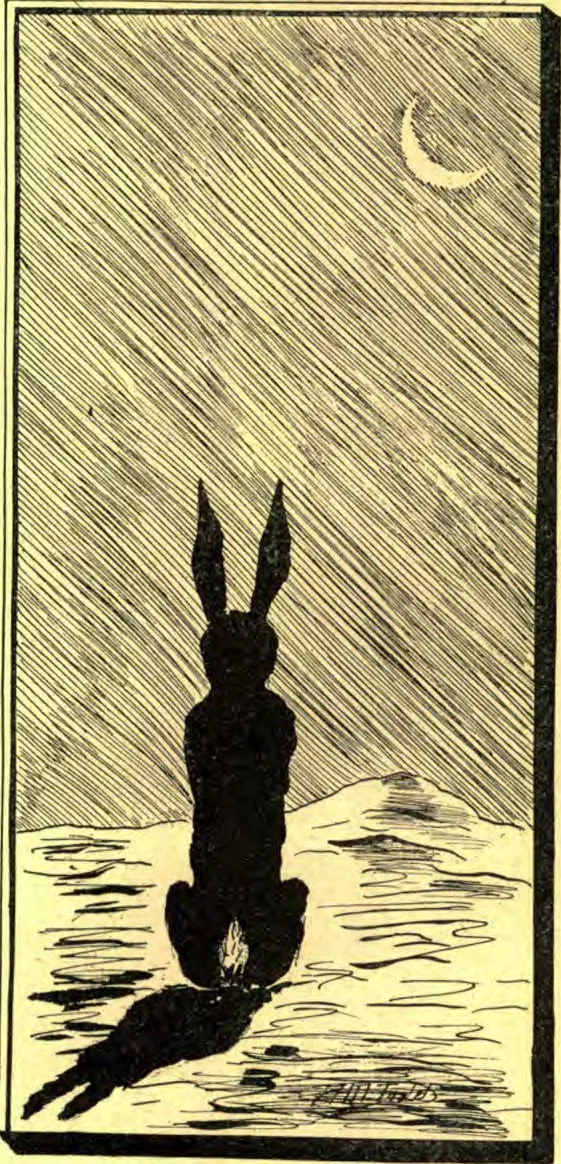
It was not unusual on those fine moonlight nights to see Jack and his mother and sister, in their wild sport, scampering back and forth between the rank grove of wild sunflowers and their hiding-place below the spring, under the brown, prickly Russian-thistles covered with wild buckwheat. On one of those occasions the trio made a flying trip to their favorite forage grounds in Farmer Bloomfield’s garden at the foot of Plum-thicket Ravine. He had a fine garden that year, and the frozen cabbage stubs were delicious to the Brown-tips. As they approached through the cornfield on the hill, Jack led the way. He stopped many times, and stood up straight and sniffed the air, and each time signaled the others to follow. As they nibbled the cabbage stubs, and now and then stood up on their haunches, and quickly rotated their ears to catch every sound, and as they moved about so gracefully, one could not help admiring them. All went well until the farmer’s back door opened, and, “Here, Bay, catch the mules,” rang out. Bay came tearing down the hill. The Brown-tips scattered and flew like the wind to different parts of the cornfield, and on by different routes to the tree claim, where they met, and returned to their cozy nook.
The next morning the sky was dark, and every sign indicated a storm. About noon the snow began to come down in big flakes, and the Brown-tips, fearing they would be snowed under in the washout, settled down under the shelter of the vine-covered thistle bank below the spring. It continued to snow till the next morning, when the sun came out, and saw his own face in millions of little mirrors that draped the withered sunflowers and the old fence and the thistle dome of the Brown-tips’ new home.
After a day and a night without food, Jack was hungry, and set out for the cornfield. As he picked his way through the gulch, he saw the cozy nook above the spring drifted full, and the tips of the dead sunflowers nearly covered with the light, drifting snow, which was very deep on the level ground. Jack found difficulty in proceeding, even at the slowest pace. He was too busy to notice the man on horseback coming at full speed straight for him, but his faithful ears soon received the message, and then Jack saw his danger. It was too late to burrow in the snow, besides he would be caught if he did. His only hope was to trust all to his strong legs, and with him to think was to act. Bang! and Jack fell limp in the snow with an ugly death wound in his side. A. M. TODD.