In June, 1893, there was organized at College View, Nebraska, the Young People’s Society of Christian Service. This society had many of the characteristics of our present denomination-wide organization. Their record book, containing their constitution and by-laws and the reports of their meetings, lies before me.6
The objects of this society, as set forth in the constitution, were “to secure the increased spirituality of the young people, their enlistment in all missionary activity through existing channels of work, and their elevation to a higher plane of living and thinking.”
The society was organized into five departments: Religious Work, Sociability and Help, Juvenile Work, Literary Improvement, and Health and Temperance. The department of Religious Work arranged for all meetings and lectures of a religious character. It was to provide for instruction in Scripture knowledge and in the history and doctrines of the denomination. The department of Sociability and Help was to form the acquaintance of strangers stopping in the village, and introduce them to other members of the society, and also to render deeds of kindness and help to the sick and unfortunate. The department of Juvenile Work was expected to assist in the children’s meetings, and in other work for the general elevation of the children. The department of Literary Improvement was to arrange for literary programs and lectures, provide for a course of reading for the society, and take steps for founding a library and reading-room. These departments were to take turns in providing programs.
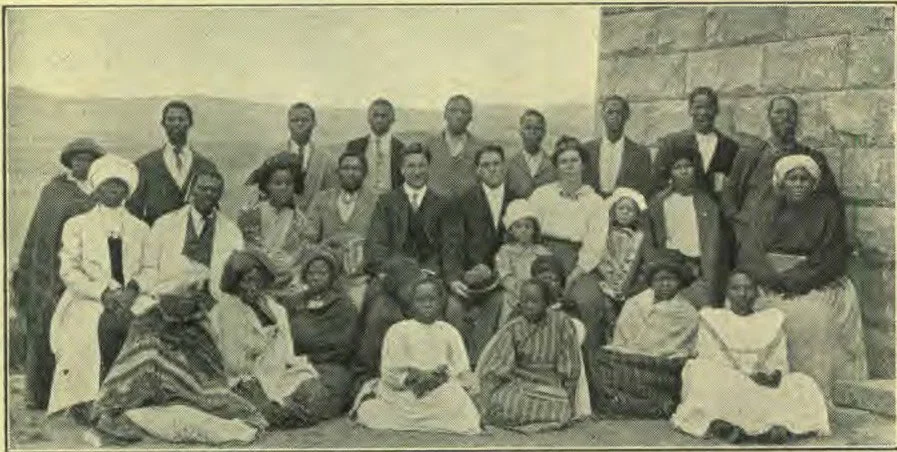
MISSIONARY VOLUNTEER SOCIETY AT EMMANUEL MISSION, SOUTH AFRICA
The relation of the society to the church was thus defined: “The society hereby acknowledges its allegiance to the church, and invites the church, through its officers, to assist in its plans and management.”
There are ninety-three names attached to the constitution. Many of these are now engaged in various kinds of missionary work—as teachers, nurses, secretaries, doctors, and ministers. I notice the names of the following well-known ministers: L. V. Finster, H. E. Reeder, F. L. Perry, C. R. Kite. Later this society became one of the regular bands of missionary activity in Union College. C. C. LEWIS.