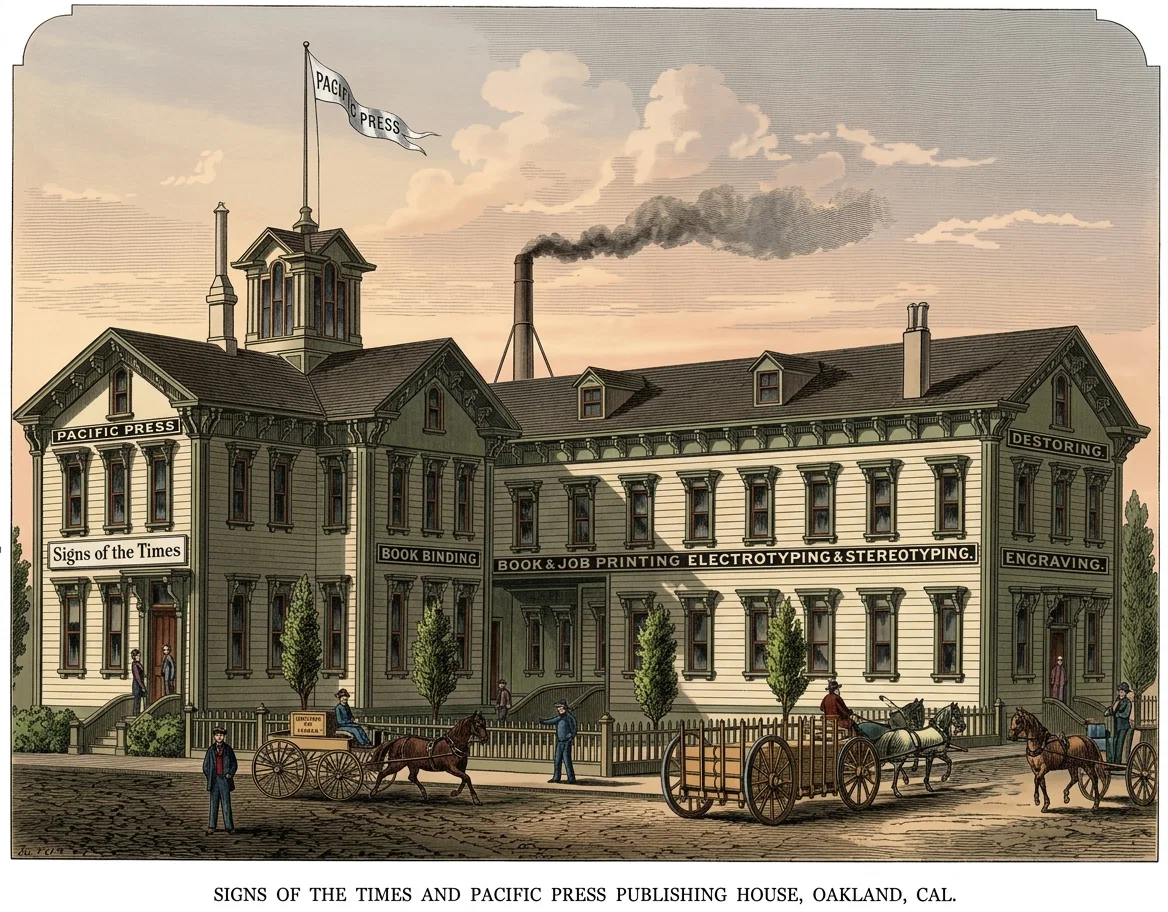
As we are about to enter upon the seventh volume of this popular religious journal it may not be uninteresting to our numerous readers to give a brief history of its early rise and progress, and a description of the office of publication from which it is now issued.
In 1868, Elders J. N. Loughborough and D. T. Bourdeau were sent by the General Conference of S. D. Adventists on a mission to California. Previous to this time the views now advocated by the SIGNS OF THE TIMES were little known on the Pacific Coast. It was soon seen that the growing cause in this locality needed a medium of communication nearer than the publishing house in Michigan, by which it had heretofore been supplied, and by the earnest efforts of Elder James White the first number of the SIGNS OF THE TIMES was issued June 4, 1874. It was started as a weekly paper, and contained eight pages of reading. The editorial work and type-setting were done in a small room at the corner of 12th St. and Broadway, Oakland, and the forms then taken to another office for the papers to be printed.
Elder White continued to publish the SIGNS regularly till April 5, 1875, when an association, called the Pacific Seventh-Day Adventist Publishing Association, was organized and duly incorporated under the laws of the State of California, to carry on the publishing work.
The subscription list of the SIGNS increased rapidly, and calls began to come in for books, pamphlets and tracts treating upon the views which were advocated in this paper. The old quarters were found to be entirely inadequate to carry on the business of the Association, therefore, in the Spring of 1876, the Association purchased a lot of land on Castro Street, between 11th and 12th streets, and commenced the erection of a building especially suited to its work. It was built in the form of a Greek cross, the main portion 26x66 feet, the transverse section 26x44, two stories high, with basement and attic. This office was thoroughly fitted up to publish the SIGNS, books, pamphlets, tracts, etc., for which there was an increasing demand. An engine, boiler, and large cylinder press were ordered from the East, and everything that was thought would ever be needed to carry on the work. But the plans then laid were soon found to be on entirely too small a scale.
The success of the SIGNS as a Missionary paper far surpassed the expectations of the most sanguine and at the close of the year the demand for books and tracts had so increased, that the office was taxed to its utmost to fill the orders.
In addition to the regular denominational work, the demand for job work by business men of this city and San Francisco was so great that a complete job printing office was added.
It was seen, that unless immediate steps were taken to secure more room, the work would greatly suffer, therefore, another lot of land was purchased facing 12th street and adjoining that already owned by the Association, and during the Summer of 1878 a second building was erected, 30x84 feet, two stories and an attic. It was connected with the other building in the rear, which it is finished to match.
At the close of the year 1879 the buildings were again found to be overcrowded. At that time the office was running two cylinder and three job presses, but with these running night and day the demand could not be supplied. The buildings were already crowded with machines and to make room for another press it was found necessary to raise the main building, the one first erected, enlarge the basement and put the presses in this. This was accordingly done in the Spring of 1880, and the engraving herewith gives a very good idea of the buildings as they now stand.
A large two-revolution four-roller cylinder press was ordered of Messrs. Cottrell & Babcock and is now in operation. This press has a bed 40x60 inches, and is the largest book printing press on this coast.
We have briefly traced the history of the SIGNS OF THE TIMES from its small beginning down to the present time,—from the circulation of a few hundred to that of nearly ten thousand copies weekly,—from the little room on Broadway to its present large and commodious quarters.
We will now take a brief survey of the interior of this office of publication. In the basement of the main building facing Castro Street, is a large and commodious press room, well lighted and ventilated, also, engine, boiler and stock room. The first floor is divided into a commodious counting room, a book and general sales and shipping room, and rooms for casting and finishing type.
On the second floor is a reception parlor and fully equipped book bindery. The attic is divided into five apartments and is used for storage. The whole is surmounted by a neat and commodious observatory which gives a fine view of the cities of Oakland and San Francisco, the Bay and the surrounding country.
The building fronting on Twelfth street is 30x84 feet. The first floor is occupied by the Job Printing office and is well lighted and conveniently arranged. In point of completeness, variety and extent of material and appliances this office is second to none in the State. The second story is used entirely as a composing room. This is where the type for the SIGNS OF THE TIMES and book work generally is set up. The attic is used for storage.
At the rear of this building, and properly forming a part of it, is a three story frame building 14x24. The first floor is occupied by a complete stereotype and electrotype foundry; the second and third for bath and lodging purposes.
Over all is a 5000 gallon water tank, which is supplied from a well by a steam pump, and furnishes water for the entire institution and some neighboring dwellings.
The Association also owns the large, two-story, double, frame dwelling in the delta of the two business houses—not shown in the engraving.
The whole investment, including stock on hand, is about $90,000.00. The number of hands employed is about fifty-five. This Association has assumed the name of the PACIFIC PRESS PUBLISHING HOUSE and is generally known in this vicinity by that name.
Early in the Spring of 1879 the increasing San Francisco trade rendered it necessary to open an office in that city, and we now have an office at 527 Commercial street under the management of Mr. J. W. Gardner. At this office we have a first-class engraver and do all kinds of designing and engraving.
The office of the SIGNS OF THE TIMES, as it stands to-day, is one of the largest and best equipped printing and publishing houses west of Chicago.
This Association is owned and controlled by stockholders who may be found in Oregon, Washington Territory, Nevada, Colorado, and many of the States east of the Rocky Mountains. At the annual meeting, which is held on the first of April, the stockholders elect a Board of Trustees, consisting of six persons, to manage the affairs of the Association. The officers consist of a President, Vice-President, Secretary, Treasurer and Auditor, and are elected annually by the Trustees. The officers elected at the last annual meeting are as follows; President, Elder S. N. Haskell; Vice-President, W. C. White; Secretary, L. D. A. Carruth; Treasurer, John Morrison; Auditor, J. D. Rice.
The Publishing Committee consists of three persons, and are also elected annually by the Board of Trustees. The Committee elected to serve the present year are, Elder S. N. Haskell, Elder J. H. Waggoner, and W. C. White.
During the coming year especial attention will be given to the SIGNS OF THE TIMES, and the publishers are determined to make it one of the best religious papers in the world. See prospectus for 1881, on another page.