Up to June [1916], no Missionary Volunteer work had ever been attempted on our mission stations in this dark portion of Africa. But according to the plan and vote of the Union committee, the writer then accompanied Pastor W. B. White, the president of the South African Union Conference, in the interests of the Missionary Volunteer work in Rhodesia. Pastor White was touring this field with the special object of holding Bible schools with the natives on our missions; but other lines of work also received attention, especially the Missionary Volunteer work.
Solusi
After a twelve-hundred-mile ride from Cape Town, we reached Solusi Mission, in Matabeleland, southern Rhodesia. This mission station was opened in 1894, twenty-three years ago, and was the first one established among heathen people by Seventh-day Adventists. When we reached the mission home on the sixth of June, the white missionaries and the native students gave us a royal welcome. “Welcome” was not only written on the blackboard, but was acted out by all, especially by our faithful and self-sacrificing white brethren and sisters. To meet again those of like precious faith brought joy to all our hearts.
We presented to the church the object of our Missionary Volunteer organization and some of its lines of missionary work, also the plan of organization, and then asked how many wished to become members. Thirty responded to the call. At a later meeting fourteen more joined, and still later seven others, making in all fifty-one natives, besides the three white persons who are serving as officers.
After the society was organized, and the officers were elected, several workers spoke words of encouragement to the members. Clarence, one of the native teachers, who had been elected assistant leader, was asked to speak. He arose, and with deep emotion said: “Today I am very glad to be here. I am glad for what I see. I am very weak, and do not know how to work for Jesus. I hope this society will help us to do better work for our people. They need light, and I give myself to do all I can to save them.” Here he stopped speaking, and sat down, weeping.
The following are some of the other testimonies that were given:
“I thank the Lord that he give me strong. This week, I give the Lord my heart. I praise the Lord give me power on my heart.”
“I am like an old blanket. I am full of holes. I can’t be mended. I must have a new one.”
“God saw me in darkness. My heart wish to see more of his love. I thank the Lord, he stay long, he wait for me.”
We presented the Bible doctrines portion of the Standard of Attainment, and one hundred and sixteen persons gave their names for membership. They cannot take the denominational history portion, as they do not have the books in their language; but they will soon learn the Bible texts from their Zulu Bibles.
The Lord surely visited us all during the few days upon this station. As Pastor White, on two Sabbaths, presented Christ to these people, thirty or more for the first time in their lives expressed a desire to find Jesus as their personal Saviour. This shows how the Lord is working to finish the message and bring us home to heaven.
With Brother R. P. Robinson as experienced leader, Clarence as assistant leader, Sister Robinson as secretary-treasurer, Sister W. C. Walston as a member of the executive committee, and Brother Walston as elder, we believe the Solusi Missionary Volunteer Society will, under the blessing of God, accomplish great things for Christ and his cause among this needy people.
The Somabula Mission
From the Solusi Mission we went about one hundred and fifty miles to the Somabula Mission, ridingp. 9 fourteen miles of the last twenty-one of our journey after a team of ten donkeys, and the last seven miles in an oxcart.
We reached the station about 9 P. M., and were ready for a night’s rest. All the missionaries were glad to see us, and we rejoiced to meet them again in the bonds of Christian love.
In the morning, the native students welcomed us heartily to the mission. Many of the outschool teachers were there to attend the Bible school, and great interest was shown in all the lessons. I believe many souls will be gathered into the fold of Christ as the result of this institute.
The first Sabbath we were there, Pastor White spoke from Matt. 11:28-30: “Come unto me, all ye that labor and are heavy laden, and I will give you rest. Take my yoke upon you, and learn of me; for I am meek and lowly in heart: and ye shall find rest unto your souls. For my yoke is easy, and my burden is light.” The message seemed to be just what these poor, heavy-laden, sin-sick souls needed. There was a large number of unbelievers present; and when the call was made for those who wished to get rid of their load of sin and take the yoke of Christ upon them, full twenty for the first time publicly came to the altar, seeking the Lord for mercy and peace. Among the seekers was a chief, a man about thirty or thirty-five years of age. He was the first to pray for himself when opportunity was given. Later on in the day we had a testimony meeting, and he with others who had come forward confessed that he believed the Lord had forgiven his sins, and declared that he wished to live for him.
As Brother J. N. de Beer, the mission superintendent, was leaving at once for an extended visit to the outschools, and Brother Hubert Sparrow, his assistant, would be extremely busy during his absence, it hardly seemed best to organize a Missionary Volunteer Society then; but all the mission workers were anxious to do their utmost in this direction, and doubtless Somabula will soon be well organized, and do her part in pressing forward in this work.
A number of the more experienced native teachers are so far away from the mission that they cannot get in oftener than once in three months; but when the society is organized, they will join, and send in their reports.
We presented the Bible doctrines portion of the Standard of Attainment at Somabula also, and eighty-five persons enrolled.
Glendale Mission, near Fort Victoria
After a half-day’s ride from Somabula, first with oxen and then with donkeys, we reached Gwelo, where we took the train for Fort Victoria, eight miles from Glendale Mission. We reached Fort Victoria in the evening, and riding for about three hours with an ox team, we camped for the night, and early in the morning proceeded to the station.
This is our youngest mission in Rhodesia, having been established in 1911. Brother T. J. Gibson is the superintendent and teacher, with Brother Laurie Sparrow as assistant. Brother Gibson’s house is beautifully situated on the top of a hill, and Brother Sparrow’s is near by on the side of a hill.
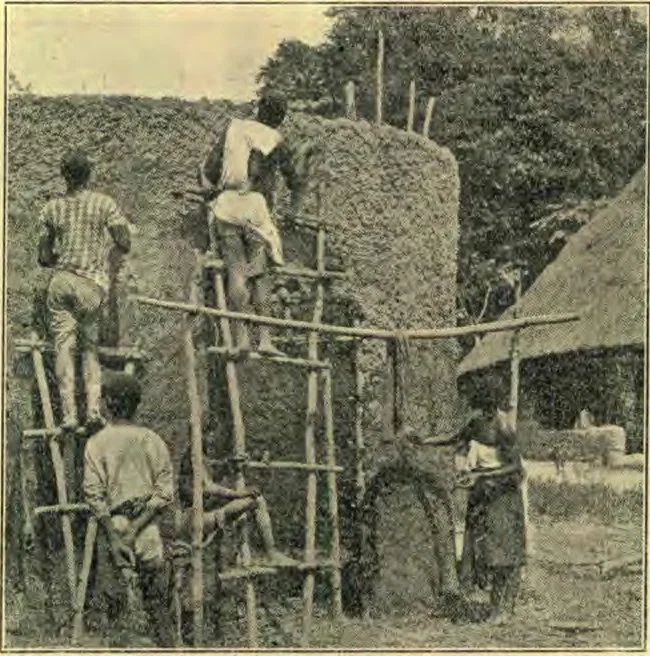
The natives have their huts on the mission farm, not far away. These are built of poles and mud, with grass roofs. Some of the natives keep these little homes very neat and orderly, while others show small interest in looking after them.
Previous to our visit, no church organization had been effected here. Both white and native members were formerly connected with the Somabula church; but at this time Pastor White organized a church of about twenty-five members.
As nearly all the native members are inexperienced in church work and methods, and young in the truth, it was deemed best to postpone the formation of a Missionary Volunteer Society until a later date; but after I explained the idea of the Bible doctrines portion of the Standard of Attainment, six white persons and forty-eight natives gave their names for membership. Brother Gibson has a large baptismal class, and is planning to use these subjects and texts in connection with other matter in preparing the candidates for intelligent church membership and consistent Christian living.
One of the native outschool teachers connected with this station, attended the Bible school at Somabula, and since his return to his school has sent for extra copies of the Bible doctrines list of subjects and references for use in his school.
There seems to be in the hearts of this people a strong desire to learn what the great God has spoken to them through his Word. May this desire possess all our hearts until we shall search the Scriptures, and learn for ourselves what the Lord has spoken to us.
Tsungwesi Mission, near Inyazura Siding
After two days’ travel by train from Glendale, we reached this, our last station, safely. When we arrived, all the white workers and natives, about one hundred, met us, and welcomed us heartily.
When I explained the organization and work of the Missionary Volunteer Society, I said that just as the nations are calling on their people to act a part in gaining victories for their side in the great war, so the Lord is now calling all his people, especially the young, to come to the front in the great conflict between the forces of good and the forces of evil. After explaining fully, and, to my mind, clearly, the whole matter, I asked all who wished to unite, and form a society to do this kind of work, to raise their hands. Not a hand went up. I then asked why they did not wish to have such a society. After some time, I found that they understood me to be after recruits for German East Africa. This called for more instructionp. 10 and explanation, which finally resulted in removing all obstacles from their minds, and they were ready to act intelligently. We formed a society of forty-five members. Brother F. B. Jewell, the mission superintendent, was chosen leader, with Isaac, one of the native teachers, assistant, and Sister Ida Bowen as secretary-treasurer. Brother E. Tarr and Sister Jewell were chosen members of the executive committee.
All the members, and thirty-four others, joined the Bible doctrines portion of the Standard of Attainment, making seventy-nine in all.
Plans were discussed, and I believe aggressive work will be done there through the members of the Missionary Volunteer Society.
My visit to these missions in Rhodesia was most pleasant and interesting. Surely the gospel is the power of God unto salvation to those who believe and obey it. In a few years’ time, heathen men and women are wonderfully changed. Instead of being idle, aimless, and hopeless, they are filled with a desire to learn and to impart to others the good news of salvation. How changed are the men and women found on our stations from what they were in their heathen condition! To God be all the glory.
The report of this trip in figures is as follows: Number of Missionary Volunteer Societies formed, 2; number of members, 100 (9 white persons and 91 natives); number taking Standard of Attainment texts, 344 (21 white persons and 323 natives).
This is only the foundation; yet we feel thankful that a beginning has been made for this work among the mission stations. Let us help them by prayers and in every other way possible. G. H. CLARK.