INEZ HOLLAND-STEVENS
ARGENTINA is a country of large families, eight or ten children being an ordinary number, and there are many families much larger. I know one Adventist mother who hovers a brood of eighteen, and two other families that have twenty-two and twenty-five children, respectively. These large families are especially common among the Italian and Russian-German settlers; but the native Argentinians are also great lovers of home and fond of children, and seem to take seriously the command to multiply and replenish the earth.
The government, moreover, smiles upon the prolificness of its people, and to show its approval has instituted a custom known as “El apadrinamiento,” which means the official act of becoming godfather to a child.
To explain further: The government, represented by any one of its higher officials, promises to become the godfather, or protector, of the seventh son in any Argentinian family. However, there must be seven sons in succession, without a death or a daughter born between.
That seventh son is, in a way, adopted by the government; that is, after finishing the public school he may choose any profession or career, and the attending expenses to the completion of the course will be met by the government.
The public ceremony is interesting, and varies somewhat according to the conditions and religion of the family in question. In the case of a wealthy or distinguished family living in the city, much is made of the event, the music being furnished by the provincial band, the governor of the province being present to act as godfather, accompanied by soldiers finely uniformed. After the christening, performed often by a priest, the officer attending presents the medal to the child, and then follow congratulations, and refreshments consisting of liquors and cakes.
The government gives two hundred pesos to the family to defray the expenses; but in wealthy families this money is, after the ceremony, distributed by the father among the poor who assemble to witness the ceremony.
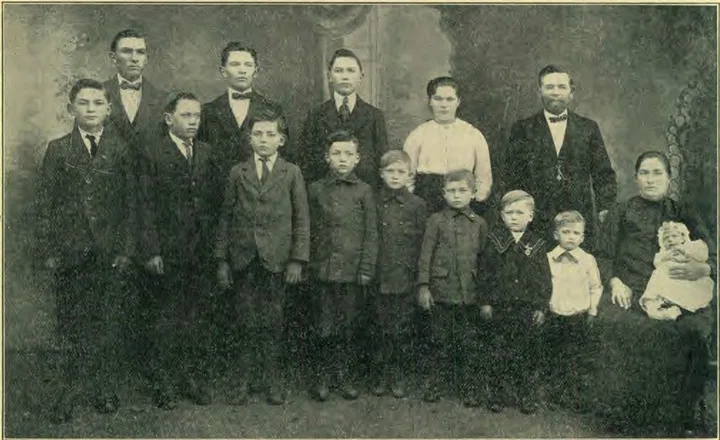
The accompanying photograph shows an Adventist family of Russian-German extraction who recently celebrated this most interesting rite with their seventh son. They live just a few miles from the school, and the three oldest sons are pupils in our school and sanitarium here.
This particular family is interesting because its father, David Riffel, with his parents, first brought the Adventist truth to Argentina. More than thirty years ago they came from Russia to Brazil, and shortly after came to Argentina, locating in Entre Rios. Cousins in North America, however, soon persuaded them through correspondence, to go north, which they did, settling in Marion, Kansas. While there they became Adventists, and their first desire was to return to Argentina to impart the good news to their former neighbors. This they did in 1890, bringing with them some other German families, among the company being Brother Oswaldo Frick, who is one of our old charter members here now. They were active missionaries, and soon had several believers ready for baptism.
Old Santiago Riffel, grandfather of the children in the picture, was always a zealous missionary, and did a great deal of good among the Germans. Just last year he was laid to rest, and we all miss him greatly. Having had no schooling himself, his great desire was to see his grandchildren get an education,p. 11 and he worked constantly to that end by his influence and means.
But to return to the photograph. As you see, these parents first had three sons and one daughter (standing in the back row with the father). Then followed nine sons, the seventh being the little lad wearing the gold medal, who now has the honor of being the adopted son of the president of Argentina.
The public ceremony in this case was simple, owing to their being Adventists and living in the country. One of our ministers, Brother Godofredo Block, was present to preach a short sermon and offer prayer. The mayor was present to represent the government, and after a few remarks he placed the medal on the child. It is of gold, bears the date and the Argentinian shield, and on it is engraved the name of the child,—Andres Hipolito Riffel, being named after the president, Hipolito Irigoyen.
After the ceremonies, there were congratulations, and a typical German “feast,” consisting of a fruit soup, roast mutton with potatoes, and a dessert of fresh fruit with kuchen.
Little Andres seemed to enjoy the dinner more than anything else; in fact, I think he only half realized what the whole affair was about. However, he is very proud of that gold medal, and stoutly declares that he is a loyal son of Argentina.