Experiences at Sea

11%

Review and Herald Publishing Assn. · Takoma Park Station, Washington, D. C. · Apr 18, 1916

FromThe Youth’s Instructor, Vol. 64, No. 16.

Read the full edition

Experiences at Sea

IN the year 1895, as I was returning to England from the General Conference, about six o’clock one morning, while most of the passengers were still in their cabins, we suddenly felt our ship shake as if it were scraping over a rough cobblestone road. We soon learned the cause. A man from the steerage had jumped overboard. The officer on the bridge saw him. He gave orders to reverse the engines, and running to the stern of the boat, he mounted another bridge and jumped in after the man. He succeeded in getting to him, and held him up until a boat was lowered. For this act of bravery the officer received a purse of sixty pounds sterling from the first-class passengers.
The ship that signaled for help
In October, 1910, I took a boat in Barcelona, Spain, for Brazil and Argentina. The second day out from Barcelona, about 1 P. M., as we were sailing down the Mediterranean, with beautiful weather and a perfectly smooth sea, suddenly we heard the cry, “Un hombre en el agua!” (A man overboard.) Women wrung their hands, some of the men wept, and there was general excitement. The ship stopped, a boat was lowered as quickly as possible, manned with eight men, who put off to look for the unfortunate man. For nearly an hour we circled around and looked, until finally the man was discovered and picked up. But the rescue was too late; he was already dead.
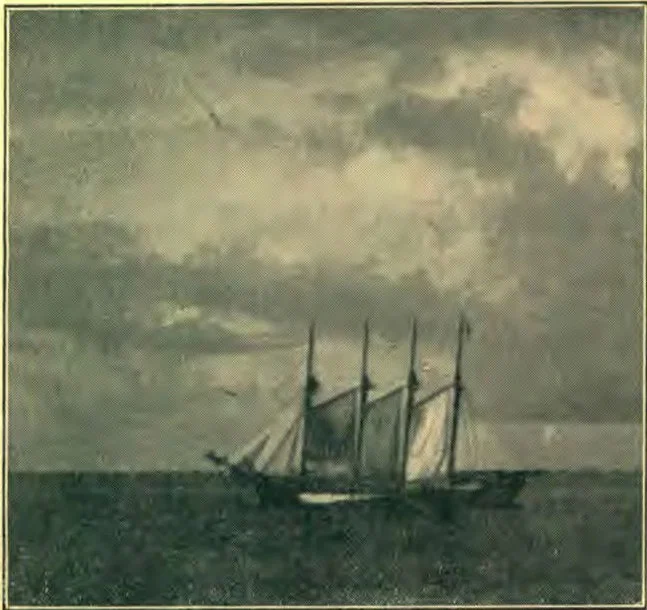
On our recent trip to South America no one jumped or fell overboard, but the fifth day out from New York, about six o’clock in the morning, when the engines stopped we knew that something out of the ordinary had happened. As we rushed up on deck to learn what it was, we saw on our port side not very far away a four-masted sailing ship lying to, and talking with our ship. When the officers of our ship first sighted her, she flashed to them a signal of distress. So our captain gave orders to slow down and see what was needed. It was soon learned that they were asking for a doctor. As soon as this word was received, our ship stopped, a boat was lowered, and our doctor was taken off to give help if he could.
When the doctor returned, he reported that the sailing vessel was already thirty-two days out from Philadelphia, bound for Rosario, Argentina. About two weeks before we sighted her, she encountered very severe gales, during which one man had a leg broken, another an arm, and a third “had his ribs stove in.” The poor men had been suffering for two weeks with no one to set their broken bones. Then, too, their boat was leaking and filling with water at the rate of six inches an hour. The doctor did what he could to relieve them, and they decided to put into Porto Rico for further repairs.
When I asked our captain if there was any written law which governs in the matter of helping ships in distress, he replied, “Only the law of sympathy and kindness in the heart.”
What a blessing that sympathy for those in distress or danger has not altogether been eradicated from the hearts of men! And how should we, who see the danger of a perishing world, be stimulated to go out of our course or relinquish our own time or cherished plans, if thereby we can help one soul in need!
N. Z. TOWN.