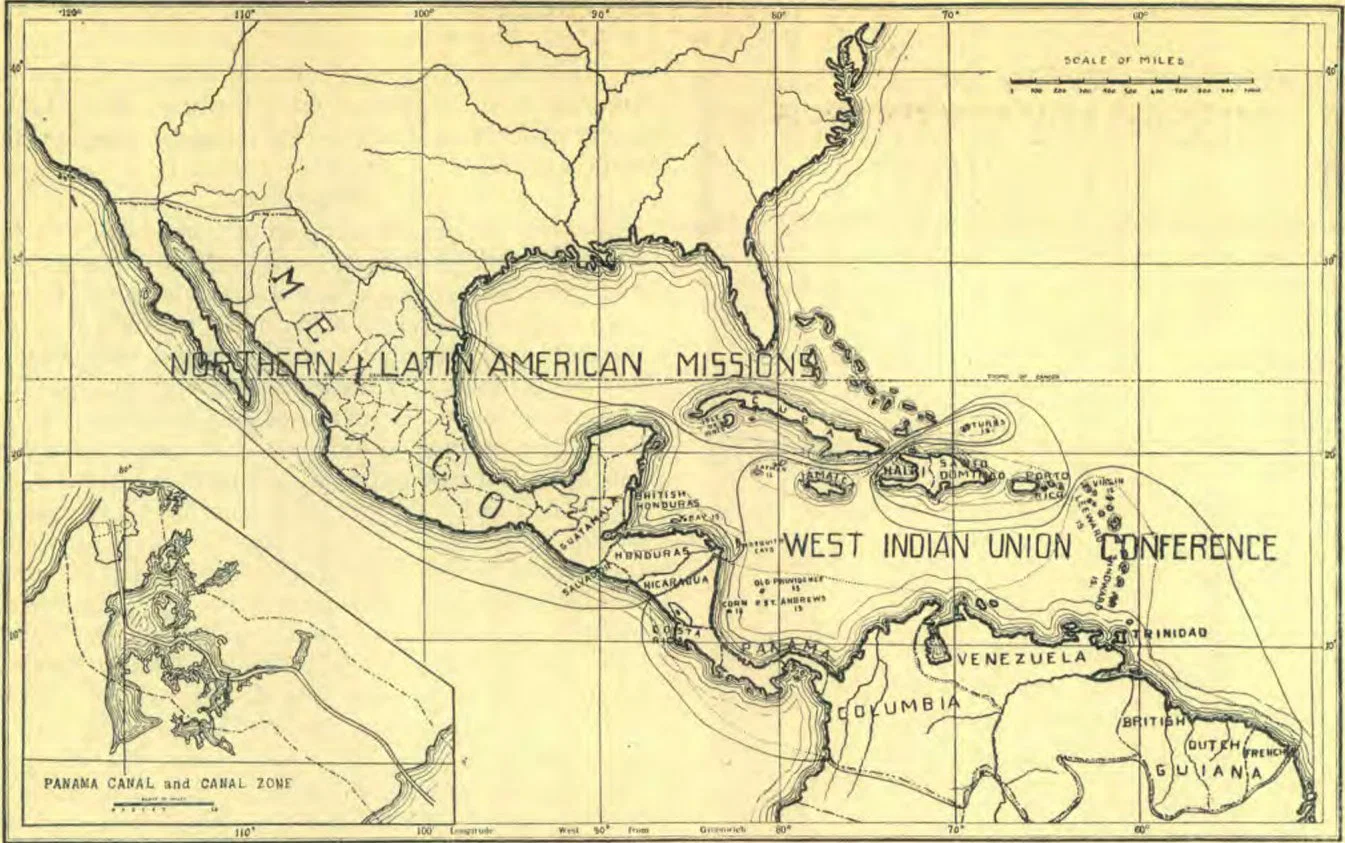
THIS Spanish mission field, lying just to the south of the United States, since the last General Conference has been organized into a separate mission group, largely because of its one common language, the Spanish. A portion of its territory was released by the West Indian Union, while Mexico, a separate mission, has been added. The field now includes Mexico, Guatemala, Honduras, Salvador, Cuba, Haiti, and Porto Rico. This field, at the request of the different missions comprising it, was placed under General Conference direction; and Elder N. Z. Town, who has spent years in South America, and is familiar with the Spanish language, was asked to take the general supervision.
The population of this group is 25,000,000. The territory lies between 30° and 13° north latitude, and between 65° and 92° west longitude, bringing the field well into the semitropical climate, the heat being governed largely by altitudes. That portion of this mission territory lying farthest south in Central America is in a general way, because of its tablelands, about as livable as the islands lying to the north.
Mexico
The republic of Mexico, lying immediately to the south of the United States, with which it has a common border of 1,500 miles, contains an area of 767,000 square miles. Its length from north to south is about 2,000 miles. The inhabitants in the last census numbered 15,000,000. Of these about twenty per cent are pure white, forty per cent mixed, and forty per cent Indian. The Catholic Church has had almost complete control for four hundred years, and such has been her course that very few of the people have any respect for the church. There is a sort of latent superstitious regard for the church buildings and the church rites, but there is really no heart religion, nor confidence one in another. It is the lack of this confidence that is at the root of all the troubles in Mexico. Among the leaders, each one desires to rule, and is afraid to trust any one else. It would seem that if Rome had desired to uplift the people, she has had a splendid opportunity; but after all this time, seventy-five or eighty per cent of the people can neither read nor write. If they could be educated and given fair and honest treatment, there is no reason why the Mexican people might not take rank with any other people of the world. But no nation that has been under Rome has ever advanced very rapidly in true civilization and culture.
As to the climate, I will let another speak:—
“We are accustomed to consider Mexico as lying entirely south of the United States, and as entirely hot and tropical; but nearly one half of the area is north of the southernmost points of the United States. Furthermore, one half of its area, even much of that extending into the tropics, is cool and temperate.
“Mexico lies at the meeting place of two zones, the temperate and the torrid; and from its geographical position, combined with its varying altitudes, possesses a greater variety of soil, surface, and vegetation than any equal extent of contiguous territory in the world. Basking in the sunshine of the tropics, her head pillowed in the lap of the North, her feet resting at the gateway of the continents, her snowy bosom rising to the clouds, she rests serene in the majesty of her might. She guards vast treasures of gold and silver, emeralds and opals adorn her brow, while the hem of her royal robe, dipped in the seas of two hemispheres, is embroidered with pearls and the riches of ocean.
“Mother of Western civilization! cradle of the American race! a thousand years have been gathered into the sheaf of time since her first cities were built. When the Norsemen coasted our northern shores, she had towns and villages, and white-walled temples and palaces. When the Pilgrims landed on Plymouth Rock, a hundred years had already passed since the soldiers of Cortés had battled with the hosts of Montezuma. In no country in the world can you pass so rapidly from zone to zone,— from the blazing shores of the heated tropics to the region of perpetual winter, from the land of the palm and vine to that of the pine and lichen,— for in twelve hours this can be accomplished, and the traveler may ascend a snow peak with the sands of the shore still upon his shoes.”
The work of the message began in Mexico about twenty-five years ago, and although it has not made8rapid advance, still there are now believers scattered from one end of the land to the other, with centers in the northern, central, and southern parts. For the last two years it has been almost impossible to travel in the country, and for that reason it has not been possible to visit the different companies. But word comes from nearly all of them that they are still faithful, and that in almost every place there are quite a number who are awaiting baptism. Even this year, in the midst of the many stupendous difficulties, the work is going forward. One brother sold over $900 (Mexican) worth of literature in the state of Yucatan during the month of January.
One of the most interesting and promising fields is in the southern part, in the state of Oaxaca. Here we have four or five companies of believers among the Zapotecan Indians. Statistics show that there are more than 500,000 of these people. They are religiously inclined and in many respects are in advance of other inhabitants of Mexico. It was from this tribe that the renowned President Juarez, who gave the country its present constitution and effected the separation of church and state, came. During the last year our only worker among these people was turned aside to the Millennial Dawn doctrine, so that at present there is no laborer for this part of the field. There is here an opening that ought to be filled. This section of the country has been in peace during all the trouble in other parts. The present year our canvassers made a short visit to this district, and labored with success.
Mexico is waiting and hoping for the cessation of the revolution, in order that the work may be carried forward. We are confident that from this land of darkness there will come many to have a part with us in the everlasting kingdom that is soon to be set up.
Guatemala
Guatemala is a republic, with an area of 48,290 square miles and a population of nearly 2,000,000. It extends from the Atlantic (or Caribbean Sea) to the Pacific, the latter having the much larger coast line. Mexico lies to the west and north, Salvador and Honduras to the east. The maximum length and breadth of the country is nearly the same, 250 miles. Its principal city is its capital, Guatemala City.
The aboriginal inhabitants were mostly agriculturists at the time of the Spanish invasion, and offered little resistance. They were put under subjection, and now their descendants outnumber those of the invaders by about twelve to one. Roman Catholicism is the prevailing religion, although Protestant missionaries are protected. Our work has gained a small foothold in the country, principally in Guatemala City.
Honduras
Honduras has been divided into a North Honduras Mission and a South Honduras Mission. What was a conference in the north (including British Honduras) was by their request turned back into a mission in 1915.
Honduras has a republican form of government, with 46,250 square miles and more than 700,000 inhabitants. Honduras, east of Guatemala, has a short line of Pacific Ocean coast, with a long one on the Caribbean Sea. It is sparsely inhabited for its size. Along its northern and eastern seacoast it is low and hot, while most of the interior is mountainous. The soil and climate on the upland plateaus favor stock raising, and the staple crops of the temperate zone are raised.
A large proportion of the native population is of mixed blood; there are also Spaniards and Indians of pure blood. The workers in Honduras are laboring to plant the seeds of Bible truth in the interior, pioneering by securing colporteurs to sow the field with gospel seed.
Salvador
This is the smallest of the Central American republics. It has an area of 7,225 square miles, with a population of more than 1,700,000. It lies directly south of the west portion of Honduras, its whole coast line of 139 miles bordering on the Pacific. It is very mountainous. Politically, as well as physically, the prevailing conditions may be described as volcanic, as the country has suffered greatly from revolutions.9Salvador is the last republic in Central America to be entered with the third angel’s message, Brother and Sister John L. Brown having but recently settled there.
Cuba
Cuba is the largest island in the West Indies. It is separated from Florida, since the railroad connection was made with Key West, by only a little more than a night’s voyage. The island, with an area of 45,000 square miles (about the same as the State of Pennsylvania), is a place truly beautiful for situation. Cuba is 730 miles long, varying in width from 20 to 100 miles. Its harbors are good, most of them being well protected by land, around its 6,500 miles of coast line.
A mountain chain extends the entire length of the island, many of its peaks reaching an altitude of 5,000 feet. The effects of the long reign of Catholicism, with Spanish rule, are still seen, the island having been started upon its independent career at the termination of the Spanish American War, in 1898. Since then, as the regulations for sanitation have been more and more put into effect, the island has, in large part, been converted into a beautiful place in which to live. Cuba boasts of 200 varieties of birds. Wild ducks, pigeons, quail, turkeys, and guinea fowl are found in abundance.
Havana, the capital, is Cuba’s principal city, being only 90 miles from Key West, and 1,240 miles from New York. The headquarters of our mission have been established at Santa Clara, which has a population of 16,000. Much literature has been sold throughout Cuba. Plans are now on foot to strengthen its evangelistic force in order to follow up interests created by this literature.
Haiti
The island of Haiti lies a little south of east of Cuba, separated from it by the Windward Passage, or channel, about sixty miles wide. The island is divided into nearly equal parts, Santo Domingo occupying the eastern half, and the republic of Haiti the western. The latter portion of the island, commonly known as Haiti, is the more densely populated. Haiti has been for several years in an almost constant upheaval politically because of revolution. The term for president is seven years, but no president for some time has lived to fill out his term of office. At present United States troops are stationed on the island to insure peace until a stable government shall be established.
Santo Domingo has a separate government, but so far has been worked largely by canvassers from Porto Rico. Haiti has several laborers, with quite a thriving mission work established.
Porto Rico
Porto Rico, an elongated square, or parallelogram, about ninety miles east of Haiti, is a thriving island under the United States flag. The island is a little less than 100 miles long east and west, and about 35 miles wide north and south. It is about equally distant, or 1,500 miles, from New York and Cadiz, Spain. It belonged to Spain prior to the Spanish American War. Porto Rico enjoys a splendid climate. The average temperature is 80° F., 95° being its extreme summer heat. Even then the nights are cool. In winter the temperature drops to 65° and 55°. This is very cold weather for Porto Ricans.
The two largest cities are San Juan (pronounced Sān Hwān’), the capital (32,000), and Ponce (28,000) with its port, which is practically a part of Ponce. Mayaguez (Mā-yā-gwās’) and Arecibo are the two next important cities. Our work began in these last-named cities when Brother B. E. Connerly, supported by the New York Conference, began colporteur work and the publication of a little Spanish paper on the island. A good strong force are now at work, with success, in different parts of the island.