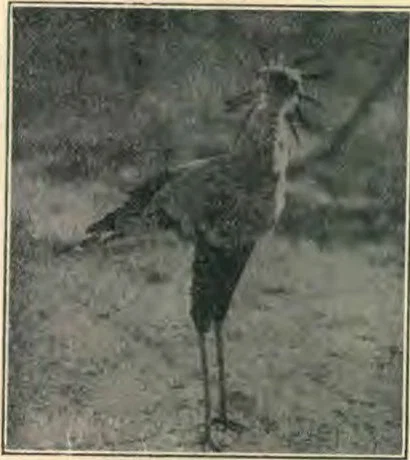
The Secretary Bird

17%

Review and Herald Publishing Assn. · Takoma Park Station, Washington, D. C. · Jan 11, 1916

FromThe Youth’s Instructor, Vol. 64, No. 2.

Read the full edition

The Secretary Bird

The very remarkable secretary bird derives its name from the curious feathery plumes which project from each side of its head, bearing a fanciful resemblance to pens carried behind the ear by human secretaries.
THE SECRETARY BIRD
THE SECRETARY BIRD
It is an inhabitant of South Africa, and is most valuable in destroying the serpent race, on the members of which it most exclusively feeds. Undaunted by the deadly teeth of the cobra, the secretary bird comes boldly to the attack, and, in spite of all the efforts of the infuriated and desperate reptile, is sure to come off victorious. Many other creatures fall victims to the ravenous appetite of the secretary bird, and in the stomach of one of these birds which was found by Levaillant, were discovered eleven rather large lizards, eleven small tortoises, a great number of insects nearly entire, and three snakes as thick as a man’s arm.
The ordinary length of the adult secretary bird is about three feet, and its color is almost wholly a slaty gray. The peculiar feathers which form the crest are black, as are the primaries and the feathers of the thigh. There is a lighter patch toward the abdomen. The tail is black, with the exception of the two central rectrices, which are gray, with a white tip and a broad black bar toward their extremities.
The nest of the secretary bird is built on the summit of a lofty tree, and contains two or three large white eggs.—Wood’s “Natural History.”