BOYS and girls, are you awake or asleep? If you are awake to life's opportunities, you are improving your time, and doing something really worth while. If you are asleep, you are wasting the days. There were two girls in a recent audience. One gave a piano recital, and the selections were beautifully rendered. The performance did her great credit. The other girl was older, and had been given musical opportunities also; but her mother remarked, “She would not practise.”
Do you practise? or are you slighting your opportunities? It may be you have no special talent for music; but talent is largely acquired. Persistence, perseverance, is talent. Without it Paderewski would not have been the world's pianist.
Perhaps you are more inclined to mechanical or agricultural pursuits than to the fine arts. That isp. 6 all right. The world would be a poor place if all were musicians, sculptors, and painters. But if you have two hands, do something worth while. You might follow with profit the example of a Massachusetts youth, James V. Spadea. He awoke from sleep at the age of twelve years, and has been wide-awake ever since. His story, as given to the American Magazine, will, I think, convince you of the truthfulness of this statement.
James wanted an education; but his parents wanted him to work in a factory. Even when James was in the eighth grade his parents told him he must leave school and become self-supporting. But James himself proved the inadvisability of this plan. He says:
“Six years ago, when in the seventh grade of grammar school, I was as mischievous a boy as one could find anywhere.
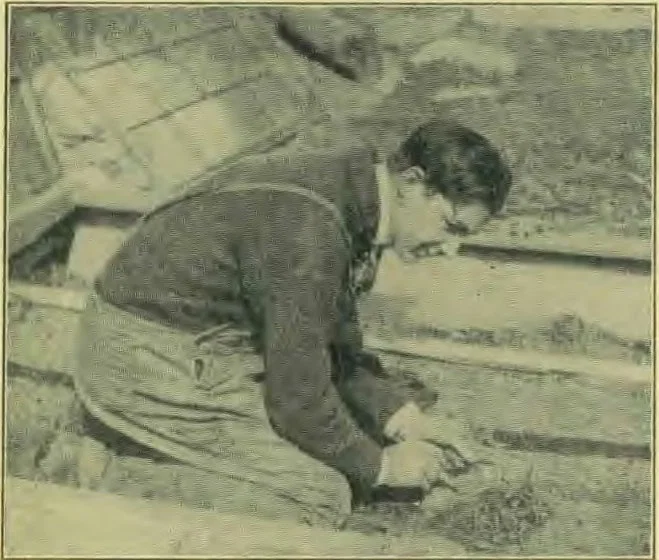
“Fortunately, that year there was a contest in our city for the best story of a pet animal. I made myself acquainted with an old dog named Jack. I wrote about this dog Jack, and received a fourth prize of fifty cents. This insignificant start from a mere contest was enough, evidently, to spur me on to greater achievements.
“In the spring of 1913 a new movement was started in our schools. Prof. Q. A. Morton, who was State leader of boys' and girls' extension work at the time, came to Brockton to interest us in the home garden club work. I was one of his first converts. Several days later our local leader distributed some cotton bolls containing seed. Prizes were offered by a public-spirited citizen for the best cotton plant received from these seeds. Receiving one of these bolls, I went home, and without stopping to eat my supper, removed the seeds from it and planted them in several boxes. These were the first seeds I ever planted in my life. Several days later I discovered two big leaves coming through the soil, which showed that my seeds were coming ‘over the top.’
“Besides these boxes of cotton, I planted a little garden twelve feet square. I was interested enough to want to try to grow all kinds of crops, although when I started I knew nothing about any of them.
“Besides the many ordinary garden seeds, I planted tea, coffee, rice, wheat, oats, barley, and the like. These experiments made me the ‘Charlie Chaplin’ member of our home club, and my ‘twelve-foot-square’ garden became to every one a sort of home-garden continuous vaudeville.
“My cotton plants so thrived that when they were shown at the boys' and girls' club fair I had the best cotton plant in the city, and won the first prize—a five-dollar bill. I exhibited the plant at our local exhibit, and won a first prize of three dollars. Making eight dollars so easily, after having before practically wasted all my time and energy, I was convinced that life is not a mere joke, but that great things can be accomplished by a mere boy; so, with this in mind, I set out to do things; and when my parents saw how enthusiastic I was over the work, they began to hope for better things for me.
“During the evenings of the following winter I was constantly reading the boys' and girls' club instructions and Government Bulletins, and other material, to get ideas and help for my garden club work.
“With the opening of the next planting season I planted one-eighth acre of potatoes and our garden at home, and was able to supply my family not only with fresh vegetables during the summer, but also with the entire winter's supply of white potatoes.
“At the fairs in the fall I captured twelve dollars in prize money.
“The next year I cultivated one and a half acres of land and took charge of nine other club boys as the local volunteer leader. Each of these boys had one-eighth acre of potatoes. This land was situated one and one-half miles from home; but in spite of this I kept three pigs out there on my garden plat. These pigs were fed twice daily and I had to walk six miles each day to take them their feed.
“I made a profit of twenty dollars on the pigs, besides receiving a fourth prize for them at the local club fair.
“One hundred forty bushels of potatoes were raised by us boys, besides large quantities of other vegetables. Many of these were sold; the surplus vegetables I soon learned to can for winter use.
“A team of our club boys carried their work through to a finish, raising an average of fifteen bushels of potatoes each. At the fairs this year I also won many dollars in prizes.
“The next year I was ready to enter high school; I was told by my parents that I could go if I pleased, but that they could not help me. I entered school with two objects in view: to earn enough money to stay in high school, and to save from my club activities as much as possible toward my college expenses for the future, for I was planning to enter the Massachusetts Agricultural College. I received constant encouragement and help in carrying out my plans from Supt. George L. Farley, who has since been promoted to State director of boys' and girls' extension work.
“That year I cultivated over an acre of land and entered one-twentieth acre in the State contest. In the summer I entered the canning contest, and received a third prize for canning two hundred sixty-nine quarts of fruits, vegetables, and soup combinations, which entitled me to a free trip to our State agricultural college. In the market-garden contest I received first prize, which entitled me to a second free trip—this one carried me to our national capital.
“At the fairs that year I won over fifty dollars in cash prizes. In the summer I assisted Miss Annie L. Burke, supervisor of Brockton, in the care of the home and school gardens. The achievements of this year absolutely proved to my people that my efforts had not been wasted and that I should carry out my plan of going to college.p. 7
“The next spring, April, 1917, I went to Washington, and arrived on the historic day that our country entered the war.
“When I returned from the joyous trip, the call for planting came, and now I was able to help my people and the community through my four years of hard work, study, and experience.
“This I did gladly by giving instructions through the local newspapers and many times by personal visits to club members.
“During this same year I also planted about one-quarter acre of land, principally to staple and garden crops. From this quarter acre I was able to supply my family with all kinds of vegetables, both winter and summer.
“Several hundred cans of perishable products were canned for home use and for the market.
“I had charge of our boys' and girls' canning kitchen, where more than five thousand quarts of surplus food products were canned. At the fairs that year, more than fifty dollars was realized in prizes. The garden that I entered in the State contest again received the first prize, which gave me, for a second year in succession, a trip to Washington.
“These achievements have led me to undertake greater things, for now I have taken over a nursery business, where I also have a hothouse and many hotbeds. I have one hired man working for me and with me all the time, and several people when extra help is needed. I own an autotruck to help me in the business, and things are running finely. In undertaking this business my aim is one thing only, and that is to earn money enough now to go through college. I am also attending the local high school, preparing for a higher institution.
“This is a brief summary of the work done by one who might have amounted to worse than nothing had he not been introduced to the boys' and girls' club work by trained co-operative leaders of the United States Department of Agriculture and the Massachusetts State College of Agriculture.
“Now, if there are others in the same predicament as I was six years ago, I want to introduce them to the boys' and girls' club work, where there is an opportunity to be of great service, and a help to one's family, school, city, and country, and to humanity.”
F. D. C.