After men learned how to read Egypt’s sealed history, there were eager students everywhere anxious to add to the world’s knowledge of the past through archeological service. So it came about that not only Egypt but Asia became a rendezvous for explorers, linguists, and archeologists.
Archeological Conditions Differ in Egypt and Assyria
The country about the Euphrates and Tigris Rivers being the birthplace of civilization, naturally was the first Asiatic field to receive the attention of these students; and it proved a rich field, yielding no less interesting returns than had Egypt. The two countries, however, presented entirely different problems to the archeologist. Because of the fact that Egypt is dry, rain rarely falling, and that frost is uncommon; and because stone was the chief building material in that country, ancient structures, covered with historical data, have been well preserved. The Egyptians buried their dead often in the dry, sandy region, so the tablets and other inscribed articles buried with the dead have remained in good condition to tell their story to eager listeners thousands of years farther down the stream of time. The history of Egypt is therefore read from the dusty beds of the dead as well as from her imperishable monuments.
The Spade as Teacher — No. 4
The Archeologist in Babylonia and Assyria
In Babylon and Assyria the climate was not so auspicious, and brick, which is less enduring, instead of stone, formed the chief building material. The upper part of the buildings would decay and bury the lower portions, so Babylonian ruins are all underground. Just the way these ancient cities, palaces, and temples were buried is graphically described by Dr. George Barton in his work, “Archeology and the Bible.” He says:
“Babylonian cities were usually built on terraces of brick. The walls of the cities and their buildings were constructed of the same material. Refuse from the houses in these towns was always thrown out into the streets, so that, as the centuries passed, the streets were gradually elevated. The walls of the brick houses gradually became unstable in the lapse of time, and as the houses were repaired they were brought up to the level of the street. Consequently, even in peaceful times the mounds on which the cities were built gradually grew higher. Most of these cities were at various times destroyed in warfare. Sometimes all the houses would be partially demolished and the site would be for a time practically uninhabited. When at length the place was repeopled, the top of the mound would be smoothed off and taken as the base of a new city. In this way through the many centuries of Babylonian history the sites of her cities have become great mounds. When these cities finally fell into ruin, the clay of the upper part of the walls disintegrated in the weather and formed a coating of earth over the whole.”
Explorers wishing to discover the history of Babylonia and Assyria have therefore literally had to get down and dig for it, and their remarkable success in reading the buried history has been possible because of the fact that Babylonian and Assyrian records were made upon soft clay tablets which when baked were very enduring. The thousands of these that the archeologist has found is but another evidence that human nature is much the same whatever the age or nationality . Man likes to be remembered, so the kings of all ancient nations made voluminous records of their deeds of war and peace. These, though unread and perhaps unseen for millenniums, now fill our museums and are cherished as the world’s most reliable histories.
French First in Assyria as in Egypt
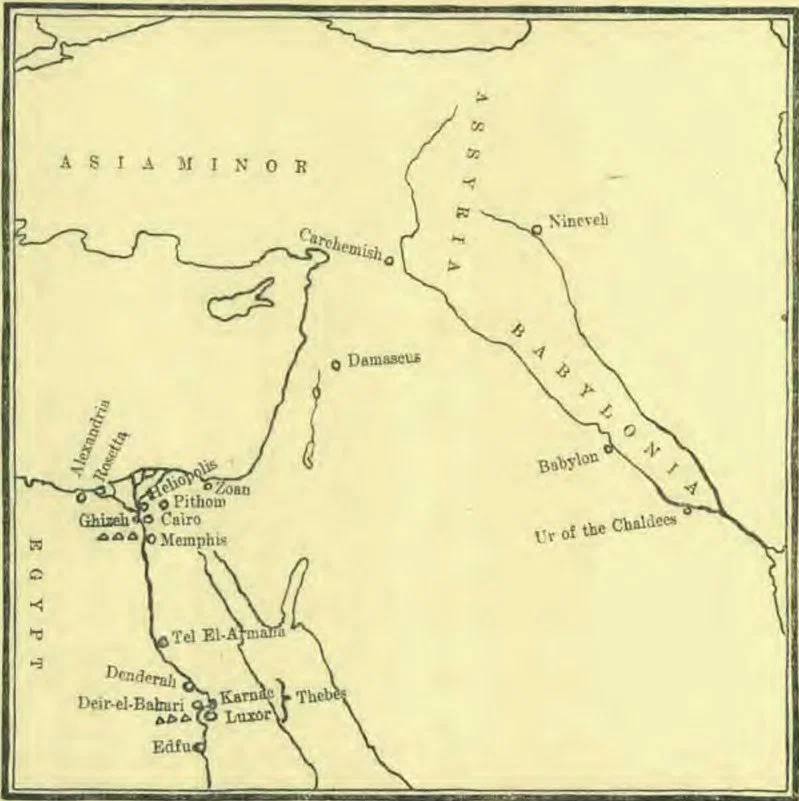
In the archeological work in Asia as well as in Egypt, the French were among the first to make notable discoveries. In 1842 Paul Emil Botta was sent by the French government to Mosul on the Upper Tigris, opposite the site of the ancient city of Nineveh. After months of hard work with small returns, he changed his place of excavation and was rewarded with a wonderful find in his new field.
Sargon’s Royal Palace
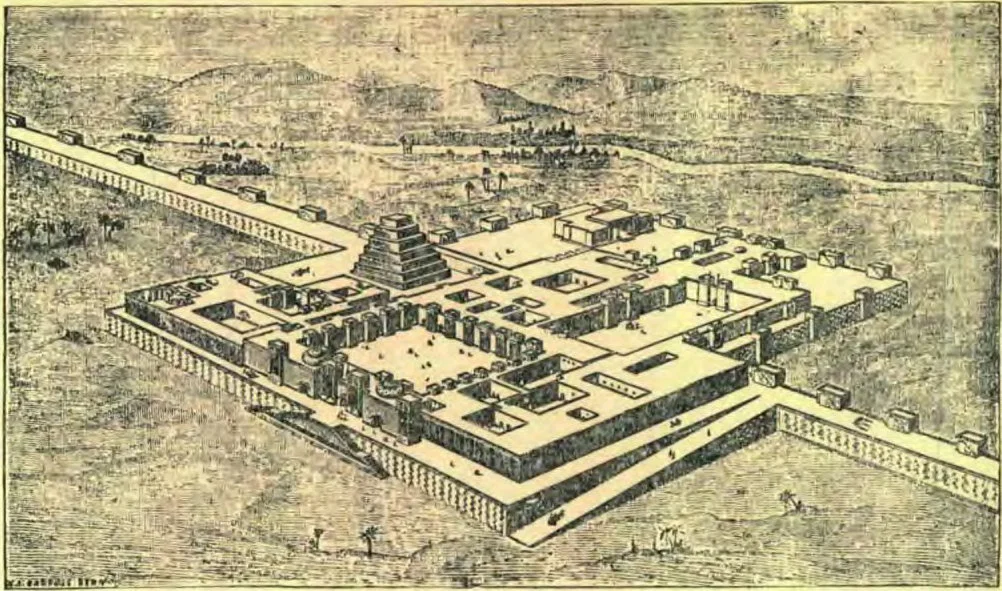
Having sunk a shaft into a mound at Khorsabad, which had stood undisturbed for two thousand years or more, he struck the walls of a large room. Ten9years of digging uncovered one of the world’s largest and most magnificent royal palaces, that of Sargon, king of Assyria. Under the corners of the palace and under the city gates of Sargonsburg were found many cylinders of clay, each with writing upon it. The palace itself contained many inscribed bas-reliefs of alabaster. All these held secrets that the world wanted, but could not interpret. Even the excavators at the time of their find could not ascertain what it was they had unearthed.
Sargon’s palace covered more than twenty-five acres, and its walls were wainscoted with sculptured alabaster slabs. According to Mr. Price:
THE PALACE OF SARGON II AT KHORSABAD RESTORED
“There were figures of battles, sieges, triumphal processions, hunting scenes, and like events, all in relief. Across the face of many of these were lines of characters similar to those found on the bits of burnt brick and alabaster found scattered on the plain. Aroused to the highest pitch of excitement and joy, Botta passed from the first room into others of similar dimensions and ornamentation and figures. He pushed on and on, until he discovered acres of such chambers, with scores of remarkable figures and colossi. When he once stopped to think of the antiquity of his finds, he was astonished. He faced a new race. A new-old civilization gazed upon him from every slab of alabaster, and from every giant colossus. In fact, he seemed to be walking in a dreamland, inhabited by gods, fairies, and colossi, by demons, dragons, and crooked things.
“What can all this mean? Who built this structure? In what century did he live? To what nation did he belong? Are these walls telling me their tales of joy and woe? Is this beautiful cuneiformed character a language? I know not. I can read their glory and their victories in their figures, but their story, their age, their blood, is to me a mystery. Their remains mark the fall of a glorious and a brilliant past, but of a part known not to a living man.”
Assurnatsupal’s Palace
A young English scholar, A. H. Layard, was inspired by Mr. Botta’s successes to undertake similar work. He also was rewarded by the discovery of a most beautiful palace, that of Assurnatsupal, who reigned from 884-860 B. C., being contemporary with Omri, king of Israel. The rooms of his palace were also wainscoted with alabaster slabs seven feet high. Marvelous figures were on each separate slab, or extended over several slabs. Across the middle of these were lines of wedge-shaped characters. Out of this palace the excavator took more than one hundred colossi and alabaster slabs, many of which are now in the British Museum.
Sennacherib’s Palace
Mr. Layard was fortunate enough to find three or four more interesting palaces, one of which belonged to Sennacherib, son of Sargon, king of Assyria. It was Sennacherib who attacked Israel in Hezekiah’s day, but whose army of 185,000 men was blotted out in one night by the breath of the Lord. This palace, covering about eight acres, or four ordinary city blocks, contained seventy rooms. Here also was followed the usual custom of covering the walls with sculptured pictures of events at home and abroad.
Sennacherib’s own record of the building of the palace, as well as of the improvements he made in Nineveh and the adjoining country, were later found.
His egotism is well illustrated in this record, which says:
“Of all the kings of former days, my fathers who went before me, who reigned before me over Assyria; and governed the city of Bel; and every year without fail augmented its interior rooms, and treasured up in them all their revenues which they received from four countries; not one among them all, though the central palace was too small to be their royal residence, had the knowledge nor the wish to improve it. As to caring for the health of the city, by bringing streams of water into it, and the finding of new springs, none turned his thought to it, nor brought his heart to it.
“Then I, Sennacherib, king of Assyria, by command of the gods, resolved in my mind to complete this work, and I brought my heart to it. Men of Chaldea, Aram, Manna, Kue, and Cilicia, who had not bowed down to my yoke, I brought away as captives, and I compelled them to make bricks. In baskets made of reeds which I had cut in the land of Chaldea, I made the foreign workmen bring their appointed tale of bricks, in order to complete this work.
“The former palace of 360 measures long, adjoining the gardens of the Great Tower: 80 measures wide, adjoining the watch tower of the house of worship: and 95 measures wide, . . . which the kings, my fathers who went before me, had built for their royal residence, but had not beautified its front,—the river Tibilti [‘the Stream of Fertility,’ a poetical name of the Tigris] had ruined the brick work of it, when it ravaged the quays of the central city. The trees of its gardens had been burnt for firewood years ago.10
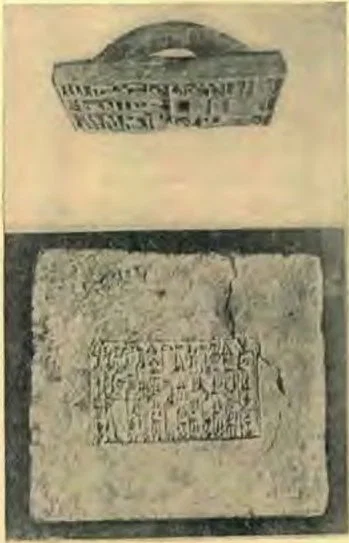
A brick made during the reign of Sargon I (2800 B. C.); also stamp used in making impressions on bricks.
For a long time this river had undermined the front of the palace. In the high water of its floods it had made great rents in its foundations, and had washed away the timin. [The timin was a small, inscribed clay cylinder, that was placed in the first corner-stones of buildings: sometimes at all four corners. “It was regarded with peculiar reverence.”]
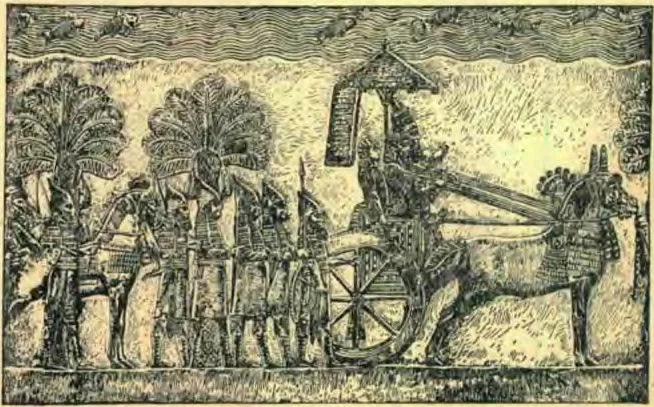
SENNACHERIB AT THE HEAD OF HIS ARMY
“That small palace I pulled down, the whole of it. I made a new channel for the river Tibilti, I regulated its water, I restrained its flow. Within its old limits I walled up its stream. The low platform I raised higher, and paved it firmly with stones of great size, covered with bitumen, for a space of 354 measures in length, and 279 in breadth. That space I elevated above the waters, and restored it to be again dry ground: 1,700 measures long; 162 measures wide on the upper side toward the north; 217 measures wide in the center; 386 measures wide on the lower side toward the south, fronting the River Tigris; I completed the mound, and I measured the measures. “On a high festival, in a great affluence of people, I replaced the timin. With a layer of large stones I inclosed its place, and I made its deposit sure. The written records of my name, 160 fathoms of bas-reliefs, I sculptured in the palace; but the lower part of the wall, next to the ground, I left to be filled up in future times. Afterward I resolved to have more tablets carved. I sculptured 20 fathoms of them in addition to the former ones, so that I formed 180 fathoms of them altogether. The inclosure itself I increased beyond what it was in former days; above the measure of the former palace I enlarged it, and I liberally augmented its dwellings, and its fine buildings.
“In the midst I placed my royal residence, the palace of Zakdi-mu-isha [‘Has not an equal’]. Around it I planted the finest of trees, equal to those of the land of Khamana [Amanus], which all the knowing prefer to those of the land of Chaldea. By my care I caused the uprising of springs in more than forty places in the plain: I divided them into irrigating canals for the people of Nineveh, and gave them to be their own property. To obtain water to turn the flour mills, I brought it in pipes from Kishri to Nineveh, and I skilfully constructed water wheels. I brought down the perennial waters of the river Kutzuru, from the distance of half a kasbu [three and a half miles], into those reservoirs, and I covered them all. Of Nineveh, my royal city, I greatly enlarged the dwellings. Its streets, I renovated the old ones, and I widened those which were too narrow. I made them as splendid as the sun.”
“Just a century,” says Dr. Edgar J. Banks, after Sennacherib beautified the city, the Medes and Babylonians destroyed it, and gradually the words of Zephaniah 2:13, 14, were fulfilled.
Nineveh’s Library Found
In 1872 another excavator uncovered in one of the mounds of Nineveh a great palace with its library of 30,000 tablets or cylinders, all in good condition. These belonged to the collection of Assurbanipal (Asur-bā’ni-pal, 668-626 B. C.), said to be the last great king of Assyria. He lived at the time of Manasseh and Josiah. He is supposed to have been the great and noble Asnapper spoken of in Ezra 4:10.
Key Found to Assyrian and Babylonian Writing
So the valuable and interesting work of exploration and excavation continued, until large volumes are required to tell the story of the great past as revealed by the spade. But it was almost a vexation to discover palaces, slabs, and cylinders written all over if the writing could not be read. Fortunately the hope of finding such a key kept these men enthusiastically digging, for the key was being earnestly searched for while Mr. Botta and Mr. Layard were carrying forward their work of unearthing treasures. As perseverance must bring results, success crowned this earnest effort, and the two excavators were enabled to ascertain the result of their years of toil without any great delay. Dr. Price tells the story of the marvelous unlocking of these cuneiform secrets of the Babylonian and Assyrian language, which was found to be “a half sister to the Hebrew, as the Italian is to the Spanish.” He says:
Behistun Group Proves to Be the Key
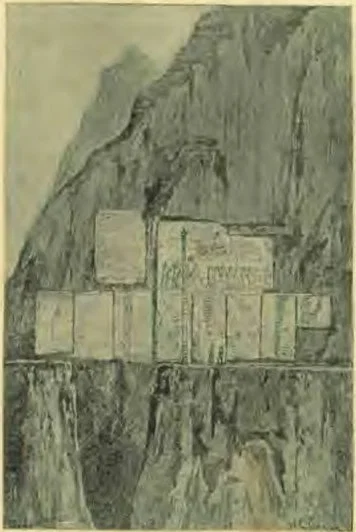
“Oriental scholars in Germany, France, Scandinavia, and other countries had set their wits to solve the wedge language of old Persia. By shrewd guessing only did they arrive at a few results of value. No very substantial progress was made, however, until a young Englishman, an officer in the Persian army, Henry C. Rawlinson, made a discovery in 1835 in the Zagros Mountains. Here he found a limestone mountain rising out of the plain to a height of 1,700 feet. One side of this mass was almost perpendicular in form. About 350 feet above the base on this perpendicular side, Rawlinson could see a large space which had been carefully hewn off and polished. Upon this prepared surface he could also descry a large bas-relief representing a king, before whom stood a long line of captives bound neck to neck with a rope. Adjacent to this group were several columns of cuneiform inscriptions. Rawlinson thought that in ancient times there might have been a scaffolding of some kind, so that the passer-by might reach and read the inscriptions; but at this time they were too high and too inaccessible. Rawlinson’s perseverance over slippery and dangerous places finally brought him to the narrow ledge at the foot of the inscriptions. This ledge, about fourteen inches wide, had been made when the large surface had been hewn and smoothed off, and the artistic work done. Rawlinson resolved at once to copy these wonderful columns of inscriptions. The narrowness of the ledge, and the disappearance of a part of it by the ravages of time, and the fearful chasm below him of 350 feet, put him in peril. Some of the inscriptions he could copy from the ledge, for others he climbed a ladder, the foot of which was held on the fourteen-inch ledge by an attendant. But even this perilous task could not be carried out above a space from which the ledge had been worn away. Various schemes were devised and native help employed to accomplish his purpose. For a time he was suspended in a swing in front of the columns of writing. Suffice it to say that only after most painstaking effort and dangerous risks, at intervals during four years, was Rawlinson able to complete the copying of these columns of wedge writing.
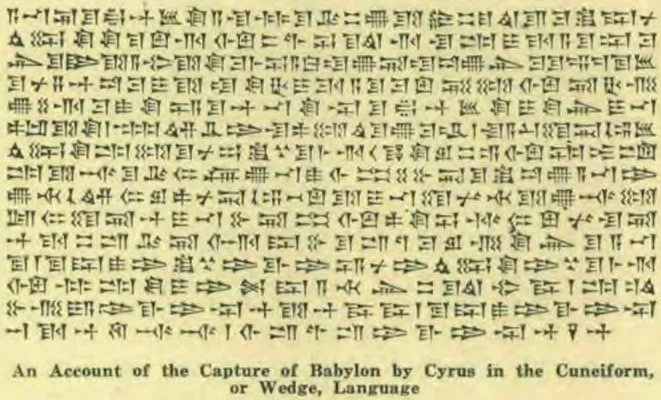
An Account of the Capture of Babylon by Cyrus in the Cuneiform, or Wedge, Language
“As soon as he discovered the probable value of the inscriptions, and that he had not one language but three in his possession, he set about industriously studying the Sanskrit, Zend, and Phelevi languages, that thereby he might be the better equipped for his task of translating. Some smaller Persian inscriptions found at Persepolis and other points were also used to advantage. Being familiar with modern Persian, he was also in a peculiar sense ready for his work. As other scholars who had at various times tackled old Persian inscriptions, Rawlinson selected as a basis for investigation the names Darius, Xerxes, and Hystaspes. These same names occurred on a number of inscriptions, and by ingenious guesses he discovered some of the letters of which the names were constituted.
Then by testing the values of these letters in other words the meanings of which were known to him as a modern Persian scholar, Rawlinson succeeded finally in translating the five columns of old Persian cuneiform writing—nearly four hundred lines. Ten years after his discovery at Behistun, he sent his translation to Europe. In 1847, the text, translation, and a commentary appeared in the Journal of the Royal Asiatic Society.
“Rawlinson tells us that these inscriptions were cut here by order of Darius I, king of Persia, about 515 B. C. They relate how, while Darius was still occupied in the reformation of the national faith, an insurrection broke out in Susiana; that the rebel ringleader was seized without the employment of any11military force; that there was also a revolt in Babylon of such a determined character that Darius was obliged to lead his own troops to put it down. Other valuable historical information is also contained in this old document. “On the supposition that the other two inscriptions told the same story, scholars began to attempt to read them. Very soon the second tongue, the Median, or Susian, yielded its secrets. Then the third series of columns, the Babylonian, was forced to give up its hidden treasures. This Behistun group was found to sustain the same relation to the cuneiform languages of Babylonia that the Rosetta stone sustained to the tongues of ancient Egypt. It was the key to its ancient life, people, and government.”
The Behistun rock, discovered in the Zagros Mountains in 1835, by H. C. Rawlinson.