The Crow

6%

Review and Herald Publishing Company · Battle Creek, Mich. · April 10, 1902

FromThe Youth’s Instructor, Vol. L, No. 15

Read the full edition

The Crow

THE Crow is a bird that every one knows by sight, I think, though few seem to know him for what he is. He has some bad traits,—there seems to be little question of that,—but, then, he has some excellent qualities as well.
Men employed by the government have made an exhaustive study of the Crow’s life and habits. They tell us that he does pull up some corn. They also tell us that he devours thousands and even millions of grubs, insects, mice, and other small creatures, which, if they were allowed to live, would do far more damage to the crops than the little that the Crows do.
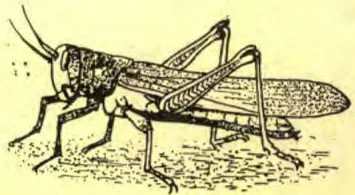
Dr. Merriam, after examining the stomachs of nine hundred crows, says that the amount of good done by these birds in destroying grasshoppers, cutworms, May-beetles, and other injurious insects, is greater than the loss occasioned by the destruction of the corn. But it is not difficult to prevent the crows from eating the corn after it is planted. If the corn be first soaked in water overnight, then placed in a vessel containing enough soft tar to coat each kernel, and afterward rolled in plaster of Paris or wood ashes, so that it may be more easily handled, Crows will touch neither the kernel nor the young sprout. A good authority says that tarred corn scattered on the borders of the field is a sure protection against crows. A few quarts used this way will protect a field of eight to ten acres. It will cost but little to try the experiment.
Olive Thorne
Miller relates an incident which shows that farmers sometimes make a serious mistake in being too hard on the Crows. One year the farmers out West were startled to see so many Crows around their fields. They could not remember seeing so many there before. Thinking that the Crows had come to eat the corn, they began to kill off all the birds they could. After they had been killing the Crows for some time, they discovered that they had other visitors. A new grub, which they had never seen before, was eating their young corn. There were literally millions of these grubs; and when they had eaten all the corn, they began to eat the grass.
But still the farmers kept killing off the Crows, never noticing that the birds were eating the grubs. They did not seem to realize that if they would leave the Crows alone, they would soon finish the grubs. And this went on for several years, until somebody had eyes sufficiently sharp to see that the Crows were after the grubs. He at once told the farmers, and then they were sorry enough that they had been killing the Crows.
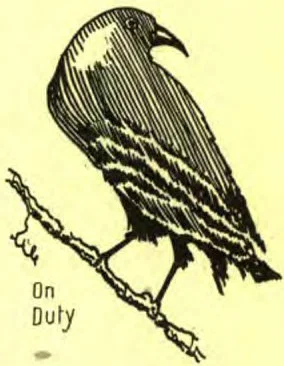
On Duty
On Duty
Suddenly it was discovered that the Crows were the farmers’ best friends, and they began to coax them back. They even had Crows caught and brought to their fields. As soon as the Crows were given a chance, they made short work of the little corn-eating grubs. The farmers in that section of the country learned a lesson that they will not soon forget.
Crows mate in March, and early in April they build their nests. The nest is large and bulky, made mostly of sticks, and lined with strips of grape-vine bark, grasses, moss, etc. In the winter, Crows travel in flocks, and roost in large colonies. They select a certain place, and here thousands of them—sometimes as many as three hundred thousand—retire for the night. It is interesting to know how they do this. They come to the roosting-place in small flocks from all the surrounding country. One might think they would act on the principle so common among the boastedly intelligent and unselfish human race, “First come, first served,” and that the first one to get to the spot would choose his place to sleep, and let the last one take what he could find.
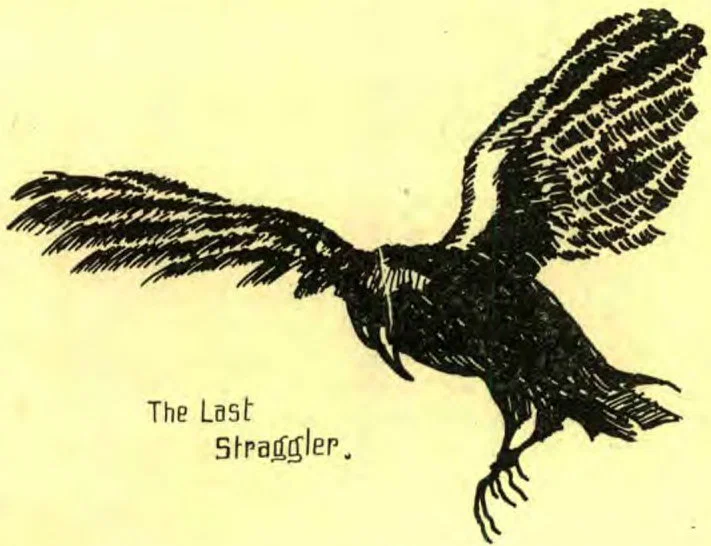
The Last Straggler.
The Last Straggler.
But not so! Each flock, as it comes, alights in some place near the roost. Here all patiently wait until the last straggler has arrived. Then at a given signal, they rise on wing together, circle around for a while, and finally settle down for the night. They often use the same roosting-place year after year.
Crows are very intelligent. It is affirmed by some that they talk to one another, and there is no question that they have an elaborate system of signals. It has been stated on good authority that each flock has a watcher, or sentinel, who gives the order to fly, and warns the troop at every approach of danger. If a man appears a long distance away, the birds act very much afraid, and fly off, only to settle down in another part of the field, until the sentinel gives the signal to move on again.
The tricks and pranks related of tame Crows are many and amusing. A writer in a late number of Success tells of a tame Crow that mimicked the hens. He would scratch about and find a worm, then he would call the hens by imitating the call of the rooster. The hens would come flying across the yard, only to see the Crow gobble up the food. This Crow imitated the notes of the chickadee, and even learned to say, “Hello.” When the woman of the house hung out clothes, she carried the clothes-pins in a bright tin pail. The Crow would watch for an opportunity when she was not looking, hurry over to the pail, snatch a pin, and run off to hide it in the grass.
This story reminds us of another Crow we have read about. He liked to get out in the yard when the washed clothes hung on the line. He would walk along on the clothes-line, and pull out each one of the pins, letting the wet garments fall down in the dirt. He carried the pins, one by one, to the roof of the house, and laid them safely away. Of course he was always well scolded for his mischief. At this, he would fly up to the roof, pick up every pin, and throw it to the ground, as much as to say, “Well, if you are going to make so much fuss about it, just take your old pins.”
L. A. REED.