Frost Potencies
Have you ever thought of the power required to condense vapor and crystallize it into snow? We are told that to make snow enough for a snowball such as a boy throws, calls for as much energy as would be required to lift a ton one hundred feet. The great electric-power stations of the city have not capacity enough to produce the snow-power represented by a single drift along the highway. The snow also has power in another way. A single flake would melt on a babe’s hand, but too many flakes drove Napoleon from Russia, proving more powerful than the strongest armies. In its cumulative capacity snow locks the trade of a continent; roads are blocked and trains stalled as by a mighty hand. “Who can stand before His cold?” The power behind all these frost agencies is the power with which we have to deal. What a note of warning to those who oppose God! for nothing can withstand him. But what a message of cheer to those who trust in God’s power! for it never faileth.
Art in Snow
In forming snowflakes this power works skillfully and beautifully. What designs are exhibited in the little six-pointed crystals! What a marvelous geometry the student finds in flakes! When all the different figures have been drawn and counted, they number over one thousand shapes. And then, to think that every one of them that has ever fallen to earth is thus carefully and individually designed! Not content with this, the Creator’s skill is extended to his arrangement of the snow, as seen in the fantastic decorations of trees, grasses, houses, mountains, and meadows. Everywhere the touch of the artist is seen: Law and order are stamped on every snow-crystal, as upon all God’s works,—salt, quartz, and all else, up to man. What a blessed revelation of our Maker! What a bulwark to faith to feel that all things are under his forming hand! Winds, nor clouds, nor storms, can thwart his power and plan in our lives. This stimulates hope and faith in God.
The Silent Flakes
How silently the snow falls! In utmost quietude God makes his snow-treasures. While the earth slumbers, often while we slumber, the air is alive with feathery flakes descending. We do not hear them, unless perchance a gust of wind furiously blows them against the pane. But we awake, and with the morn look to see in frosty skill a kind of icy spray fantastically, as if by an enchanter’s hand, scattered over the glass. But it is no enchanter’s work; it is God’s wondrous art. We arise from our couches, pass to the window, and through a little open place in the glass, or through one made by our thawing breath, we look out of doors, and see with surprised eyes the great white veil which God has quietly and quickly and beautifully woven, let down from heaven, thread by thread, to cover nature’s face. It has snowed! O, the wonderful, the mysterious snow!
Crystallizing Righteousness
God’s skill is not exhausted in occasional snowstorms. His art does not all go to flakes. He who works so marvelously in the frost is able and desires to work even more wonderfully in human hearts, crystallizing righteous characters, working in us to will and to do his good pleasure, carrying forward through us his redemptive designs. If any man lack wisdom how to live, let him ask of God, who makes the snow, who is the source of skill, “who giveth to all men liberally, and upbraideth not; and it shall be given him.”
Nature’s Overcoat
A cold, snowless winter is the severest for plant- and tree-life. Snow is nature’s protector. “He giveth snow like wool.” This beautiful blanket covers all the flowers in their quiet winter sleep so that they will not catch cold. The wool-like snow is their winter overcoat. The snow is likewise a blessing to man. It increases our supply of moisture, fills the springs, swells the streams, helps forward the great lumber industries and the movements of machinery. Snowstorms make brisk work in chopping, logging, and sawing. Besides, what a number of odd jobs are given to men with but scanty employment at this season of the year! Think of the thousands of people called out by snowstorms to shovel walks, to clear car-tracks, to haul off the snow from busy thoroughfares in cities and towns! All this puts thousands of dollars into circulation, wonderfully helping those who otherwise would see little mercy in the cold snow.
Innumerable Mercies
Who can count the number of flakes that fall in a snow-storm? And who can count all God’s mercies to us? We may be able to tell the number of our disappointments and sorrows, for we are prone to dwell upon them and recount them. But who is so skilled in enumeration that he can count all God’s benefits? They are numberless as snowflakes.
A cheerful Christian entered a counting-room, and said to a friend who was brooding over his “hard times,” “What! wrapped in gloom again?”
“Yes,” replied the melancholy merchant. “Why not, when there is nothing but gloom in the outlook?”
“But,” replied the caller, “I can see rifts in the clouds which oppress you, and you would see them, too, were it not for your habit of looking only on the dark side of things. He who would see light must open his eyes. Suppose now, instead of dwelling on your present and prospective troubles, you spend the next half-hour in counting your mercies, past and present, and in searching for facts on which to build hope for brighter days to come. Good morning!” With these words the cheerful brother left, leaving a ray of light behind him.
“He bade me count my mercies,” thought the sad-hearted man. And he began to do so, casting swift glances over all the good things in his possession, over all God’s leadings in his past life; over the grounds on which faith and hope might safely build for the future,—until his heart leaped, his counting-room grew bright as with the presence of angels, his business prospects seemed no longer shrouded in utter blackness, and he began to sing a song of praise.
The Gospel like Snow
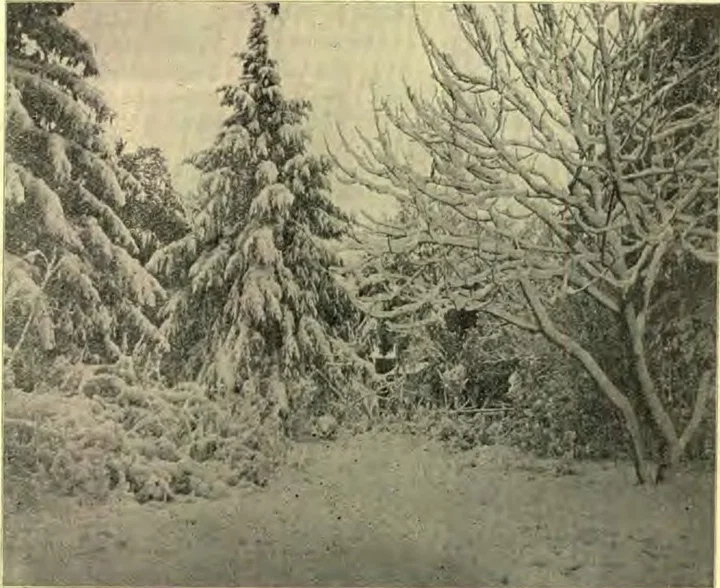
The prophet Isaiah saw this symbol in the snow: “As the rain cometh down, and the snow from heaven, and returneth not thither, but watereth the earth, and maketh it bring forth and bud, that it may give seed to the sower and bread to the eater: so shall my word be that goeth forth out of my mouth; it shall not return unto me void, but it shall accomplish that which I please, and it shall prosper in the thing whereto I sent it. For [as a result of receiving and obeying God’s merciful word] ye shall go out with joy, and be led forth with peace: the mountains and the hills shall break forth before you into singing, and all the trees of the field shall clap their hands.” How like these benefits in the vegetable world are the benefits of God’s gospel! What rejoicing God’s love begets in all who receive him! How impartial is God’s love, coming with mercy and forgiveness to all men alike, pardoning every penitent.
Nature’s Great Wash
How the snow cleanses the air! A snowy day is its wash-day. The wonderful rarity of the atmosphere after a snowfall is inexpressibly delightful. How we rejoice to inhale it! and howp. 36 it invigorates us. However, the snow suggests something even more to be prized. Here again we are led up to God, who dwells, eternal and immutable, in spotless purity. “Holy, holy, holy,” is his name, nature, and habitation. And yet he is the blessed One forever, and desires to impart his holiness and blessedness to us. God will do more than mercifully cover our sins. He longs to make our hearts white like snow.
The White Life
A writer tells of going down with a party into a coal-mine. On the side of the gangway grew a plant which was perfectly white. The visitors were astonished that there, where the coal-dust was continually flying, this little plant should be so clean. A miner who was with them took a handful of black dust, and threw it on the plant, but not a particle adhered. There was a wonderful enamel on the plant, to which no finest speck could cling. Living there amid clouds of dust, nothing stained its snowy whiteness. Is not this a picture of what our lives should be? Unholy influences breathe incessantly upon us, but it is our mission to be pure amid it all, “unspotted from the world.” If God can make a little plant so wondrously that no dust can stain its whiteness, surely he can by his grace so transform our hearts and lives that sin shall not rule over us.
The Cross of Snow
The snow-line on the sides of lofty mountains is suggestive. Above certain altitudes there is perpetual snow, hence perpetual purity of air because of oft-recurring snow-falls. So, too, there are high spiritual places, lofty altitudes of spirit, near to the heart of God, where it is always pure, rendered so by constant communings with the sinless One.
You have seen the picture of a peak in the Rockies, a lofty mountain cut by two ravines in such a way as to form a perfect cross. In those ravines the snow never melts; and in summer, when the snow disappears from the rest of the mountain, far up on its side is displayed this cross of snow. When a traveler comes in sight of that divine symbol for the first time, a feeling of awe takes possession of him, and the head is bowed in respectful veneration. The snow-cross suggests the way by which moral purity is produced. It takes us back to Calvary’s cross, on which the Son of man was lifted up, and we recall the triumphant language of his atoning work: “And I, if I be lifted up, . . . will draw all men unto me.” Many a sinful soul, from that cross and that Saviour, has found the power to transform his character, helping him to live the white life. Let us come to Christ with utter consecration. Let us take from him holy inspiration. And let us become in character and conduct pure, “even as he is pure.”—L. H. Dorchester, in Young People’s Weekly.