English, or House, Sparrow
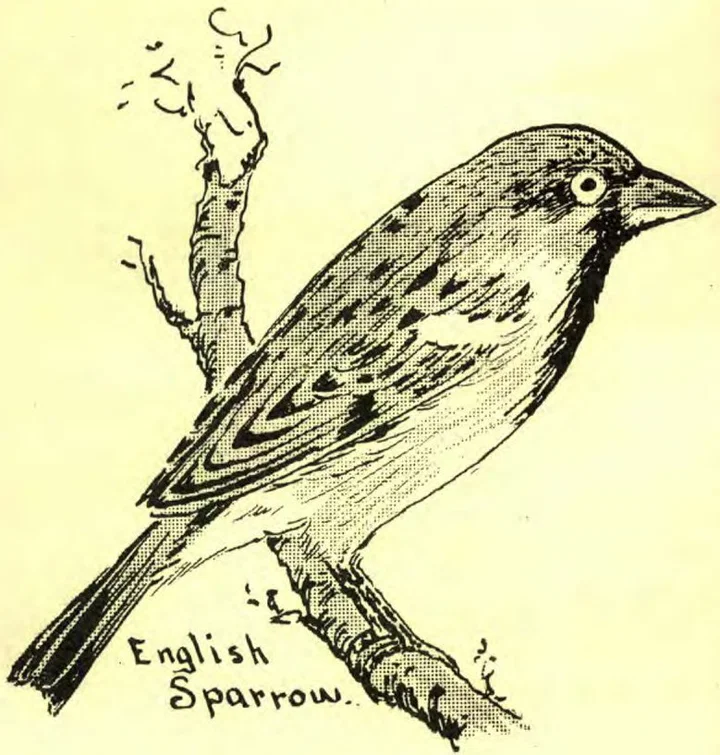
If you do not already know the English Sparrow, these cold months are an opportune time to make his acquaintance, provided you think it worth while. Although this bird is fast becoming a veritable nuisance, it has its good characteristics; and I have learned many lessons from, and seen many things of interest in, the lives of these busy little creatures.
It seems that the English Sparrow was introduced into the United States at Brooklyn, N. Y., in 1851 and 1852. As late as 1870, it was largely confined to the cities of the Atlantic States. But the bird has rapidly increased, and being able to adapt itself to varied conditions, it has spread over most of the United States and Canada, and will soon be firmly established in the West. According to the reports of the United States government, the children of a single pair in ten years might amount to 275,716,983,698 sparrows!
These sparrows drive the bluebirds and the wrens from the bird-boxes and other nesting-places, taking complete possession. But I will tell you how to outwit the sparrows, and at the same time invite the bluebirds. The sparrow finds difficulty in entering a hole unless there is a perch beside it; but the bluebird has no trouble in flying directly into a nest-hole. If your bluebird-boxes are made without perches, therefore, they will serve the purpose for which they are intended. (Never use cigar-boxes; to do so would be an imposition on the birds.)
And if you wish martins to nest in the martin-boxes, be sure to keep them closed during the winter. In the spring, when the martins come back from the South, open the boxes. Once these sturdy birds get possession, they can hold their own against the whole tribe of sparrows.
Sparrows eat many seeds of weeds in the fall. I have seen them at such times in large flocks, feeding exclusively on these seeds. One very cold day this winter, I observed some sparrows feeding in the road. One of them hopped about awkwardly on one leg, and I was at first certain it had frozen the other. By watching it for a moment I learned my mistake. The other leg was pushed up into its fluffy feathers. The little creature hopped about until the leg “in its pocket” was warm, and then brought it down again, using it while it warmed the other leg after the same fashion. All the while it kept both legs up inside the feathers as far as possible, and as a result its little body lay in close contact with the ground the greater portion of the time. Thus we see that this bird has learned to travel about on the snow and ice, and not lose its feet.
But the sparrows now, as in the days when Christ was on earth, are little valued. They had a low price then (see Matt. 10: 29-31), and nowadays some States put a price on their heads. But Jesus declared that not one of these lowly birds falls to the ground without our Father’s notice. God cares for the seemingly worthless sparrows, even as he cares for us, who are often so unthankful and always so unprofitable. If we would remember this, it would give us a living trust in God, and make us kind and charitable of the mistakes of others.
Description.— Adult male: crown gray, bordered from the eye backward and on the nape with chestnut; back streaked with black and chestnut; middle of throat and breast black; sides of throat white; belly whitish. Female: head grayish-brown; back streaked with black and deep ochraceous buff; under parts dirty whitish.
Song Sparrow
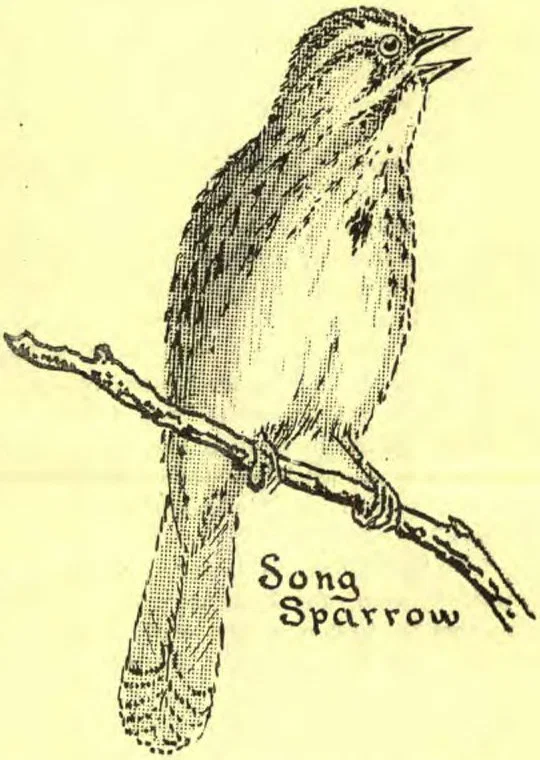
Another bird you should be able to find in winter is the Song Sparrow. This is one of the commonest and most familiar of the sparrows. It is with us both winter and summer. The bird is said to live on injurious caterpillars, grasshoppers, leaf-cutworms, and rosebugs. If not disturbed, the Song Sparrow is said to raise three broods in a season.
Though not a brilliant singer, it is well entitled to its name of Song Sparrow; for its song is as sweet as its good nature is unfailing. There is also a great variety in its song. Florence A. Merriam says that fifteen varieties of its song have been noted in one week, and the same individual has quite a number of tunes in his répertoire. The bird is full of life and good cheer, and its song may be heard in every month of the year, and in all kinds of weather, night or day. You will usually find the Song Sparrow near water. In early spring, I have seen fairly large flocks of Song Sparrows along the brook that flows through our town. When frightened, this sparrow never flies upward, but downward, or straight on into some low thicket, working its tail up and down as it flies.
Description.— Upper parts brown, streaked with black; under parts white, streaked with black, with a dark central blotch on breast; length, six and one-fourth inches. L. A. REED.