Caltha Palustris

5%

Review and Herald Publishing Company · Battle Creek, Michigan · October 9, 1902

FromThe Youth’s Instructor, Vol. L, No. 40

Read the full edition

Caltha Palustris

Marsh Marigold

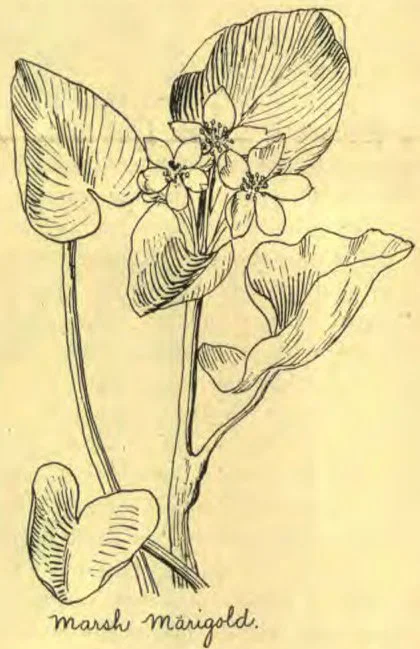
DIFFERING widely from the larkspurs and the aconites, is the innocent Marsh Marigold, whose showy yellow flowers deck the marshes in spring. Doubtless nearly all who live near marshy places are acquainted with this plant, as it is usually common in such localities. It is often, but erroneously, called cowslip.
The stem, which is from one to two feet high, bears one or more rounded or somewhat kidney-shaped leaves, and a few flowers. Corolla absent. Calyx yellow, about one and one-half inches across. The flowers are followed by a cluster of pods, each containing many seeds. Let us examine one of these clusters carefully, and see what we can learn from it.
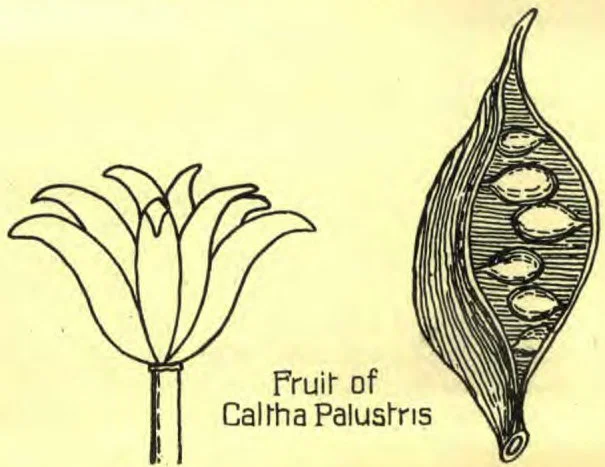
Each pod is a simple pistil, since it contains but one cavity, or cell. By opening the pod we find that it quite closely resembles a small leaf-blade with its margins turned inward and united to form a closed case, called the ovary. The line which corresponds to the united margins of the leaf is called the ventral suture, since it is always on the inner side, or the side which faces the center of the flower. The line on the opposite, or outer side, corresponding to the midrib of the leaf, is called the dorsal suture. The seeds are borne along the ventral suture. All simple pistils are formed on the plan of the one just described, while a compound pistil consists of a number of simple ones united.
Fruit of Caltha Palustris
One of the chief purposes served by fruits of all kinds is the development of seeds to produce new plants. It is therefore necessary that some provision be made for the escape of the seeds from the ripened ovary, and we find that this is provided for in various ways.
There are many fruits which do not open at maturity for the purpose of scattering their seeds. Such fruits are said to be indehiscent. Fleshy fruits, as apples and pears, stone fruits, including peaches, plums, etc., and many of the dry fruits, are of this class. Their seeds are liberated only by decay of the surrounding tissues, or by the various animals that feed upon the fruits.
Some fruits open in various ways, but without any regularity. Others split open along certain lines. Fruits of this class are said to be dehiscent. They usually contain several or many seeds.
The pods of the Marsh Marigold differ from those of leguminous plants, such as peas and beans, in that they open only along the ventral suture. A fruit of this kind is called a follicle. The peonies, larkspurs, and milkweeds have similar fruits.
The young plants of the Marsh Marigold are often boiled for “greens,” but care should be taken that some poisonous plant is not mistaken for this, as cases of severe poisoning have arisen in this way.

Paeonia Officinalis—Common Peony

The beauty and splendor exhibited by many members of the Crowfoot Family culminate in the magnificent peony, with its great, showy flowers of various colors, sometimes single, but often very double.
marsh Marigold.
marsh Marigold.
The leaves are large, ternately decompound, and the leaflets coarsely divided. Each stem bears but one flower, which opens in spring. The fruit consists of downy, leathery pods, containing many large, somewhat fleshy-coated seeds.
There are many species and varieties in cultivation, some having smaller flowers than Paeonia Officinalis, while others have very large flowers. Paeonia Moutan, the famous Tree Peony of China, is a shrubby plant two or three feet high, with flowers six or more inches across, and of various colors.

Questions

  1. Describe the Marsh Marigold.
  2. In what places does it grow?
  3. What is its character?
  4. What is a simple pistil?
  5. What is meant by the ventral and dorsal sutures?
  6. What is meant by indehiscent fruits?
  7. What are dehiscent fruits?
  8. What is a follicle? How does it differ from the pods of leguminous plants?
B. E. CRAWFORD.