WHEN Luther nailed his theses to the door of the Wittenberg church, neither he nor anybody else had any idea whereunto this thing would grow. The pope, when news of the matter first came to him, laughingly treated it as the squabble of some jealous monks, and turned aside to his favorite pursuits. When the dignitaries of the church at length realized how great a fire this little spark had kindled in Germany, and how it was threatening to spread through all Europe, and destroy the vast edifice of papal claims, it was too late to quench it. Three years had passed since the posting of the theses. Luther had become increasingly bold in his opposition to the corruptions of the Roman Church, and the decision had been reached that he must be excommunicated as a heretic, and that all possible means must be used to secure his utter destruction.
But Luther was not at all daunted by these preparations. On the contrary, he was roused to more active and strenuous contest with the evils in the church, and with those who upheld these evils. Pamphlet after pamphlet from his busy pen issued from the press, each dealing heavy blows against his adversaries. Finally he determined to burn all his bridges behind him, and so to defy the papal power as to make it impossible that he should ever be forgiven. On the morning of Monday, Dec. 10, 1520, the following notice appeared on the bulletin-board of the University of Wittenberg:—
“All friends of evangelical truth are invited to assemble about nine o’clock at the church of the Holy Cross beyond the city wall. There, according to ancient, apostolical usage, the godless books of the papal constitutions and the scholastic theology will be burned, inasmuch as the presumption of the enemies of the gospel has advanced to such a degree that they have cast the godly, evangelical books of Luther into the fire. Let all earnest students, therefore, appear at the spectacle; for it is now the time when antichrist must be exposed.”
There were then nearly a thousand students at the university, and they, together with many of the townsmen, turned out to witness the promised spectacle. Near the church named in the notice was an open square, and during the recent visitation of the plague it had been the custom to burn there infected clothing and other articles. Here a pyre was built. Luther, dressed in the robes of a doctor of theology, solemnly placed on his pyre a number of books, including the Decretals, on which imprudent forgeries the power of the papacy had been built up, and the Canon Law, by which its authority was chiefly supported. A master of arts of the university came forward, and lighted the fire; and when the pyre was well ablaze, Luther threw into it the pope’s bull of excommunication, saying in a loud voice: “Because thou dost trouble the Holy One of the Lord, may eternal fire consume thee.”
In a book that many doubtless have read, “The Schönberg-Cotta Family,” after an account of this scene it is added: “Not a word broke the silence until the last crackle and gleam of those symbolical flames had ceased, and then gravely but joyfully we all returned to our homes.”
Just the contrary was what really happened. Those who have seen several hundred college students in New York or Philadelphia, celebrating a football victory, can imagine pretty well what was done. Doctor Luther and some of the sober citizens very likely returned home “gravely but joyfully;” but students of the sixteenth century were very much like those of the twentieth, and they broke into noisy and irrepressible demonstrations of rejoicing.
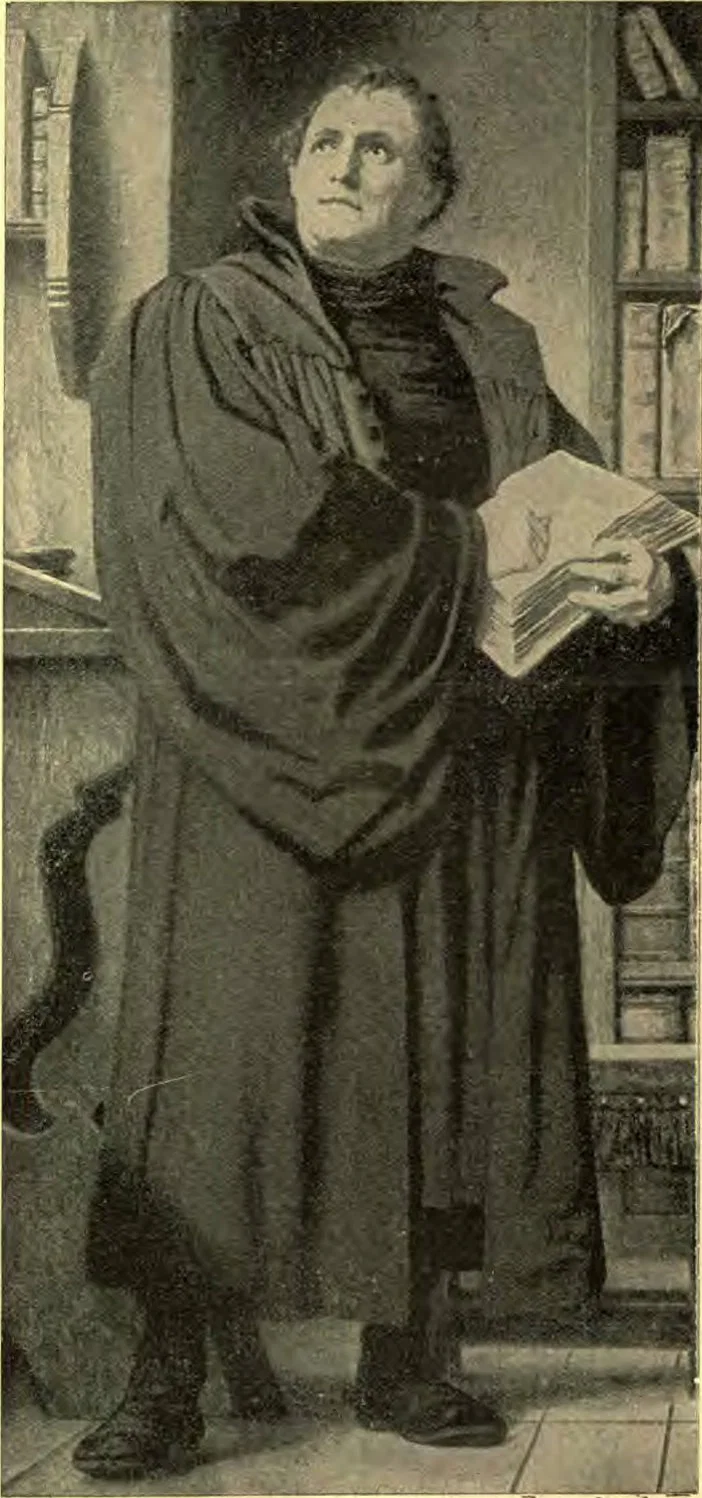
MARTIN LUTHER
First they gathered about the pyre and sang dirges, and danced while the books were being consumed. Then it occurred to them that it was a pity to have only one bonfire, where material was so abundant, so they scoured the city for books written by Luther’s opponents, and finally collected a wagonful. These they brought to the square, where they were burned with all the fantastic exercises that the ingenuity of the students could suggest. So uproarious were the students that on the following day when he delivered his university lecture, Luther felt constrained to administer a public rebuke.
For to him, and to all who realized the gravity of the occasion, this was no frolic, but a solemn religious ceremony, and at the same time a declaration of war against the greatest power in the world. It was an announcement that the Reformation could not be stopped, indeed, that it must go much farther. And at no hour in Luther’s life does he appear to better advantage, never did his courage seem higher, never did he so unmistakably stand forth as the hero of the German nation, as on the day when, by this significant symbol, single-handed, he defied the powers that were gathering to crush him.—Selected.