EVERY Englishman must have a home, if it is only one little room in a garret. One corner must be his own, where he can reign supreme. There is none of that tendency to live an uneasy, demoralizing hotel life which is becoming so common in our country. Among all the best society of the English people, every effort possible is made to surround the home with safeguards, and so to separate it from the world that it may have a quiet, peaceable existence all its own. Mark Twain says that an Englishman builds a fine house, lays out its gardens, builds a wall around it thirteen feet high, puts broken glass bottles in the top of the wall, so that no one can climb over, shuts the gate and locks it, and is then thoroughly satisfied that he has a little corner of the world all to himself. At first thought this seems ridiculous to an American; and yet it is precisely what the Englishman does when he is forced to live within the limits of a great city. It looks cold and inhospitable to the man who is outside; but within these high walls are some of the finest and best regulated homes in the world.
While in London, I had the privilege of visiting the gardens of several such homes; and it has never been my pleasure to visit more charming spots than these. The garden is simply a vision of loveliness. Every little nook and corner has some artistic touch, some beautiful vine or shrub or tree. There is nothing regular or systematic about these gardens: they are laid out as nature lays out her wild woods. Less than fifty feet from the main street or from the house, I have seen secluded little nooks, where one can sit down, and not be able to see a solitary indication of being in a garden or in a city. Apparently he is in some secluded nook in a great forest. The artificial is entirely excluded; every touch of the gardener’s hand is a touch of nature.
I have been told that a favorite rule given by English gardeners for laying out the yard of a private residence is to stand on the front porch with a basket of potatoes, and throw the potatoes promiscuously over the yard, and then plant a tree or place a flower-bed wherever he finds a potato. At least it is true that the trees are scattered about as nature would plant them.
The lawns are kept with great care. It is said that a certain American millionaire, when visiting the home of an English nobleman, particularly admired the beautiful lawns around the Englishman’s private residence; and before he went away, he asked his host to explain to him just how he could make such lawns around his home in America. The gentleman sent for his gardener, who explained with great care all the processes by which a perfect lawn may be prepared, and then finished by saying: “Prepare the lawn in this way, and then care for it as I have told you, for a hundred years, and you will have a lawn like this.” An Englishman once advised an American to carpet his yards with brussells carpets rather than attempt to make a real lawn, if he wished to save expense.
The following beautiful paragraphs descriptive of the English rural instinct are taken from Rural Life in England in “The Sketch Book” by Washington Irving. If you have this book, or can obtain it, you will enjoy reading the entire chapter:—
“The taste of the English in the cultivation of land, and in what is called landscape gardening, is unrivaled. They have studied nature intently, and discover an exquisite sense of her beautiful forms and harmonious combinations. Those charms, which in other countries she lavishes in wild solitudes, are here assembled round the haunts of domestic life. They seem to have caught her coy and furtive graces, and spread them, like witchery, about their rural abodes.
“Nothing can be more imposing than the magnificence of English park scenery. Vast lawns that extend like sheets of vivid green, with here and there clumps of gigantic trees, heaping up rich piles of foliage; the solemn pomp of groves and woodland glades, with the deer trooping in silent herds across them; the hare, bounding away to the covert; or the pheasant, suddenly bursting upon the wing; the brook, taught to wind in natural meanderings, or expand into a glassy lake; the sequestered pool, reflecting the quivering trees, with the yellow leaf sleeping on its bosom, and the trout roaming fearlessly about its limpid waters, while some rustic temple or silvan statue, grown green and dank with age, gives an air of classic sanctity to the seclusion.
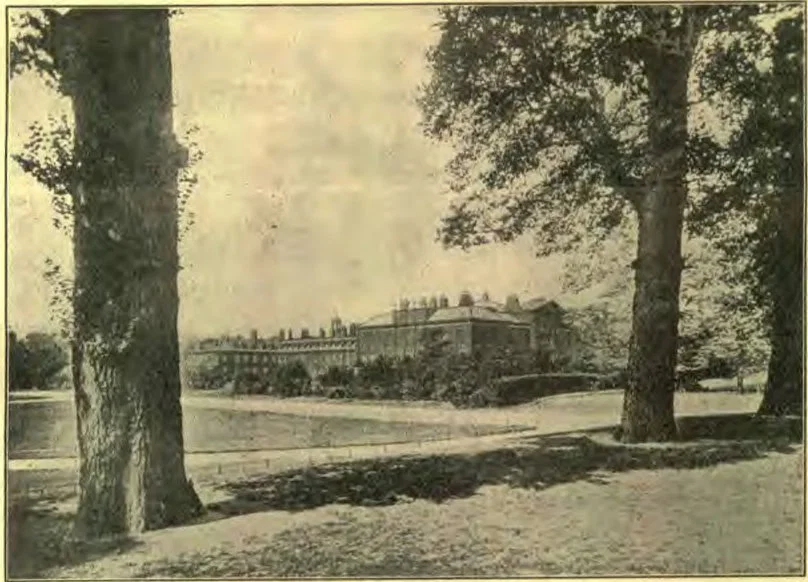
KENSINGTON PALACE
“These are but a few of the features of park scenery; but what most delights me is the creative talent with which the English decorate the unostentatious abodes of middle life. The rudest habitation, the most unpromising and scanty portion of land, in the hands of an Englishman of taste, becomes a little paradise. With a nicely discriminating eye, he seizes at once upon its capabilities, and pictures in his mind the future landscape. The sterile spot grows into loveliness under his hand; and yet the operations of art which produce the effect are scarcely to be perceived. The cherishing and training of some trees; the cautious pruning of others; the nice distribution of flowers of tender and graceful foliage; the introduction of a green slope of velvet turf; the partial opening to a peep of blue distance, or silver gleam of water,—all these are managed with a delicate tact, a pervading yet quiet assiduity, like the magic touchings with which a painter finishes up a favorite picture.
“The residence of people of fortune and refinement in the country has diffused a degree of taste and elegance in rural economy, that descends to the lowest class. The very laborer, with his thatched cottage and narrow slip of ground, attends to their embellishment. The trim hedge, the grass-plot before the door, the little flower-bed bordered with snug box, the woodbine trained up against the wall, and hanging its blossoms about the lattice, the pot of flowers in the window, the holly, providentially planted about the house, to cheat winter of its dreariness, and to throw in a semblance of green summer to cheer the fireside,—all these bespeak the influence of taste, flowing down from high sources, and pervading the lowest levels of the public mind.
“It is this sweet home-feeling, this settled repose of affection in the domestic scene, that is, after all, the parent of the steadiest virtues and purest enjoyments; and I can not close these desultory remarks better than by quoting the words of a modern English poet, who has depicted it with remarkable felicity:—
“‘Through each gradation, from the castled hall,
The city dome, the villa crowned with shade,
But chief from modest mansions numberless,
In town or hamlet, shell’ring middle life,
Down to the cottage vale, and straw-roof’d shed;
This western isle hath long been famed for scenes
Where bliss domestic finds a dwelling-place;
Domestic bliss, that, like a harmless dove
(Honor and sweet endearment keeping guard),
Can center in a little quiet nest
All that desire would fly for through the earth;
That can, the world eluding, be itself
A world enjoyed; that wants no witnesses
But its own sharers, and approving heaven; That, like a flower deep hid in rocky cleft,
Smiles, though ’tis looking only at the sky.’”