MANY an absent boy or girl, whose earliest recollections are associated with a home “far away on the hills of Old New Hampshire” or some other New England State, has longed for just one glimpse of a clump of white birches, with their dainty, sensitive leaves shimmering and fluttering in the slightest breeze, which was so peculiarly one of the features of the old home.
In New England, under the favorable climatic conditions, these trees attain to their greatest height and beauty, it being a not uncommon thing to see them fifty or sixty feet in height, and with a diameter of a foot to a foot and a half. The white birch prefers a cool climate, seeming to love the realm of the Frost King, although diminishing in size as we proceed into the regions of the “farthest north.” It even dares to brave the rigors of an arctic winter, and is found in far-away Greenland.
One of the most attractive features of this most attractive tree is the bark, which is smooth and silvery-white, its outermost layers being thrown off as the tree advances in age. The uses of this bark are legion. In the days before the white man came to these shores, the primitive forest-dwellers fashioned from it their graceful canoes; baskets were made from it, its fibers were twisted into a kind of coarse rope, and in time of famine it has even been steeped and served as food. At the present time it is used for many decorative purposes, that of writing-paper being one of the most familiar. Some affirm that it possesses medicinal properties of value in cases of fevers and eruptions.
The wood is white, firm, and tough, and has a variety of uses. It is much in demand for spools, barrels, and in wheel-making; in fine, it is one of man’s most useful forest friends. No doubt some of the older New England boys and girls will recall another use to which the “birch” has often been applied.
There are many species of birch, but the white birch is most picturesque. The bark is so strong and firm that the wood of the fallen tree will not rot entirely away as long as the case of bark remains sound and solid. The Indians appreciated this fact, and many a child of the forest lies sleeping in a shroud of birch bark, this being their primitive method of embalming the dead.
The birches are clannish trees, seeming to prefer growing in little clusters of their own kind, although individual trees scatter occasionally, being sometimes found among the evergreens, their silvery bark making a beautiful contrast against the dark background. Their favorite haunts are rocky old fields and abandoned farms, often some barren, sandy spot where no other trees grow; perhaps this explains why the birch clings so lovingly to New England. The saying “shaking like an aspen leaf” could be varied by saying “like a birch leaf;” for the leaves of this tree are so hung on the branches that they respond to the slightest flutter of the air.
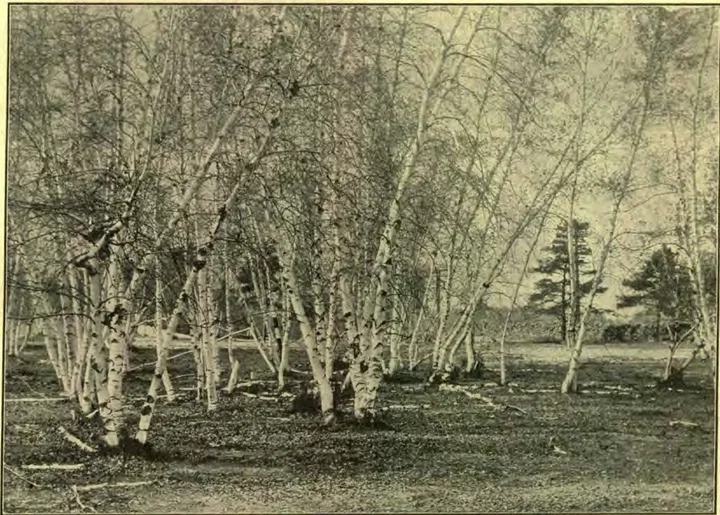
The beauties of the birch tree furnish a fitting theme for the brush of the artist or the pen of the poet. A lover of nature has paid a fitting tribute to our theme under the caption, “My Lady Birch:” —
“You are indeed a lady, My tall and slender birch, And none will find a fairer one Wherever he may search.
“My lady birch, I wonder What does my presence give To one so very delicate, So finely sensitive.
“I only know there never Seem darker stains on me, Than when I come and look on you, And all your whiteness see.”
F. A. FROST.