KUMATARO was the name of a little Japanese boy who lived in the house adjoining mine in Tokyo, the capital of Japan. He was only three years of age, and I met him toddling along the narrow foot-path one morning as I started out for a walk.
“Master Bear,” for that is the literal translation of his name, was dressed in a very pretty light-blue kimono, or wrapper, with a bright-red sash, or obi. He wore little straw sandals and short white stockings called tabi, which reached to the ankles. These stockings were like mittens: they had a division between the great toe and the others, through which the thong was passed that held the sandal to the foot.
The top of his head was shaved, leaving a circle of hair extending around that made him look like one of those odd Japanese dolls we all have seen.
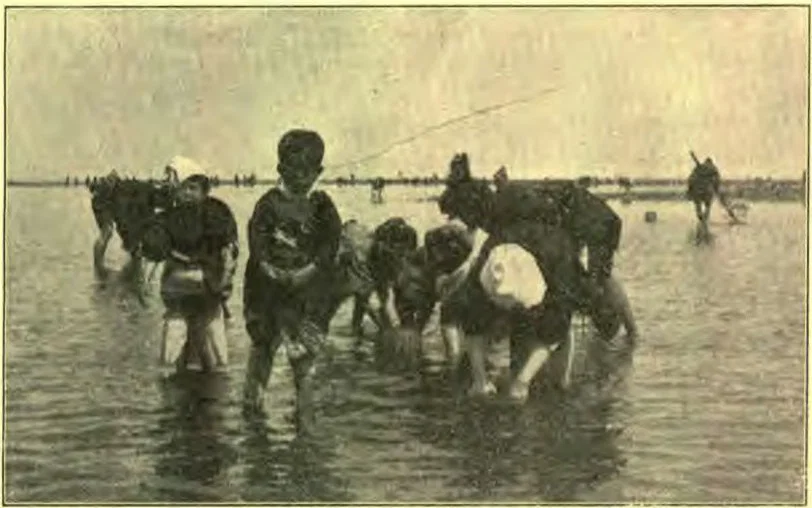
GATHERING SHELL-FISH — JAPANESE BOY AND GIRL IN THE FOREGROUND
His little legs were hardly strong enough to hold him up; still he toddled along with an air of dignity that was highly amusing. His dignity did not relax at my approach, and I could not help stopping, and making a low bow, in true Japanese style. I remarked most respectfully, “Kekko no tenki de gozaimasu,” which is the Japanese way of saying, “What a beautiful day this is!” I feared that my action might scare this little man, for I knew that a meeting with a white man would be regarded by many Japanese children much as suddenly confronting a Turk in a turban would be regarded by a timid American baby. Japanese children, as a rule, are rather apt to be afraid of foreigners, but this is not to be wondered at, for I found it to be a very general belief that white men carried away little Japanese children if they caught them out alone after dark. I often noticed, as I walked through the streets of Tokio, that crying children suddenly became as quiet as mice on seeing me, and gazed at me with large, frightened eyes. I wondered at this, until one day I overheard a nurse say to a little child, “Be still; here comes a white man, and he will carry you away if you do not behave yourself!”
I was, therefore, rather surprised when, instead of becoming frightened, Kumataro stopped and gravely returned my salutation ducking his little shaven head in the most approved Japanese fashion, and then resuming his lordly progress. I was, to say the least, somewhat taken aback at the coolness of this little man, especially when I observed that his mother, who stood in the doorway, had not failed to see the humor of it, and could hardly keep from laughing. After this first meeting I became very friendly with the boy.
Around my house was a pretty Japanese garden, which was separated from that of my neighbors by a bamboo fence. Consequently I saw Kumataro almost daily. Japanese houses are very lightly put together. The shoji, or doors, which also serve as windows, consist of light lattice frames three feet wide and six feet high. These are covered with thin but tough paper to admit the light, and they slide in grooves along the sides of the room. A narrow veranda usually extends around the house, and is closed at night by wooden shutters that likewise slide in grooves along the edge of the veranda.
The long, overhanging roof protects these paper windows and doors from the rain. Glass is rarely used for windows; and it was almost unknown in Japan until that country was thrown open to foreign nations about forty years ago. Many of the Japanese, especially the country people, are still so unaccustomed to glass windows that it has been found necessary, in many of the third-class compartments of railway carriages, to paste strips of paper across the windows in order to attract attention to the glass, for it has frequently happened that, in their ignorance, these people have stuck their heads through the window-panes of the carriages.
There is but little privacy in Japanese houses, for the reason that everything that is said on the other side of the paper doors can be overheard, and as these are usually left open, one can not help seeing much of the domestic life of one’s neighbors.
Thus I often observed little Kumataro at his meals, which, according to the custom of his country, he ate with chop-sticks instead of knife, fork, and spoon. It is very difficult for a stranger to handle these two little sticks; but Kumataro, who had been taught how to hold them properly managed them so easily that he was able to pick up any little morsel from his plate as easily as an American boy could with a fork.
Everything that is served at a Japanese dinner is cut into small pieces, that may be picked up and eaten with the chop-sticks. A dinner consists of a number of courses, such as soup made of bean-curd, fish, and mushrooms, or seaweed, which are served in lacquer bowls. This is followed by fish boiled with lotus-roots, and raw fish cut into thin slices and eaten with a sauce called soyu; also salad and pickled vegetables and soba, and a sort of buckwheat vermicelli. The Japanese eat very little meat, and rice takes the place of bread. Soup is usually served at the end as well as at the beginning of a dinner.
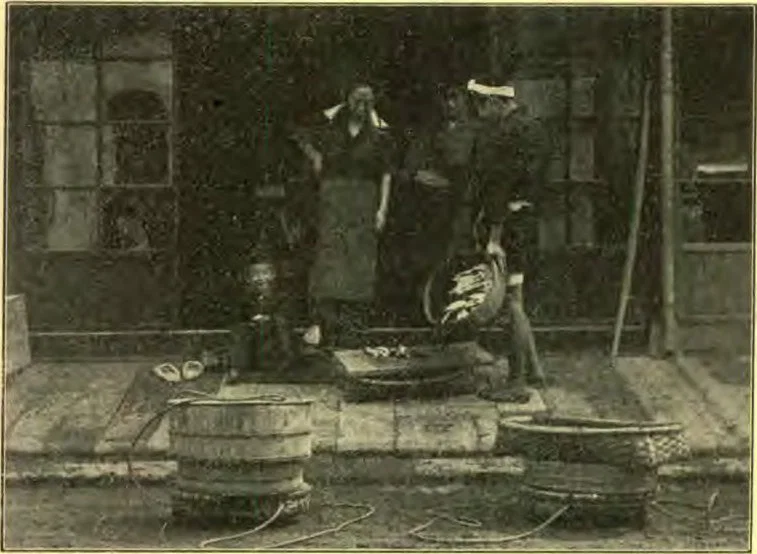
FISHMONGER AT THE DOOR OF A JAPANESE HOME
Tables and chairs are not used in Japanese houses, and our little friend, in accordance with the general custom in Japan, sat on the floor, with his dinner spread out before him on lacquer trays.
Whenever I called at Kumataro’s house, I was invited to be seated on the floor. The floor of a Japanese room is covered with fine straw mats, called tatame, which are always kept scrupulously clean, for a Japanese never enters a house with his shoes on. These are always left outside of the door, and he walks about on the matting in his stockings. Whenever a Japanese sits on the floor, he doubles his legs up under him, crosses his feet, and squats on his heels; and he can remain in this position for hours.
Kumataro had a brother named Matsujiro (literally “Pine-tree”). He was about five years of age, but passed for seven, for the Japanese have a curious method of computing age. No matter when a child is born, its age is always reckoned from the first of January. If, for instance, a boy is born in February, the first anniversary of his birth falls on the following first of January, and he is then said to be in his second year.
These two little youngsters, like most Japanese children, managed to have a very good time. They had many different ways of amusing themselves, and rarely quarreled with each other. When any disagreement arose, they generally settled it pleasantly, as in the following instance. Master Bear and his brother scrambled, one day, for the possession of a ball that I had thrown over into their garden. The elder boy succeeded in grabbing it, but the younger was by no means disposed to give up his claim to it. Instead of becoming angry and fighting about it, they decided to settle the question of ownership by means of a game known as ken. The game is played as follows:—6
Two players, facing each other, throw out their right hands at the same time. As the hand is thrown forward, it assumes one of three positions. An open hand represents a sheet of paper. A closed hand represents a stone. The two first fingers extended, with the others closed, represents a pair of scissors.
The following are the points for the player to bear in mind in scoring the game:—
Scissors can cut paper.
Scissors can not cut stone.
Paper can be wrapped around the stone.
If player No. 1 extends his two fingers and No. 2 his open hand, No. 1 wins, for the reason that scissors cut paper. On the other hand, if No. 2 had presented his fist, he would have been the winner, for scissors can not cut stone. Again, if No. 1 extends his open hand, and No. 2 his closed hand, the former wins, as the paper can be wrapped around the stone. In case both players make the same movement, it does not count, and they try over again. This expedient is resorted to not only by children, but by grown persons as well, who often settle trivial disputes in this peaceful manner.
The most popular, as well as the most familiar, of all children’s games is known as hyaku-min-shu, or “the poems of a hundred poets.” It is a card game, and is played as follows:—
Two hundred cards, each printed with the first or last half of one of these well-known poems, are used.
The cards representing the last half of these short poems are spread out on the floor, while the others are held by the players. Some one who has been appointed reads the beginning of the poem as he draws them from a pack.
The skill lies in quickly uniting the first half that the player holds to the second half on the floor, and the one who first gets rid of all his cards wins the game. It will thus be seen that in order to play this game skilfully, it is necessary to be perfectly familiar with these hundred poems, and it is, therefore, as instructive as it is amusing.—Theodore Wares, in St. Nicholas.