Meenie’s Thanksgiving

5%

Review and Herald Publishing Company · Battle Creek, Michigan · November 27, 1902

FromThe Youth’s Instructor, Vol. L., No. 47.

Read the full edition

Meenie’s Thanksgiving

MEENIE’S back was aching badly, and big tears stood in her blue eyes as she gazed out into the alley. The day was cold, and the wind blustered through the narrow street as if in a tempest of passion. Papers whirled hither and yon, a piece of tin hanging loose on the house opposite clanged a noisy protest, the children shouted and yelled in derision, though their tattered garments were scant defense against the cold. A group of sparrows were chattering and quarreling over a crust of bread, vanishing as a hungry-looking cat skulked hurriedly across the area, only to renew the debate more vigorously when their enemy had disappeared. There was nothing very cheery in the prospect,—“Nothing but walks and windows and cobwebs—all of it broken and dirty,” as Meenie said, in a tired little voice.
Meenie was what the boys of the alley tersely dubbed “a tie-in.” Poor little girl! A year ago she was racing, quarreling, playing, with the most sturdy of them. Now she was looking down upon the boisterous group with bitter rebellion in her little heart, and angry tears in her eyes. Why should she have suffered the accident which left her poor spine all twisted and hurt? What had she done more than the others, that she should be tied down and in, helpless as a baby? And the rebellion and the tears grew bigger and bigger as she gazed and pondered.
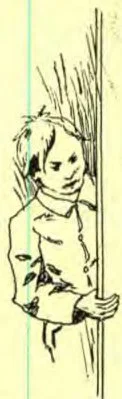
Just as the tears were threatening to fall, the door of her room was pushed open, and a dirty little face peered timidly in.
“You there, Meenie?” queried a small voice. Meenie turned her head slowly, still lost in the misery of her own thoughts. Then her face brightened.
“Yes, I’m always in. Come on.”
“I’ve got suthin’. Want to see?” and the in- truder advanced boldly, with a tightly clenched fist held behind him.
“What is it?” demanded Meenie. “Lemme guess first. Marble?” “Nop,” with a delighted chuckle. “Picture?” “Nop.” “Buzzer?” A contemptuous shake of the head. “I dunno. Lemme see now.” The newcomer advanced a grimy fist, and slowly unrolled the dirty fingers, disclosing a bran new dime. There was a gasp of wonder, delight, astonishment. “Bud,” whispered Meenie, in an awed voice, “where’d you get it? Ain’t it a beauty! My! but it’s fine. What are you going to do with it? Ole Nan’ll whip you if she catches you not giving it to her.”
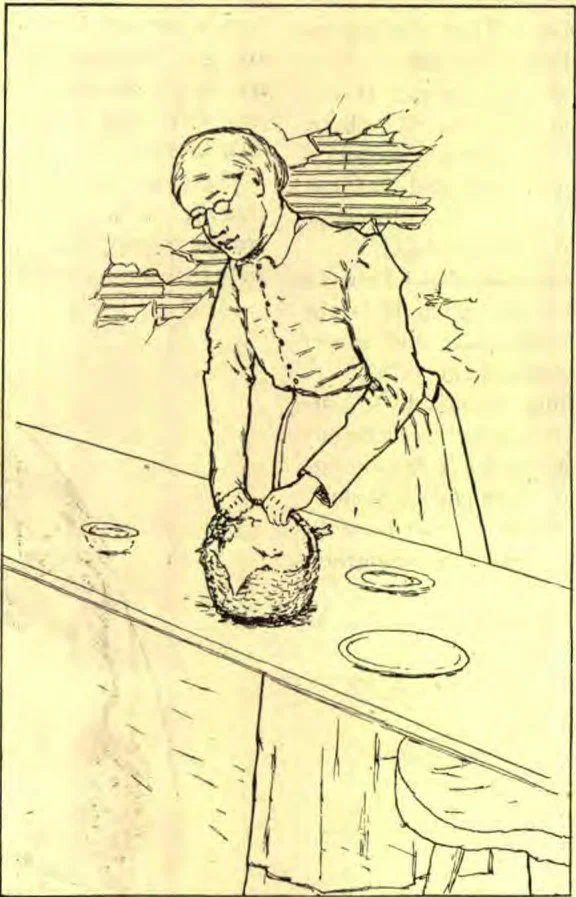
“A BOARD PLACED ON TWO CHAIRS”
“Ole Nan ain’t going to catch me, though. Nobody saw me pick it up. I was a racing Jim Flannigan down the alley, an’ I caught my toe on sumpin’, an’ down I goes; an’ when I rolled over to get up, there lay the dime a shinin’ an’ a shinin’. I grabbed it, an’ nobody saw it but me. I just wish I had all of ’em I could carry.”
Meenie reached out her hand and touched the coin with one finger. “What you going to do with it?” she again demanded.
“Guess ’gen,” and Bud’s eyes danced with roguish delight.
“No, I’m tired guessing,” as her back gave a twinge. “’Sides I never guess right. What are you?”
Bud reached over and whispered in her ear. A flush of pleasure spread over Meenie’s face, and she leaned back in her chair, and gazed at him with shining eyes. “O Bud! how buchiful!” “Yep. I’ve got to go now, but you just wait. We’ll have the greatest Thanksgiving you’ve ever seen. You think up things to do, an’ we’ll do it.”
It was only a week till the great day. Thanksgiving day in Halsted Court passed just the same as any other holiday in the year,—men drinking, women washing, gossiping, scolding; children playing, quarreling, crying,—the monotony broken occasionally by shrieks, and the sounds of crashing glass from some house where tempers had risen, and drink flowed too freely, ended probably by the rush and clatter of the patrol, which carried off the unfortunate victims of appetite and passion. But this day was to be different for one small soul at least. Bud had found a whole dime, and (blessings on the generosity of his small heart!) had confided to her that she, Meenie, was to spend it all for Thanksgiving. What should she buy? This was the problem which Meenie propounded excitedly to the sweet-faced deaconess who had found her out, and was doing all she could to make life more beautiful for the little sufferer. They discussed the question, pro and con, and finally decided that Bud and the birds, the dear little sparrows which had helped Meenie through many a dreary day of suffering, chirping gaily at her window-sill, should share the treat. The wonderful dime was taken from its hiding-place, and given over to the care of Deaconess Grey, who was admonished to be “awful keerful ’bout spending it, and to git jest as much as ever you can with it.”
Dear little Meenie! She little thought that her dime, exhibited that evening in a crowded church, accompanied by a recital of its history by Deaconess Grey, would bring her many, many times its worth. But she bade Bud attend the feast the next morning, and be ready to hang the birds’ dinner outside her window for her.
They had a beautiful time the next day,—Meenie, Bud, Deaconess Grey, and the sparrows. The first three had a dinner which made Bud roll his eyes in ecstatic glee, and execute a genuine war-dance around the room, while Meenie sat lost in speechless admiration as Deaconess Grey spread a snowy little cloth over a board placed on two chairs, and then set upon it the contents of her basket,—bread and butter; hot baked potatoes, plump and mealy; rice as white as snow; a quivering mound of crimson jelly; pudding, nuts, oranges—an array such as the two children had never seen.
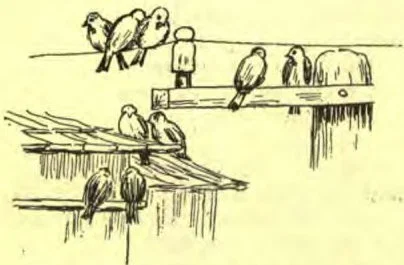
They had great fun after dinner, nailing a board on the window-sill, upon which a branch from an evergreen tree was fastened. Deaconess Grey had brought some grain with her, and this they scattered on the board, with some crumbs. Then they fastened little strips of meat and pieces of bread and potato to the evergreen, and all three sat down to watch the result. It didn’t take the sparrows long to find it out, and what a scolding, fussing, twittering, chirping bunch they were. Bud had to fill up the board and tree three or four times before the hungry crowd got enough, and then one fat, saucy fellow insisted that he was yet starving, and chirped for more.
“THE DEAR LITTLE SPARROWS”
That night Meenie added to her evening petitions, “Please, God, I’m very glad you let us have such a nice Thanksgiving. Thank you for letting Bud find that dime—and please let him find some more.” ANNA CLIFF WHITE.