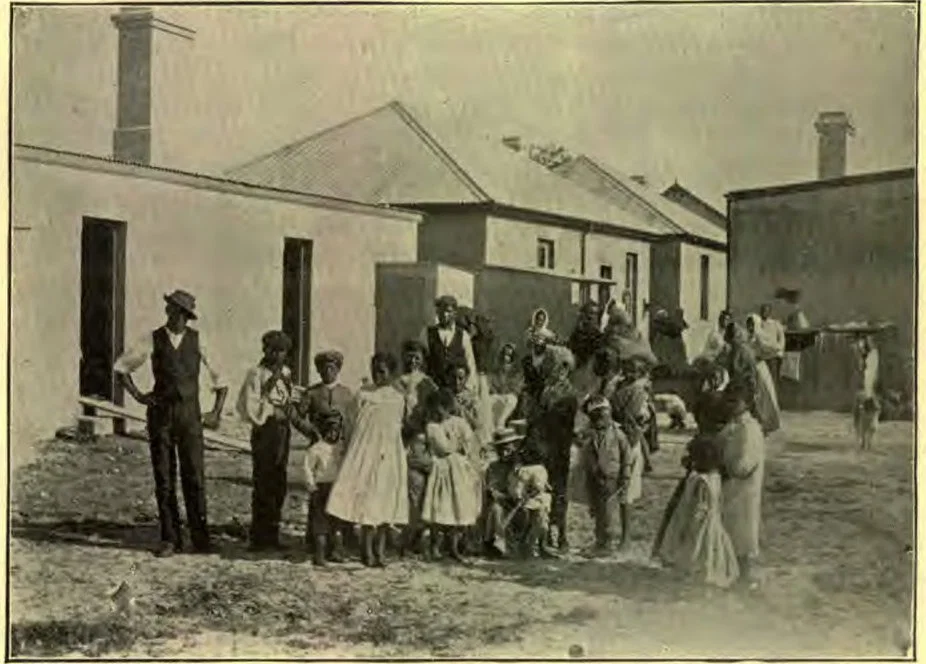
AFRICA as a continent has seemed to have more of the curse, caused by the fall of man, resting upon it than almost any other portion of the globe. Disease, plagues, and war have been prevalent in the land ever since it has been known to civilized man. From the time when the Lord sent the plagues upon the Egyptians, because the wicked Pharaoh would not obey his command, Africa has seemed to abound in trouble; and we can not look for peace until the “King of Salem, which is, King of peace,” shall come again. Our duty is to do all in our power to prepare the inhabitants of this darkened land for the coming of our King.
Let us take a glimpse of the field. In the north there is Egypt, with Tripoli, Algeria, Tunis, and Morocco. Their population is made up of Arabs, Greeks, Jews, Syrians, Armenians, and negroes, and save for one or two workers in Egypt, we have no one upholding the truth of God there. Then there are the West Coast, and the Sudan in the interior, with no one proclaiming the message of Christ’s coming. The Hausas (inhabitants of the Sudan) are an intelligent people, who have written and preserved the history of their country. They weave strong and beautiful fabrics for their clothing, and are lovers of peace, but they are followers of the Mohammedan religion, and very superstitious. They live in walled cities, some of which are of considerable size.
Besides these countries, there are East Africa and much more of Central Africa. These we will not consider at present, but will take a brief glance at the needs of the South African field. This is generally regarded as not very large; but when we consider what it includes, we see something of the vastness of the territory comprised in the name “South Africa.” First of all, there is Cape Colony, with Natal, Basutoland, the Orange River Colony, the Transvaal, Zululand, Pondoland, Griqual, and Rhodesia, including Matabeleland, Mashonaland, and Khama’s country, and numerous others of less importance. In all these colonies we have only eight white laborers who are working for the natives. In addition to the millions of natives in South Africa, there are thousands of Dutch people with scarcely a worker, besides the English. With a field so needy as this before us, can we remain unmoved?
In the native work, our white workers can not expect to do it all; but we need central mission stations, where the natives can be trained, educated, and then sent out to the kraals (native villages), there to teach their own people the truth. It is next to impossible for the older natives to receive such a training, but the children and young men and women are glad to learn, and it is much easier to reach them than their fathers and mothers. You know we often find it so with those in our own home country; that is, after people are brought up to believe one thing, it is hard for them to change their views. This characteristic is much more marked in the African than in their white brothers and sisters. But while the young Africans are much more easily influenced in the right way than their elders, it is also true that they are especially susceptible to evil influences. They are generally taught that the white man is above them, and therefore they must respect him. As a result, they think that everything he does is desirable, and seek to follow him, and in that way have learned many evil habits, such as smoking and drinking and others even worse. Not long ago, when speaking to one of the native boys, he said to me, in his broken English, “I want learn read English. Zulu no good; English ways better.” This was a boy who had lived in the English cities for years, and had learned a little of the language. I taught him for several months; and as he wished to learn to read English, we used the “Gospel Primer” as our text-book. He came regularly at the appointed hour, although the only time that he could come was after the day’s work was done, and I know that he was often tired. He asked a great many questions, and in that way I could tell him many things about the Saviour, his love, and the plan of salvation. It always seemed to do him good, although he could not understand all that I said, as I could speak to him only in English.
The natives live in villages, or native settlements, and it is here, or near them, that we should have our mission stations, so the children can go to a suitable school. Often their parents are not willing for them to come, but after they once have a taste of better things, it is hard to influence them to stay away. Some will run away from home, and come to our school; but others remain with their parents, and endure real persecution, thus upholding the standard of truth by their lives.
Our first native workers have just lately been sent out. They go and hold schools in the kraals for a few months, and then return to the home station. In this way they gain an experience of their own, and still keep in touch with the white workers. If we only had more of these workers, we would be very thankful; but we must first have more training-stations where they can be educated.
Besides the African natives, there are thousands of East Indians and Arabs in South Africa who come here to find employment. As yet nothing whatever has been done for them by our people.
With these thousands of souls dying in darkness and sin, sinking into Christless graves, can we remain silent and unconcerned? There is a far greater work to be done than many of us realize. Where there is now one worker in the field, there should be one hundred. God calls upon young men and women to give their lives to this work; calls them to leave home and loved ones, and devote their whole energies to saving souls in this benighted land. And not only in this country; for this is only one of the many very needy fields. Look also at India, Japan, China, South America, and the islands of the sea. From all these countries comes one great cry for salvation; but where are the workers and money with which to carry on the work? “The harvest truly is great, but the laborers are few: pray ye therefore the Lord of the harvest, that he would send forth laborers into his harvest.” And let us answer our prayers by giving our lives to this work.
Besides the great need of more workers, and of money with which to carry forward what has already been begun, we who are in the field need the prayers of our brothers and sisters in America. Let us all come up to the help of the Lord; let us lay our lives, our means, all that we have, upon the altar of God, and thus hasten our Saviour’s coming. If God’s people as individuals and as Sabbath-schools and churches will do this, we shall see the message go with much greater rapidity than it is now going, and we shall enjoy much more of the blessing of the Lord.
“Can we, whose souls are lighted
With wisdom from on high,—
Can we, to men benighted,
The lamp of truth deny?
Salvation, O salvation!
The joyful sound proclaim
Till earth’s remotest nation
Has heard Messiah’s name.”