THE ROYAL CHINOOKS

3%

Review and Herald Publishing Company · Battle Creek, Mich. · January 9, 1902

FromThe Youth’s Instructor, Vol. L, No. 2

Read the full edition

THE ROYAL CHINOOKS

THE Prince and Princess of Chinook were born under more auspicious circumstances than their ancestors for many generations back had been. The former princes and princesses had been accustomed to fight and flee for their lives from their earliest infancy, and many of them were destroyed by their enemies before they reached an age at which they were able to protect themselves. But the Chinook family was a prolific one, and despite the great mortality among their youngest children, the family continued to grow larger each year.
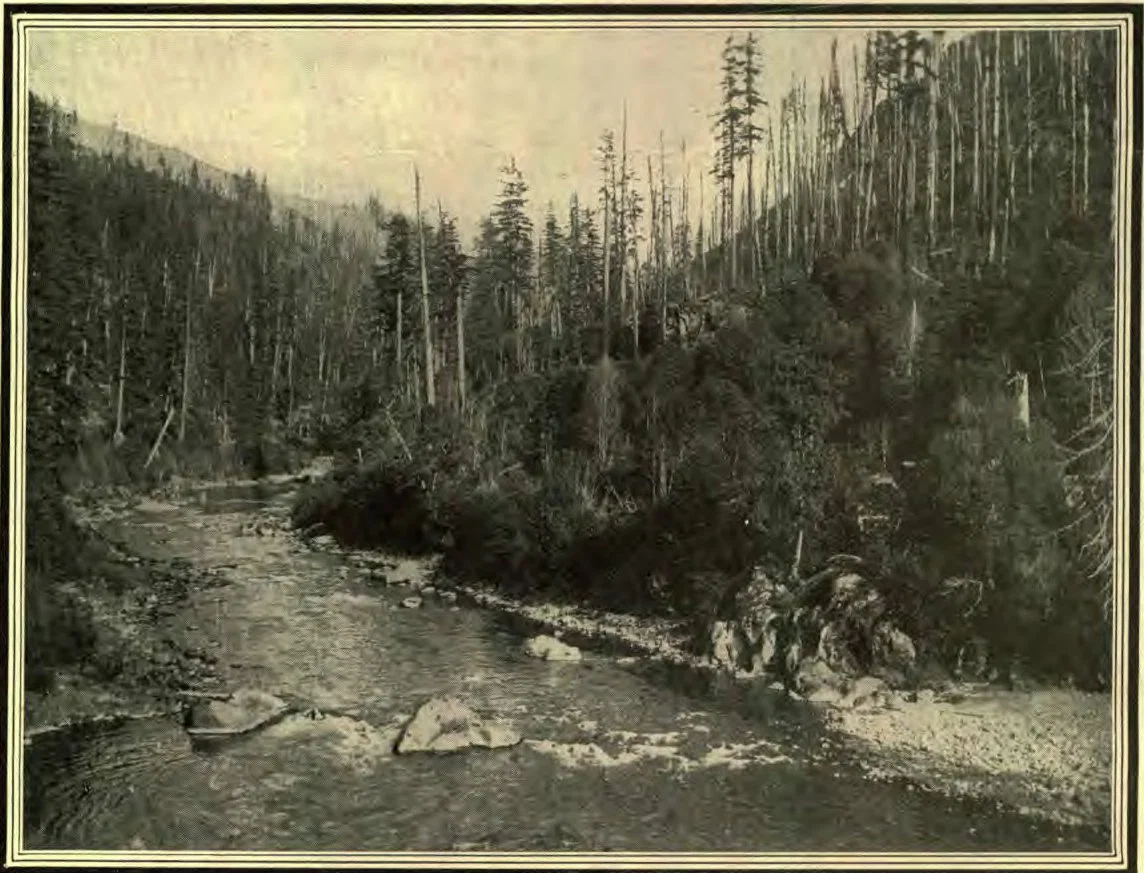
A FAVORITE SPAWNING-GROUND OF THE ROYAL CHINOOKS
The custom of the family was that as soon as the children reached a vigorous youth, they should be sent abroad to remain till they were mated; and each year brought a company of brides and grooms back to their old home. On such occasions, few of their old enemies would molest them; for the full-grown Chinooks, dressed in their bright silver armor, were rather formidable looking. But they had a new enemy, one whom they had never met before, and whose traps and snares were all strange to them. This enemy was strong and cunning, and against him the poor Chinook that he marked for a victim was almost defenseless. He was a cannibal creature, and used the bodies of his victims for food. For ages he was the hereditary enemy of the Chinook family; but for ages he was satisfied when he had secured enough of their bodies for his present wants.
Finally, however, one of these creatures discovered a method by which the bodies of the Chinooks could be kept from decay for an indefinite time. Then they conceived the idea of sending the canned Chinook salmon to their brother cannibals, some of whom lived thousands of miles from the haunts of the Chinook family. That called for a greater supply than could be secured in the old ways; but as soon as the demand existed, men set about to devise new methods of securing the supply.
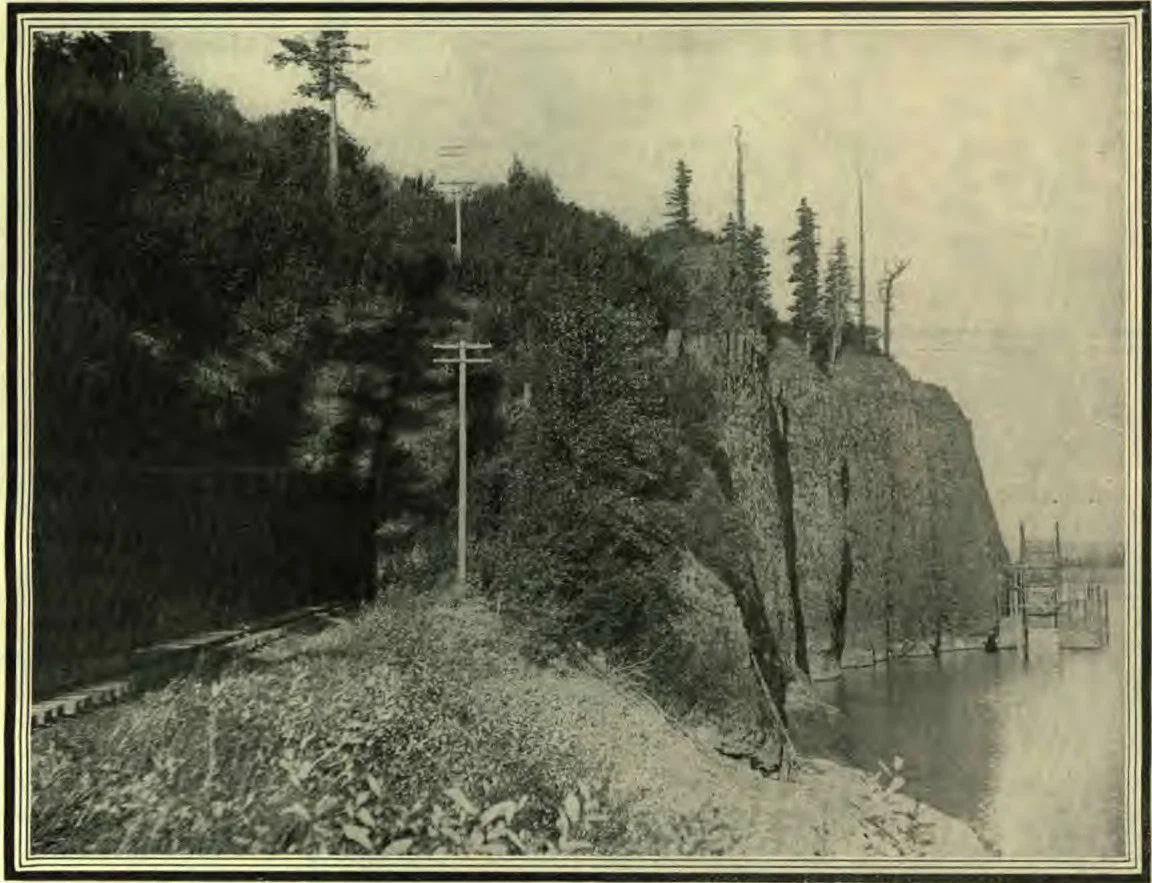
FISH WHEEL (ON EXTREME RIGHT) ON COLUMBIA RIVER.
When the young parties began to arrive from the sea, they found the shallow water near the mouth of the river patrolled by their pitiless enemies, who were constantly stretching out seines in a semicircle, and drawing them to the shore, where the poor Chinooks that they inclosed were left to die upon the sand. Many escaped the seines, only to become entangled in the nets of the fishermen who were stationed above. If these also were passed in safety, and the fish succeeded in reaching the swift water of the upper river, they were met by a new danger,—the fish-wheel. This was a V-shaped inclosure built in shallow water near the shore. The open end was pointed down the stream, and at the other end was anchored a wheel something like the paddle-wheel of a steamboat. This wheel was kept in constant motion by the current of the river, and being armed with dip nets, it scooped up all the fish that came within its reach, and dumped them into a scow behind it. The few that escaped these almost ubiquitous traps were assailed by men who, armed with barbed spears, stood in the rapids, or beside the waterfalls near their spawning-grounds.
Not many, alas! of this royal family were able to run such a terrible gauntlet, and deposit their eggs in a favorable place near the source of some stream. Every couple that did succeed would leave from five thousand to fifteen thousand eggs; and if all these had hatched, and the young grown to maturity, there would probably have been no diminution of the supply. But many fishes, birds, and quadrupeds consider salmon eggs a dainty titbit, and devour them without compunction. After the young are hatched, they are very delicate; and for the first few weeks the slightest injury is fatal, even if they succeed in escaping from their enemies.
Under so many unfavorable conditions, it is no wonder that the “runs” became smaller and smaller every year, and men began to fear that the species would soon become extinct.
“We must build fish hatcheries,” they said, “where we can guard the eggs, and protect the young till they are able to care for themselves.” So they set to work to carry out this plan.
Across a stream where the salmon were wont to run, they built a dam twenty feet high,—higher than the strongest fish could leap. When the royal Chinooks reached this dam, they could go no farther. They would not turn back; for instinct impelled them to strive to continue their course up the stream till they reached a favorable spawning-ground. To them the dam was virtually a prison, from which they could not escape. There they were allowed to remain till they were ready to spawn, when they were seined out, and robbed of their eggs. These eggs were deposited in long troughs, where they were supplied with an abundance of water that was always kept at just the right temperature. In thirty-five days the young salmon began to appear. So successful was this plan, that very often fully ninety per cent of the eggs secured became sturdy little fish, well able to care for themselves, before they left the protecting walls of the hatchery.
It was under such circumstances as these that our Prince and Princess of Chinook were born. They were only about half an inch long, and what they could see of the big world looked so terrible to them that they wanted to dive down under something and hide. But there were thousands of other baby princes and princesses in the same trough, and nothing for any of them to hide under; so they tried to hide under one another. In a few weeks, however, they learned to distinguish between animate and inanimate objects; though they still thought that every moving thing was a foe, from which they must flee to the deepest and darkest place they could find.
In two months they had grown to be handsome little creatures fully an inch long. Their bodies were cigar-shaped, but plump and symmetrical; and their silver sides were crossed by nine dark bars, which seemed to add the finishing touches to their delicate beauty.
About this time a man came to the hatchery with an order for ten thousand of these baby salmon to be planted in a distant stream. The order read Oncorhynchus chavicha; but the man in charge knew that these words meant Chinook salmon, and proceeded forthwith to dip the requisite number from the trough where our prince and princess were playing hide-and-go-seek. They were terribly frightened to be dumped unceremoniously into a big tin can, and they tried their best to find some place to hide. But presently the can was covered up, and when they found themselves in darkness, they were not so frightened.
They had been in the can but a short time when the water began to get foul; and before they were given a fresh supply, the princess was so nearly suffocated that she was floating on the top of the water gasping for breath. After that, however, the man who had charge of them was more prompt about renewing the water, and though they often wished themselves back in the hatchery, they were quite comfortable. They were beginning to wonder if they were always going to be kept there, when the cover was taken from the can, and they were gently turned into a big stream of pure, sweet water. Then the prince and the princess darted away together, and hid in the shadow of a great rock.
It was a pleasant place, with many hiding-places and plenty to eat. They were hungry, so they glided out of the shadow of the rock, where they had taken refuge, and began to eat. But before they were half through, the prince saw something big rushing through the water toward them. “Look out!” he cried. And with a quick flit of their powerful little tails, they were back in the shadow of the friendly rock, where the big fish could not reach them.
The whole winter passed, and the prince and princess had grown to four inches in length, and they began to be dissatisfied with the little stream where they lived. One day while they were resting beside the big rock, the prince said: “I have noticed that the water is always flowing past here in the same direction. It must be a big place where it all goes. I wonder what it is like.”
“I have often thought of that myself,” said the princess; “suppose we go down, and see where it goes.”
“Do, young folks,” said a big king salmon, who, in passing up the stream, overheard the conversation; “by all means go to sea.” Neither of them understood the joke, but they thought that they were encouraged to go. They would have liked to ask some questions of the incoming salmon; but though they were a prince and princess, they felt rather timid about approaching the big kings and queens, and finally concluded to go and see for themselves. On their journey they saw so many strange and beautiful sights that seemed to bid them linger that they were a long time in making their way to the sea,—so long that they had grown to twice the size that they were when they started.
“We are getting so big,” said the prince, as they left the fresh water, and began to swim over a bed of gorgeously colored seaweeds, “that we don’t need to be afraid any more. There are not many things that are big enough to eat us now.”
But just then they looked up, and saw a monstrous creature rushing toward them with its mouth wide open, showing two rows of great white teeth. Quick as a flash they were down among the seaweeds, where the shark could not reach them.
“Oh, wasn’t that a dreadful creature!” gasped the princess, trembling with fear.
“Yes,” answered the prince, not a whit less frightened; “it was ten times as big as the biggest sturgeon I ever saw.”
“Let’s go home,” sobbed the princess.
“All right,” consented the prince, “but we can’t start now; for that big thing is up there waiting for us.”
But presently the “big thing” moved away in search of less agile prey; and with its disappearance their courage came back, and finding an abundance of tempting food scattered about among the seaweeds, they soon concluded to stay in their new home. After that they grew rapidly.
By and by came the time when they were quite grown up, and one spring morning they started on their homeward journey.
How happy they were as they darted through the sweet, cool water of the river, or leaped into the air to describe a graceful curve and disappear beneath the surface again! Perhaps they would not have been so happy had they known that this journey was to end in death. Yet so it was; for even had they escaped the nets and traps with which the river was lined, and reached their spawning-ground in safety, they would have died on the return journey; for salmon spawn but once.
They were in the middle of the stream when they passed the seining-grounds, so that danger was passed. Once the king became entangled in a net; but there was a weak spot in it, and a few vigorous strokes of his powerful tail broke several of the strings, and set him free. Once the queen was struck by a spear; but the spearman was a novice, and she received only a slight wound.
When the journey began, they were careless, happy, and frolicsome; but by the time they were two months in the river, they had sobered down, and were swimming more industriously. They had tasted no food upon the journey; and though they were abundantly supplied with surplus blood and fat when they left the sea, the long fast was beginning to tell upon them. They were now anxious to find some suitable place where the queen could deposit her eggs, and were swimming close to the bank of the river in search of the mouth of a smaller stream, when they suddenly found themselves in a passage that grew narrower as they advanced. But presently they saw an opening ahead, and darted through it—only to be scooped up in one of the nets of a fish-wheel. They lashed the net with their tails in their frantic efforts to escape; but the net was made to withstand just such struggles as theirs, and slowly the pitiless wheel lifted them higher and higher in the air. By the time the net that held them reached the top of the wheel, their strength was exhausted, and they lay gasping for breath, but struggling no longer. Then as they began to descend, they thought that they might be again restored to the water. But in a few moments they were dumped into a scow on the top of a great heap of dead and dying salmon.
Thus ended the lives of two Royal Chinooks.
J. EDGAR ROSS.