21. So that servant came, and showed his lord these things. Then the master of the house, being angry, said to his servant, Go out quickly into the streets and lanes of the city, and bring in hither the poor, and the maimed, and the halt, and the blind.
22. And the servant said, Lord, it is done as thou hast commanded, and yet there is room.
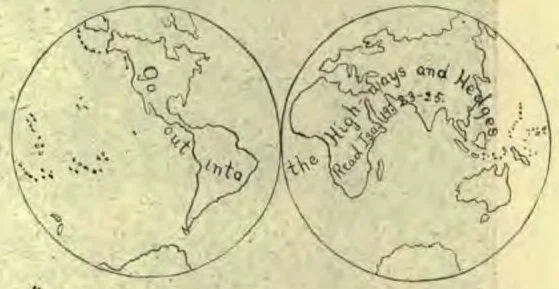
23. And the Lord said unto the servant, Go out into the highway, and hedges, and compel them to come in, that my house may be filled.
24. For I say unto you, That none of those men which were bidden shall taste of my supper.
Questions
1. When the servant found that not one of the bidden guests would come, what did he do?
2. How did his report affect the master?
3. Where did the master then tell him quickly to go?
4. Who were to be brought in from the streets and lanes of the city?
5. How did these people respond to the master’s invitation?
6. What did the servant then say to his lord?
7. Into what places was he therefore commissioned to go?
8. Why was the invitation so urgent in the highways and hedges?
9. Were those who refused the invitation ever to be invited again? Compare Matt. 21:43 with the last verse of our lesson.
10. What can we say concerning the character of the servant who gave the invitations?
11. To whom was the word “Come” merely spoken?
12. Who were “brought” in? Who “compelled”?
13. What is it that will compel men to come? 2 Cor. 5:14.
14. What will enable us to give a compelling invitation to the poor and wretched? Luke 4:17, 18.
15. At the time Christ gave this parable, had the highways and hedges yet been entered? Are they now?
Note
Please recall where Christ was when he gave the parable of the Great Supper. It was the Sabbath, and the Saviour had gone to the house of one of the chief Pharisees to eat bread. Noticing what a selfish spirit was manifested by some of the guests, he rebuked them; and then, turning to the one that bade him, he said: “When thou makest a feast, call the poor, the maimed, the lame, the blind: and thou shalt be blessed.” But this was not a blessing that the Pharisees desired; they expected to share in the blessings of heaven, but refused those offered on earth. When one of them at the table heard Jesus say this, he said to him, with a sanctimonious air, “Blessed is he that shall eat bread in the kingdom of God.” To him personally Christ then spoke the parable of the Great Supper. Jesus would have him know that unless he would accept the blessings of the gospel upon earth, he should never taste them in heaven.
Quotations on the Lesson
1. “The servant who brought in the poor and the blind reported to his master, ‘It is done as thou hast commanded, and yet there is room. And the lord said unto the servant, Go out into the highways and hedges, and compel them to come in, that my house may be filled.’ Here Christ pointed to the work of the gospel outside the pale of Judaism, in the highways and byways of the world.”—“Christ’s Object Lessons,” page 226.
2. “In the command to go into the highways and hedges, Christ sets forth the work of all whom he calls to minister in his name. The whole world is the field for Christ’s ministers. The whole human family is comprised in their congregation. The Lord desires that his word of grace shall be brought home to every soul.”—Id., page 229.
3. “To a great degree this must be accomplished by personal labor. This was Christ’s method. His work was largely made up of personal interviews. He had a faithful regard for the one-soul audience. Through that one soul the message was often extended to thousands.”—Id.
4. “We are not to wait for souls to come to us; we must seek them out where they are. When the word has been preached in the pulpit, the work has but just begun. There are multitudes who will never be reached by the gospel unless it is carried to them.”—Id.
5. “The invitation to the feast was first given to the Jewish people. . . . When they refused the call, it was sent to the poor, the maimed, the halt, and the blind. Publicans and sinners received the invitation. When the gospel call is sent to the Gentiles, there is the same plan of working. The message is first to be given ‘in the highways,’—to men who have an active part in the world’s work, to the teachers and leaders of the people. . . . Men in business life, in high positions of trust, men with large inventive faculties and scientific insight, men of genius, teachers of the gospel who have not been called to the special truths for this time,—these should be the first to hear the call.”—Id., pages 229, 230.
6. “But we are not to think only of great and gifted men, to the neglect of the poorer classes. Christ instructs his messengers to go also to those in the byways and hedges, to the poor and lowly of the earth.”—Id., page 232.