THE Bay Islands comprise Ruatan, Bonacca, and Utila. Ruatan, being the largest, is the capital. Its inhabitants, according to the yearly census, number about two thousand. One fifth are Spaniards, by whom the country is governed. The creoles are mostly descendants of the people from the island of Grand Cayman, and came here about one hundred years ago. Finding none of like blood but Indians, and being afraid of those who lived in the interior of the island, they settled along the shore. Another reason for this was that when vessels came from Grand Cayman, as they did every year to bring mangoes, oranges, shaddocks, and such other fruit as would keep during the passage, the people would be near the shores to sing out, “Sail, ahoy!” When a sail was sighted, an argument would begin as to what vessel it was. After this was ended,—and it sometimes resulted in a fight,—they would turn their attention to sharpening their knives to eat mangoes. After they had enjoyed the fruit brought them by the vessel, she would load with cocoanuts, and clear for the United States, bringing the people, on her return, flour, beef, pork, cloth, lumber, etc. This would be continued until December.
As the people multiplied, religion was thought of. Subscriptions were made, churches built, and ministers from England sent for. Several religious sects made converts here. To-day many denominations are represented among the people.
The Indians, once such a terror, have been driven over on the Mainland South, the lower classes of Spaniards occupying their place in the interior.
The chief trade of the islands is in cocoanuts, cattle, and horses. Cattle may be purchased for from thirty to eighty dollars a head, and horses for from twenty-five to one hundred and eighty dollars apiece.
The lower classes build their houses of cheap pine lumber purchased with their cocoanuts. The usual size of these houses is from twelve by ten to twenty by fourteen feet. Naturally they contain little furniture. The homes of the higher classes are somewhat more attractive.
Both classes engage in agriculture. The chief products are yams, cocoanuts, sweet potatoes, plantain, bananas, and sugar-cane. Yams and potatoes are sold in the markets at six cents a pound, and plantain and bananas for a trifle less. During the rainy season, rats are very destructive to sugar-cane and the young fruit of the cocoanut.
Ruatan is the home of many wild animals, including hogs, deer, and rabbits; also birds of various species. Pigeons and parrots are highly esteemed by the natives, the latter being found as pets in many homes. When young, they may be purchased for about forty-five cents in American gold. These birds lay their eggs in the hole of any convenient tree, about the middle of February, and in June the young are ready to fly. The natives seek these birds in May; and if a nest is found, the owner is as proud of his prize as a poor man who finds a gold doubloon. In the evening, parrots present a beautiful appearance as they fly overhead, usually in single pairs, but sometimes in groups. While thus assembling to their sleeping-places, the air is filled with their noise, which somewhat resembles that produced by a company of untrained singers. The pigeons, being of a quicker and wilder nature, are not so easily tamed. They resemble the dove.
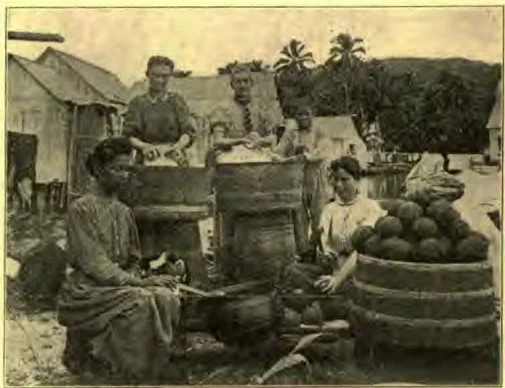
NATIVES MAKING COCOANUT OIL
This mission is in crying need of laborers. Where are those who will bear the third angel’s message to these perishing souls? Shall we save them from the “mystery of iniquity” and from the wrath of God, by faithfully giving them the truth? May the Lord of the harvest raise up laborers for this needy field.