While we know what soap is used for, we do not really know what there is in it which produces the effect it has. An explanation that does not explain is this: Soap, consisting of fat and alkali (lye), removes grease or other dirt by surrendering, when dissolved in water, part of its alkali, which thereupon proceeds to combine with the grease or dirt, forming a new material, or additional portion of soapy matter, which water will readily remove.
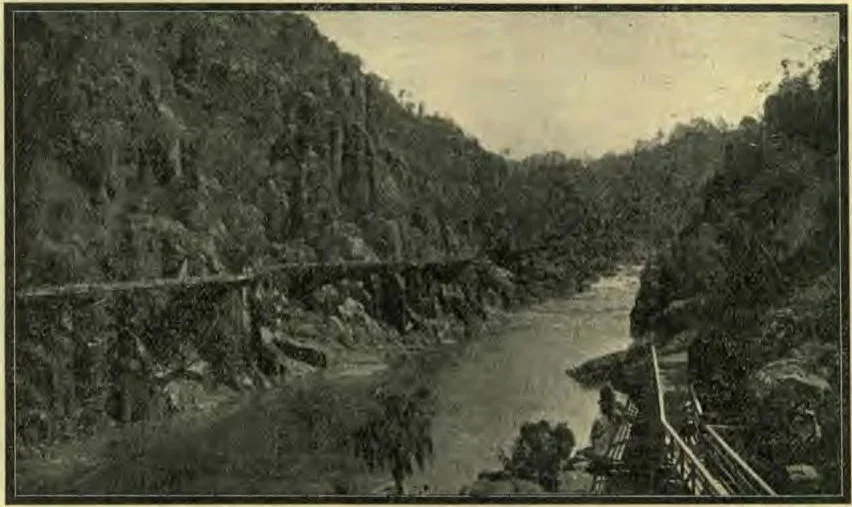
CATARACT GORGE, LAUNCESTON
Soap was made by the Gauls and Germans before the Christian era. According to Pliny, the Germans manufactured hard as well as soft soap while they were yet a wild people. The Romans learned to make it from them, though the Roman ladies used a caustic kind to dye the hair red or yellow. As further proof of its antiquity, there was found in Pompeii (destroyed A. D. 79) a complete soap-boiling establishment.
It is not known that this useful domestic article was manufactured throughout the first seven centuries of the Christian era, but it is probable that it was. There is authority for the statement that in the eighth century there were manufactories in Spain and Italy. About the twelfth century the industry was established at Marseilles, France, which section afforded two excellent materials, olive and soda. Two centuries later the business was begun in Bristol, England, and at London in 1524.
A few figures will show the importance to which soap-making has attained, but of course they do not give an adequate idea of the immense amount of soap made and used by private families. Every family used to make its own laundry soap, and this is continued in hundreds and thousands of neighborhoods. Though one of the essentials of the household, it was made of waste and refuse entirely, and the colonists of two hundred years ago made the family soap as it is made to-day in country homes. All the wood ashes were saved, as were bacon bones and rinds. Lye was made by running water slowly through the ashes collected in an ash hopper, and it and the bones and rinds were boiled together in a kettle, and stirred one way. After a day’s boiling, the soap was finished—a soft, jellylike, clean substance, showing no trace of the grease. About six bushels of ashes and twenty-four pounds of “soap grease” were required to make a barrel. But to the figures: At Marseilles alone more than one hundred and thirty-five million pounds were made in 1872. In 1852 there were made in Great Britain, not including Ireland, more than one hundred and five million pounds. In 1860 more than $6,300,000 was invested in soap and candle factories in the United States, turning out something like eighteen and one half millions of dollars’ worth annually. Since then the industry has of course grown with the importance of the country in which the manufacture is carried on.
Until the beginning of the nineteenth century, soap had been made according to the practise which had grown up in the various localities; but science has had to do with this since that time, the first scientific epoch being the introduction of a mode of making artificial soda by Leblanc, of Marseilles, who supplied that city the want caused by the war with Spain, which cut off the usual importations of barilla. Barilla, it should be understood, is a Spanish plant cultivated for its ashes, from which the best kind of carbonate of soda is obtained.
Many different kinds of materials are used. Tallow, suet, butter, whale-oil, fish-oil, goose grease, horse fat, and many more have been used.
A number of vegetable oils have been successfully tried—olive-oil, linseed-oil, nut-oil, castor-oil, sunflower-seed oil, and palm- and cocoa-oils. Fairly good soap can be made from turpentine, wax, and resin, with alkalies.
It will be impossible, in an article like this, to go into the particulars of soap-making, but the mode of making the celebrated mottled castile soap may be mentioned. It gets its name from the fact that it was first made in Spain, where soap manufacture was very ancient. This mottling is accomplished by keeping the soap thick, so that the dark ingredient, or “nigger,” as it is called, can not fall down through it to the bottom, but has to gather into streaks and veins throughout its substance, the purer and whiter soap doing the same. In case the coloring matter supplied in this way is not sufficient, a quantity of oxide of iron is added.
The manufacture of soap is more largely carried on in Great Britain than in any other country in the world.—Will T. Hale.