THE other day I went into the garden to see if any signs of life were appearing in a bed where seeds had been sown. The cabbage seeds had been in the ground only three days, but the soil was mellow and moist and warm. As these cabbages were intended for transplanting, they were sown “thick” in the row. A canvas cover had been stretched over the bed to keep the soil warm during germination. As I lifted this cover, what an interesting sight was there! Some strong power was lifting the earth along that whole row of cabbage seeds.
When seeds are planted, the ground is usually “firmed,” or packed, over them, as they are supposed to grow better, and the growing plant is held in place by this packed soil. The ground over my row of cabbage seeds was firmed; so, as the life in these little seeds began to spring forth, it was obliged to lift an amount of earth many (I think hundreds of) times the size and weight of the seeds themselves. Have you not sometime seen a heavy lump of earth lifted by a seed growing right in the middle of a hard road? If as great a weight, in proportion to his size, were lifted by a man, the feat would be thought a miracle.
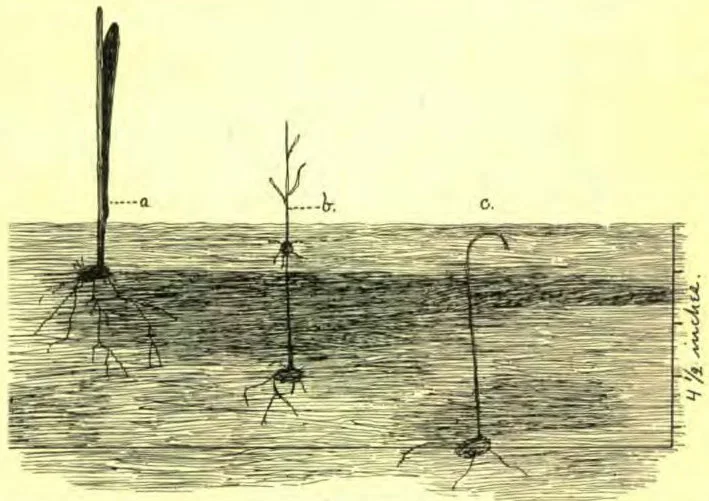
Fig. 9.—Growing Seed of Wheat. Rising toward light. a. Covered at right depth, where sun warms the ground. b. Covered too deep. Exhausts strength in cold soil, also is obliged to send out second set of roots near surface. c. Far too deep. Dies in struggle to reach light and warmth.
Seed represents the word of God, and in the growing seed is power that comes only from God. “The word of God is quick [living] and powerful.” Let us remember, every time we see a plant bursting from the ground, that there is the finger of power pointing to the word which is “mighty to save.” No stronghold of sin in our hearts can stand against this word of power.
The growing seed does not spend all its power at the start. Any one paying a visit to the Michigan Agricultural College may see the living proof of this statement. By the roadside lies a great rock of many tons’ weight. Some twenty years ago it was apparently solid and unbreakable. Look at it now in the accompanying picture; it is split from side to side! A small cherry seed was dropped, probably by a bird, into a slight crevice. The little cherry-tree evidently had rather a hard time to get its start in the world, for you can see it had to press its way across the rock from one side to the other before it could grow straight up. But it did not give up the struggle in discouragement, even if a solid rock was in its pathway. Neither did it get angry because of the resistance with which it met, and destroy itself by fighting its opposer. Silently, steadily, it grows,—first by the power its Maker had implanted within the seed, afterward by the increasing power gained through using what it had at the start.
Though the opposing rock must be broken, the growing seed does the breaking so gently that it succeeds in winning the rock for its friend and protector. What a lesson for you and me as Christian workers! We bring the living seed—the word of life—to plant in human hearts. These “stony hearts” have not yet been changed to hearts of flesh, so they resist the seed. It becomes us to work as patiently and silently as the seed itself, pressing close to the resisting heart until it is broken and won by the love of Jesus.
“Every seed grows, every plant develops, by the power of God.” It is the Creator who puts within the seed its life principle. This seed and this life are intrusted to man for his co-operation in producing “seed to the sower and bread to the eater;” but it is the continual working of God’s power that brings the result. It is our part to prepare the ground by plowing and enriching it, to plant the seed, to till the soil, and destroy the weeds while patiently waiting for growth. While we are doing our part, God does not forget his. The Bible says of the land where God’s people dwell, “The eyes of the Lord thy God are always upon it, from the beginning of the year even unto the end of the year.” I think the Lord is just as mindful of the growing seed. The rain and sunshine, which it must have, come only from him. And here, again, we may be workers together with him. Careful cultivation saves the moisture of the rain, and keeps it longer in the soil for the use of the developing plant. It also enables the sunshine better to do its intended work of promoting growth.
As the Lord invites our co-operation in the growth of the seed, so he invites it in the spiritual growth of the soul. It is “the spiritual milk [R. V.] of the word” by which we grow in grace and in the knowledge of our Lord and Saviour. And we are to “desire” this milk. “As the plant receives the sunshine, the dew, and the rain, so we are to open our hearts to the Holy Spirit.” Look at the plant while the earth is cold and dry, or after a chilling frost. Its drooping leaves seem crying for warmth and moisture. Look again, when the sun comes out after a warm shower. Now its freshened leaves lift themselves as in a song of praise.
Many hearts are drooping in the coldness and darkness of earth. You and I are invited to work with God to lift them into the warmth of his sunlight (Son-light), where they may with joy “draw water out of the wells of salvation.” His tender Spirit pleads, “Son, go work to-day in my vineyard.” I want the living coal, warmed from the altar of love, to touch my lips, so that I can say, “Here am I; send me.” Don’t you?
Seeds are sometimes planted too deep. The earth is cold down there. The seed exhausts its strength before it can grow up through the cold soil into the sunshine. It is obliged to give up the struggle. It dies for the lack of a thoughtful hand to remove some of that cold earth. So “there are many from whom hope has departed. Bring back the sunshine to them.”