THE marvelous blessings of the Lord, which were manifested during the closing months of 1899, continued to mark the work in Matabeleland until the summer of 1901, when it was the privilege of Elder G. W. Reaser, who visited this field, to organize the first church among the Matabeles, with a membership of twenty-nine, twenty-two of whom were natives. He thus describes this event:—
“While at the mission station, it was my privilege to organize a church of twenty-nine members, twenty-two of whom were natives. Of this number, twenty-one were baptized at the time of my visit, one having previously followed the Lord in this blessed rite. There were about three hundred natives present who witnessed the baptismal scene, a number of these being indunas, or native chiefs, who beheld their own children led into the water by Elder Sturdevant, to be planted together in the likeness of our Saviour’s death. Some came from the kraals to be baptized, well knowing that they must endure persecution on their return to their homes.”
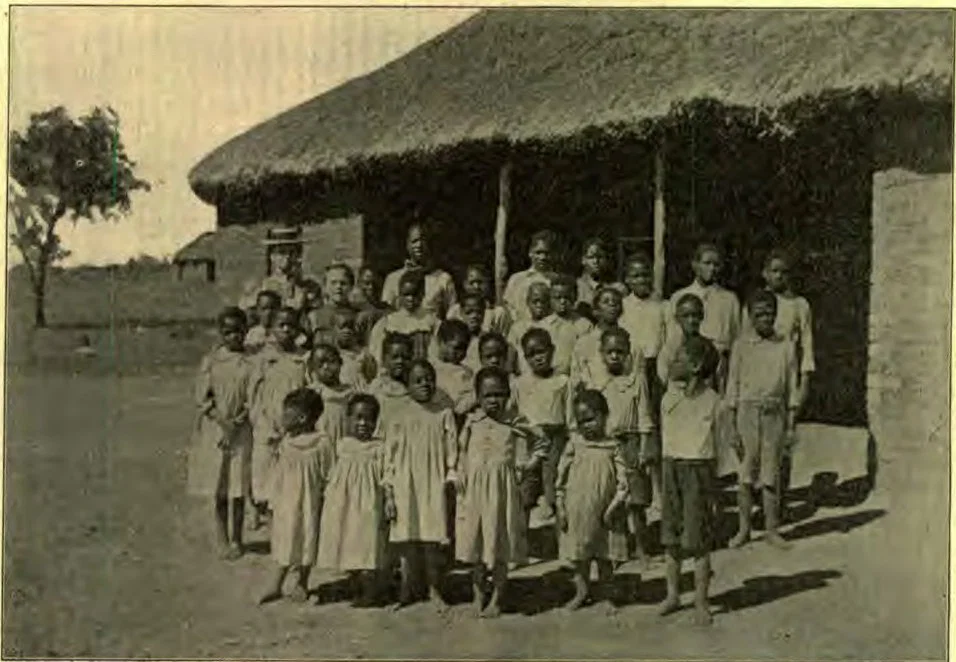
MISSION SCHOOL AT THE FARM
In this connection, the last report from the mission farm will be appreciated:—
“The boys from the kraal were in to the quarterly meeting last week, and report a good work being done. They brought one candidate for baptism; but as we did not know him, we told him to wait until we had a chance to know more about his case. There were also three more with whom we were not satisfied, so we had them wait also.”
“Thirty-one were baptized and united with the church. This swells our numbers to sixty members. Last night I had a good meeting with them. The thought presented was ‘The Church a Force, and Not a Field for Missionary Work.’”
We hope to accomplish much with them this year.
“Our converts are ostracized socially, and made the objects of all sorts of abuse and derision, but thus far they have proved faithful. For this we thank the Lord. Others are inquiring the way of the Lord, and we have more than we can do. There have been love and harmony among us all, and the Lord is fulfilling his promise that if we are one, the world will know that he has sent us.”
The progress that has been made by these native boys is marvelous. It is only a tribute to the mighty transforming power of the Spirit of God when allowed to operate on human hearts. Those mentioned as having come in from the kraal for the quarterly meeting service are boys who, having been trained in the mission school, are now engaged in teaching schools in the kraals.
At the end of the first school year after Elder Mead joined the work in Matabeleland, four young men out of a class of ten went out to work among their own people. Two of them had a school of twenty-five, and the other two had thirty pupils enrolled. They had good success, and rejoiced because they could give to others what had been given to them.
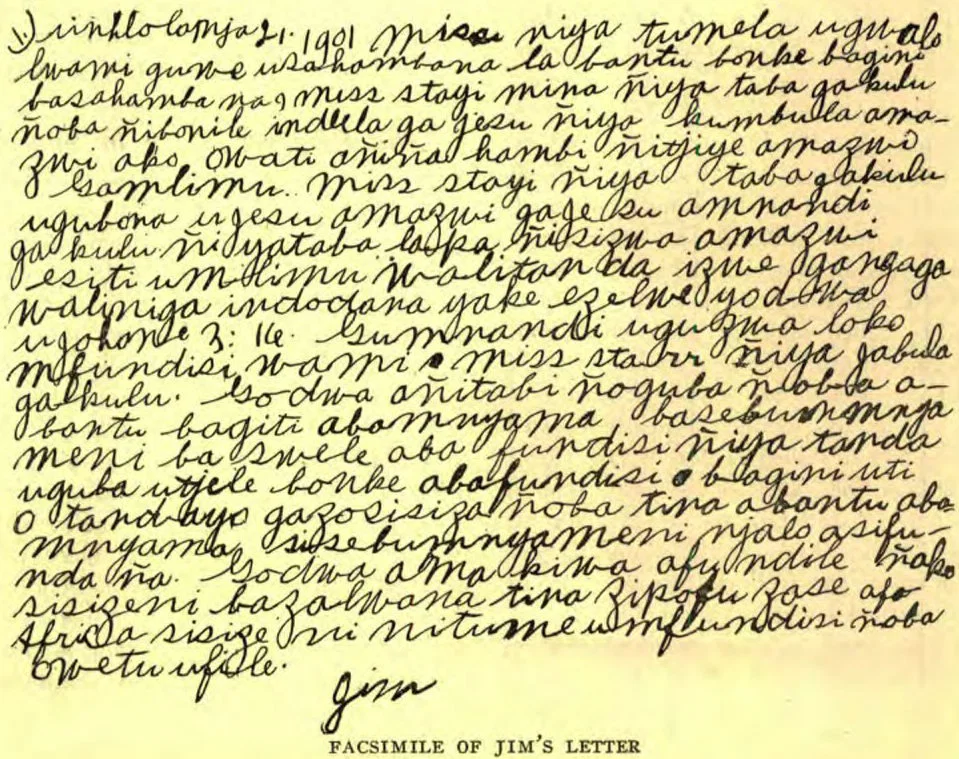
FACSIMILE OF JIM’S LETTER
In October, 1901, the hearts of our people not only at the mission farm, but all over the world, were made sad by the death of one whom God had chosen to hasten the message in this dark land. Elder F. L. Mead, when apparently in health, was suddenly called to lay aside his burdens and rest a while. But the work which God used him to strengthen in Africa continues. Soon after his death, which occurred at Kimberly, when he was on the way to the conference to be held at Cape Town, one of the boys at the2mission farm wrote to his former teacher, who had been compelled to return to her home on account of failing health:—
“To Miss ——, from Jim. Miss: I send my letter to you. Are you well and all the people at your home are they well? Miss ——, me, I am very glad because I have seen the path of Jesus. I remember your words which said, ‘If I go I leave the words of God.’
“Miss ——, I am very glad to see Jesus. The words of Jesus are very sweet. I am glad when I hear them, the words that say, ‘God so loved the world that he gave his only begotten Son.’ John 3:16. ’Tis sweet to hear that. My teacher, Miss ——, I am very happy, but I am not glad because the people of our home, the blacks, they are still in the dark; they need teachers. I wish you to tell all the teachers at your home, you say, Him that likes, let him come and help us because we black people are in the dark, also we have [or are] not learned. But white people have learned, and by that, help us friends. We of Africa are blind. All help us. You [people] send a teacher because ours is dead.”
“JIM.”
He also referred to the death of Elder Mead. When Jim came to the mission farm, he could neither read nor write; but he had an earnest desire to learn to do so, that he might teach the black people around the mission. After working hard all day, he would spend his evenings in study. He never grew tired of his books, nor had any idea how late he was studying, so he would have to be told. The gospel has thoroughly changed him.
JIM
The presence of Jesus has made a difference in his every-day life. The sweet regard with which he speaks of the words of Jesus certainly gives evidence that he has experienced something of the power of these precious words in his life. Besides helping the missionaries, as teacher, preacher, and general standby, Jim assists in the home school in the morning, and goes out to teach in the afternoon.
We are glad to report that Jim’s plea for a teacher was answered in the sending of Elder Sturdevant and his wife, of Georgia, to that field. They are most happy in their work, and feel that they are where the Lord wants them.
What the gospel has done for Jim and many others in our schools, it might do for millions more, if it were carried to them. There is a population of seventy million in Africa, and only a very few have been reached by the message of salvation, and fewer still have ever heard about the near coming of our Saviour.
Just as we finish this little outline of our first mission station among the heathen peoples of the Dark Continent, the appointment of other laborers for this field is under advisement. So many opportunities have been lost for lack of help, that our hearts rejoice to know that God’s chosen people are arousing to the great privilege that awaits them in carrying the last message of mercy to the many peoples who sit in darkness and the shadow of death.
To the young people of our ranks, especially, is this privilege offered. “Lord, what wilt thou have me to do?” should characterize every plan for the present and the future. Soon a large company must be hastening to the ends of the earth, for the coming of our Saviour draws nigh. The Master calls, “Whom shall I send, and who will go for us?” Shall we respond, “Here am I; send me”? ESTELLA HOUSER.