Beginning the Journey¹
The halo of romance which once encircled even the very idea of missionary labor among the heathen is now gradually disappearing, and in its stead the real facts—the condition of the people and their needs, their response to missionary effort, and the wonderful transformation which the gospel has made among them—are leading earnest Christians to devote themselves to this most interesting work. The dark continent of Africa has long appealed to Christian people, because of the dense ignorance and superstition that abounded, and the wretched condition of the natives, as a result of the slave trade and liquor traffic, for which the white man is responsible.
Our first mission to the heathen in this continent was practically begun on May 7, 1894, when five brethren in South Africa were finishing the preparations necessary for a journey which they were to begin the evening of that day. All was interest. For some time the Foreign Mission Board had contemplated the starting of a mission in Central Africa; and when the Chartered Company obtained control of Matabeleland, the way was opened, and the opportune time seemed to have arrived. The South African Conference kindly gave five hundred pounds to the enterprise.
At the close of the day the little company of Sabbath-keepers in Cape Town met at the church for consultation and prayer, before good-by was said. As they sang “God, Be with You Till We Meet Again,” tears dimmed the eyes, and sobs choked the voices; yet hope and courage filled the heart of every one; for all were confident that the Lord was leading those who were to go, and that he would abide with those who remained behind. Nearly all the congregation followed the party to the station; and even the trainmen were interested in the journey, and wished them success.
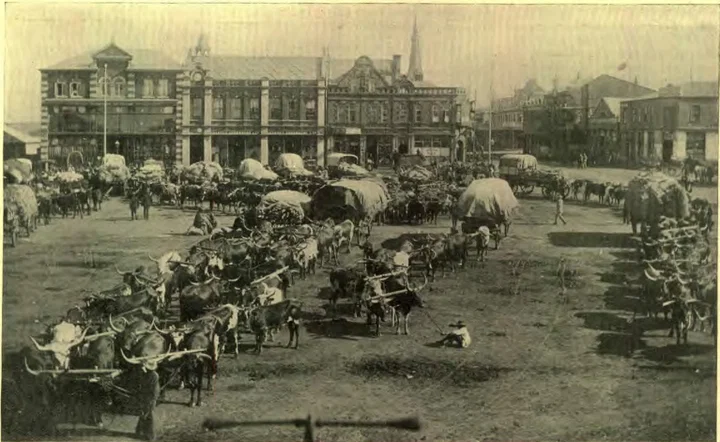
At 9 P. M. the station bell rang. The last good-by was spoken, and the party, consisting of A. Druillard, F. J. B. Wessels, F. Sparrow, E. J. Harvey, and L. Gopp, were on their journey.
After a ride of two nights and one day on the train, they reached Beaconsfield, about six hundred and forty miles from Cape Town. The company of the brethren and sisters from that place met them at the station, wishing them Godspeed. About four hours were spent in purchasing necessities for the journey, and in attending to other business matters, and they were again on their way.
The next stop, at 9 P. M. Wednesday, was at Vryburg, one hundred miles farther on, where they made a stop of one hour at the Vaal River diamond mines. Here they saw many searching for earthly treasures. During this part of the journey they passed through some of the richest diamond fields in the world. As the train was going no farther, they remained in the car overnight. At six o’clock the next morning the making-up of the train for Kimberley was begun, as Vryburg was the end of the road, and our brethren had to make quick work of leaving the train. Their farming implements, two wagons, supply of foods, together with the mules and ponies, attracted much attention. But as soon as the people learned that they were on their way to Mashonaland to teach the natives, they became interested, and spoke kindly, wishing them success in their mission.
They were compelled to remain here several days, until the arrival of the rest of their goods, which had been sent by freight, and were delayed by an accident to the train. After an almost hopeless search for a room in which to sleep, they were about to arrange to camp inp. 226 the street, when a customs officer, learning of their mission, kindly gave them a written request to the station-master, asking him to permit them to occupy a room adjoining the station. The latter had told them again and again that there was no room which he could let them have; but on receipt of the note, he gave them a very comfortable one. This customs officer aided them in many other ways. They remained here six days, and spent a part of two days looking for bullocks. As soon as it was known that they wanted to buy, the price of these animals doubled. A Christian native, learning of their desire, told them that his chief had some bullocks to sell, and through him they were able to get just what they wanted. On Sabbath, their first from Cape Town, they held a Sabbath-school and meeting. The next day they began to gather up their freight, which had arrived Friday. They were disappointed, however, to learn that Monday was a bank holiday, and they would have to remain at that point until Tuesday, as it would be impossible to persuade the railroad men to let them have their goods on a public holiday.
Finally everything was prepared, and they were ready to proceed, when they learned that they would be compelled to secure a permit from the magistrate, before they could take their guns and ammunition with them. The written petition had to go first to the governor, and this was supposed to require two days. Seeking the help of the Lord, they decided to go to the house of the governor personally, and tell him who they were, and what they desired. In this they were successful beyond their expectations. He was very kind, took the number of their guns and the amount of cartridges. He laughed heartily when he saw the small amount of ammunition they were carrying, and advised them to take a larger supply. But as their armor, weapons, and ammunition were to be the word of God, they did not take the governor’s advice in the matter. It seemed that he had read of our work in America, and was much pleased that we were ready to enter this new country so soon. He wished the brethren Godspeed, and advised them to settle near Buluwayo. In less than twenty minutes after they had seen him, the permit was ready, so that everything could be passed through the customs, and at 4:30 P. M. on Tuesday they started from Vryburg, glad to be once more on the road.
They drove about ten miles, and outspanned at seven o’clock, letting the horses and mules and oxen feed for three hours. They then inspanned again, and traveled until eleven o’clock, when they stopped for the night. After worship, in which they committed themselves to God, believing that he had sent his angels to guard them, they were soon asleep. At two in the morning they again began their journey. Soon after starting, they drove into a mud-hole, and worked until seven o’clock before they were able to extricate themselves. At nine they stopped for breakfast and fed the teams, and then reloaded their wagons, as they found from their experience in the early morning that the wagons had been too heavily loaded. At three in the afternoon they were again on the road, and traveled until nine at night. The roads were heavy with sand, and the land was very poor; but they had plenty of water, such as it was, for it was full of insects. And thus they went on, traveling at night, and letting the teams eat and graze a part of the day.
On Thursday morning they had a little meeting with three Dutch farmers. One had read “Thoughts on Daniel and the Revelation,” and said that he believed the seventh day is the Sabbath.
That night in crossing a stream they broke the tongue of their mule wagon; but, equal to the emergency, only a few minutes was required to transform their tent-pole into a wagon-tongue.
They traveled all the next day without finding water. As it began to draw toward the Sabbath, they were all very tired and thirsty, and became anxious to find water, where they might camp and pitch their tent. Just as the last rays of the sun were going down behind the distant hills, they came in sight of a small stream trickling here and there from under the stones in the sand. This called forth a shout of joy; and in less time than it requires to write it, six mules and two horses were in the water, drinking as only famished animals can. But to the dismay of the brethren, a man soon appeared upon the scene, and ordered them away, making them pay four shillings for the water the animals had drunk. It was no use to beg him to permit them to stay near the stream, as he would have required them to pay more money than they felt they could expend in this way. So they had to start on their journey again.
ESTELLA HOUSER.