“Good morning, Doctor! what brings you here this morning? None of us are ill.”
“O, it is the Nyassaland Mission. The women of Africa are in need of clothes, and do you not remember the promise made Mr. Booth when he told us about them?”
Indeed I did remember that, for my own part and also the children’s, we had offered to do something for those poor women who will walk miles and miles to get something to wear. The preaching of the gospel has just this influence upon people,—it leads them to change their garments. Even the heathen, who often, among themselves, are contented with nothing but a string of beads to cover their nakedness, are glad to put on the simple clothes which Christianity provides.
“We already have on hand a small mission fund of about twelve dollars; I am certain that our boys and girls will be glad to give this money toward the work. How many clothes do you think it will provide?”
“Let me tell you our plan,” said Dr. S——. “There are ten districts in our church in Battle Creek, and each one ought to have a set of garments for patterns. Let us read this letter from Sister Booth; you will see from it what garments we ought to make:” —
“LONDON, May 16, 1902.”
“Dear Mrs. Prescott and all the Sisters of the Battle Creek Church: “Though we have never met, and clasped each other’s hands, yet we need not feel strangers to each other; for are we not one in faith, in purpose, and in a desire to be banded together, that by us and through us and in us the Lord’s will may be done, and the advent message be carried throughout the earth? The very kindly welcome given us by Dr. and Mrs. Waggoner and others of the brethren and sisters here assures us that this is so; and as the days go by, though we may not look into each other’s faces, still may we not come to know each other by correspondence?”
“I wish to take this opportunity to speak of the clothing for the natives,—in particular that of the African women,—this being a part of the work in which I trust all the sisters will take a deep interest.
“The calico or muslin loin-cloth, with the sash and simple waist or blouse,—in all cases made with short sleeves,—is intended to take the place of the goat-skin or girdle of bark cloth, which is the only covering of the great majority of African women.
“The samples sent by Elder Spicer [Elder Spicer went to New York City at the time the Booths sailed] are intended to give a general idea of what is needed. The waist-cloth is always the same, not to be joined round as a skirt—simply left to wind round the body. These may be in different sizes, the smaller ones being useful for the children. A garment much like a child’s nightdress, with or without a yoke and with short sleeves, is also needed for the little girls. The boys wear a loin-cloth and a little vest or shirt, when they are fortunate enough to get one. . . . Good, strong shirts in all sizes are always needed.
“It would be well if the Dorcas societies would enter into this work with real good will, and go right on till enough garments are ready to fill several good-sized boxes or barrels. We can never have too many.
“Yours in Christian bonds, “ANNIE S. BOOTH.”
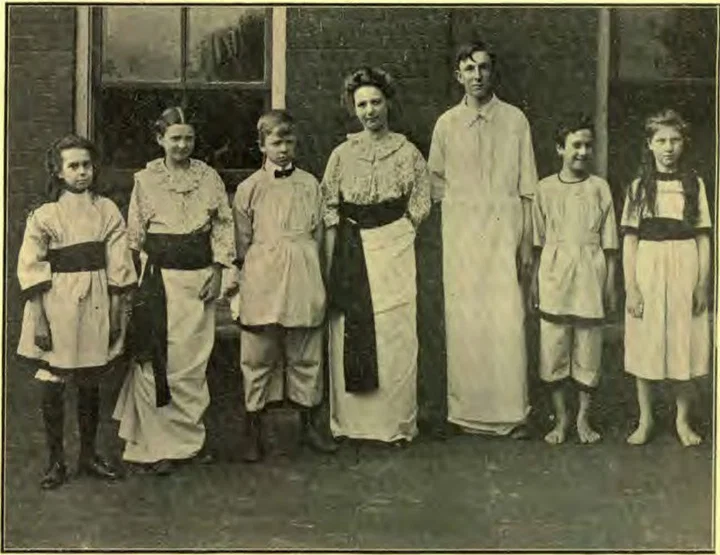
The letter was plain enough. A little girl’s dress, a small boy’s shirt and trousers, a woman’s sack and loin-cloth with sash, and a man’s shirt and loin-cloth,—these were the garments suggested, eight pieces in all, and costing not over two dollars. Just think, a family of four clothed for two dollars!
Well, we went to work. Twelve dollars was not enough, so we asked for more. Our funds finally amounted to about eighteen dollars, and this bought our cloth. Sixty yards of sheeting for the loin-cloths, fifty yards of unbleached muslin for shirts and little girls’ dresses, thirty-five yards of seersucker for the boys’ trousers and shirts, thirty-five yards of pink calico for the women’s sacks, and fifteen yards of turkey red for trimming,—this was indeed a lot of cloth for school-children to make up, and that during the closing days of school!
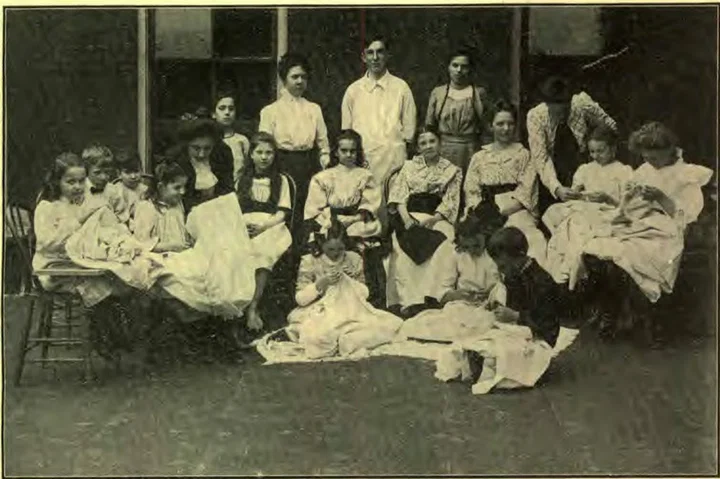
Of course this work made a change in our program: we could not sew and recite too. Therefore we sewed for two whole days. The loin-cloths were turned over to the little people. There were twenty of them, each three yards long and a yard and a quarter wide. The children turned the hems and basted them, while one of the small boys, whose mother had taught him to use a machine, stitched them. Every boy and girl in the school had a hand in this work. Some cut out the garments; others basted them together and stitched them; while still others finished off, hemming, overcasting, and making buttonholes.
“Do you think there will be enough clothes for them all?” asked Helen, one day, as we were sewing. Before I could answer, there flashed into my mind a glimpse of our high commission, “Go ye into all the world, and preach the gospel;” and as I thought how abundant and free the gospel is (surely “freely” we have received, and freely, too, we should give), I answered, “Yes, indeed; there will be enough clothes for all those dark people who accept their Saviour.p. 230 What we lack, some one else will make up,—and get the blessing, too!”
Two days by no means finished the work. In all, there were seventy-five garments to be cut and made, and even at close of school there was still much finishing to do.
The work was indeed heavy; but the children were willing, and “many hands made light work.” Early they came, and late they stayed, to sew on the Nyassaland Mission garments. For one week nearly every morning two or three children were on hand as early as half-past seven, and we seldom finished work before six at night.
We could not have done the work without our boys; they indeed filled a good place. As for their sewing,—just come and see for yourselves. It is better than many girls can do. During the first term of our school year all the boys learned to sew, and now they have given us a good return. Of course they did not all like sewing at first, and some even never really thought it just the thing for boys; but when the Nyassaland Mission demanded their help, who was going to stand back?
Sometimes we forget our privileges and do not see our opportunities. Nothing of the whole creation liveth unto itself, except the selfish heart of man. Every tree, every shrub, gives its life to God’s creatures. Even the life-blood, as it courses through the body, does not stop to nourish the channels through which it flows, but hastens on to other parts, afterward to return and give to the vessels which carried it. “Cast thy bread upon the waters, for thou shalt find it after many days.” ONE OF THE TEACHERS.