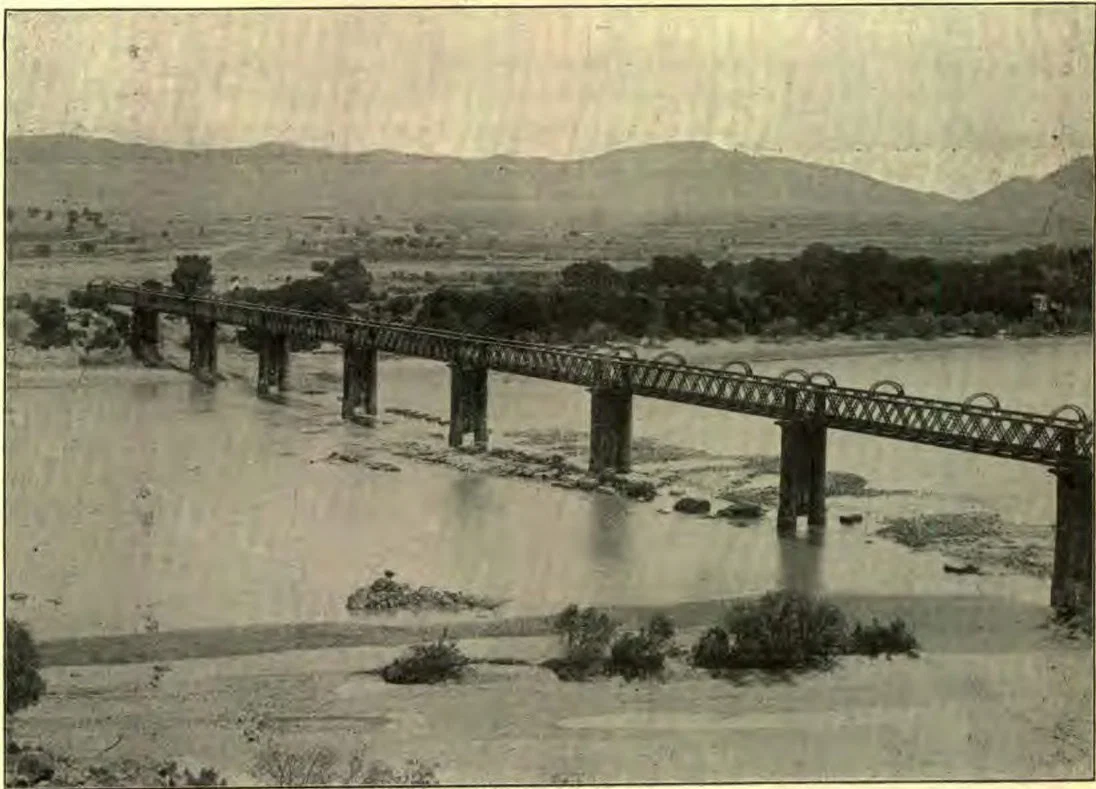
It was with an experienced Basuto driver and a South African “buggy,” in times of peace and under the most favorable circumstances for observing the life of the land, that I made this journey through the Boer Republic. Having spent a number of weeks in the vicinity of Aliwal in 1894, I felt less a stranger when I went again to that border village in September, 1898. Aliwal is a quiet country burg, lying on the south bank of the Orange River, where it forms the boundary-line of the very southernmost point of the Free State. Being the railway terminus, it holds some importance as a trading centre between Cape Colony, Basutoland, and the Free State. It is also something of a health resort, having warm mineral springs and a pleasant climate.
The river here cuts deep into the sandy soil between the hills of the Free State on the north and the Colony on the south. The high river banks are joined by a splendid span named “Frere Bridge,” after Sir Bartle Frere, one of the early English governors of Cape Colony. Aliwal lies scattered along the south bank above and below the bridge, while on the Free State side there is only a little square sheet-iron shanty, inhabited by the lone customs collector. From the shanty at the north end of the bridge there is a gradual ascent to the westward, reaching up to the plains and high hills through which the Orange cuts its way. After crossing the bridge the road to Basutoland climbs over a rocky bluff to the eastward. In sight of this road, a mile or more above the village, stands a stone gristmill, with its mill-race and turbine, while farmhouses occupied by Dutch and English are seen here and there on each side of the river.
It was only natural that the Boers should seize this convenient border village, which they did soon after the war began. From here they pushed on south through Burghersdorp to Stormberg, where a few hundred of them dealt such a signal blow to the British under General Gatacre on the tenth of December, 1899. Aliwal was left by the Boers only after the relief of Kimberley and Ladysmith, having been held by them four months. Though having ample time to destroy them, the Boers left both the village and the beautiful Frere Bridge undamaged to the advancing British army.
One bright morning a little more than a year before the thrilling scenes of this war began, I was hurrying around the quiet streets of Aliwal securing the provisions necessary for the long journey into Basutoland. It was nearly nine o’clock, and I had directed my friend Kalaka, the driver, to go on over the bridge, where I would overtake him. Crossing the smoothly flowing river on this still September morning, one could not but feel the impressive peacefulness of the place,—the village behind, the farmhouses above and below, the mill and the river, all uniting to form a picture of calm content. There had been no recent heavy rains, so only a little stream wound its way along through the wide river-bed sixty feet below the solid roadway of the bridge.
I was soon on Free State soil, and in a few minutes’ time, while talking, we were ready to start. Our “buggy” was simply a cart with two wheels, heavier and stronger than those of an ordinary lumber wagon, strong springs carrying the box with its single seat, and a tent top, which was not raised on this trip. My bicycle was fastened to the rear of the cart, and my satchel strapped onto a small rack behind the box. Several little sheaves of oats fastened against the inner side of the dashboard served to balance our cart so that the tongue would not weigh too heavily upon the necks of the horses. Our two gray Basuto ponies, though in bad flesh on account of the continued drought, were tough and sure-footed.
THE ORANGE RIVER BRIDGE
From Aliwal through the southeast corner of the Free State the road makes a constant ascent, leading directly up into the Maluti Mountains of Basutoland, which are among the higher ranges of the Great Draken Berg. This part of the Boer State is hilly, and, like most of South Africa, treeless. Small bushes grow here and there; and in dry seasons, sheep and goats, kept here in large numbers, feed upon the leaves. The soil is fairly good, being a reddish or dark, sandy loam. But for the irregularity of rains and the abundance of locusts, fine crops of wheat and other grains might be produced. As it is, one rides for miles over naked hills and plains, possibly seeing one or two little patches of wheat or barley where a fountain is found. The following lines illustrate well the prevailing barrenness of this land:—
“Where neither tree, nor cloud, nor misty mount
Appears to refresh the aching eye;
But the barren earth and the burning sky,
And the blank horizon round and round,
Spread — void of living sight or sound.”
The roads are made by one wagon following another over the veld until the trail becomes slightly smoother than its surroundings. Anthills are crushed by heavy wagons, and stones remain where nature placed them, to be hit or missed according to the vigilance of the driver. Three hours of traveling after this fashion brought us within sight of Rouxville. As we approached from the hilltop two miles distant, the sight of this little village with its tall poplars and willows was cheering indeed. It stands alone in a wide-spreading valley, and has no protection, natural or otherwise. No Boer commando would ever attempt to hold this dorp against a superior force, its threescore houses being entirely at the mercy of an enemy. However, it will be historic; for it has been taken, retaken, and taken again, being now occupied by the English, after being twice forsaken by the Dutch.
Dining here, we hastened on, leaving the post-road for a shorter cut, toward Bushman’s Kop, some thirty miles distant. An hour brought us to the first mountain, extending for several miles along the course of our journey. Fatherly old Kalaka had many stories to tell of the time when this mountain and all the district around it were taken away from the Basutos by the Boer farmers. In the valley through which we were now passing, the road began to be cut by the deep dongas eaten into the yielding soil at the foot of almost every mountain and across the plains right down to the bank of all the rivers in South Africa. With perpendicular sides, eight, ten, or even twelve feet in depth, these holes make the2country exceedingly difficult to cross, and render a night journey most unpleasant and dangerous.
Living on our road was a French family whom Kalaka had known for many years, and at their home we hoped to find lodgings for the night. At nine o’clock we drove into the large grove of willows surrounding the farmhouse, and were soon made welcome by Mrs. Bisseux and her two manly sons. This family are old residents of the Free State, being descendants of early French missionaries. Receiving every kind hospitality that night in her home, the following day’s travel over miles of prairie-like hill-country brought us at sunset to Bushman’s Kop. This place has only a country store, a blacksmith shop, and a sort of wayside inn. It gets its name from a commanding hill once inhabited by some of the Bushman race.
From this place the traveler has in full view the serried peaks of Basutoland, called the “Switzerland of South Africa;” and the chilly air, even of a September morning, reminds him that he is nearing a region of snows. The last few miles of our journey were rougher than what had preceded; and as we started up a long incline toward a ridge where a man and several boys were plowing, we noticed two road tracks, one on the right appearing preferable. Some small stones were laid across the right-hand track, and the driver, avoiding the stones, chose this side. A wire fence stretched along the top of the ridge, with a gateway across the road. The plowmen were beyond the fence at the left. As we were about to open the gate, we were met by these men, who quietly explained in Dutch that we were trespassing by driving on the veld, and must wait until the owner was sent for. Our protestations of innocence were in vain, and the determined look on the face of this sturdy Dutchman gave us to understand that we must settle with the owner, who, we soon learned, was the landrost, or sheriff, of that district.
To avoid unnecessary delay, Kalaka, who could speak Dutch, proceeded to the sheriff’s, a mile or more over the hills, escorted by one of his young sons, who was among the plowmen. An hour later he returned, poorer by a five-shillings’ fine. From this place a few minutes’ drive brought us to another fence, where stood a little corrugated iron hut, guarded by a native customs collector, who wore as black a face as men have even in Africa; and here we passed out of the Boer Republic into the land of the Basutos.