The Robin's Food

6%

Review and Herald Publishing Company · Battle Creek, Mich. · March 27, 1902

FromThe Youth’s Instructor, Vol. L, No. 13

Read the full edition

The Robin's Food

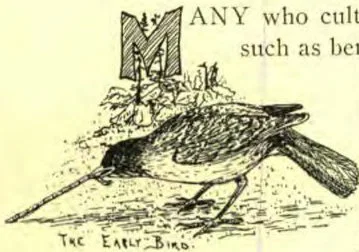
MANY who cultivate small fruits, such as berries, grapes, cherries, and the like, are greatly prejudiced against the Robin, thinking the bird destructive to their crops.
But, as a matter of fact, fruit forms but a small part of the Robin's bill of fare, and whatever he does eat, he more than pays for by the large number of injurious worms and insects he devours. All through the spring, when the insects are at work to do our fruit and vegetables all the damage they can, Mr. Robin spends most of his time catching them. He eats a great many himself, and besides there are the little ones to be fed.
And what a quantity the little birds seem to need! How many worms do you think a young Robin will eat? One man experimented on some Robins he had captured, and he found that each bird required sixty-eight worms a day. If these worms were laid end to end, they would make a line fourteen feet long! If we were to eat as much in proportion to our size, it would be necessary for us to devour seventy pounds of meat a day, and drink five or six gallons of water.
The Robin eats bugs, spiders, earthworms, many grasshoppers, crickets, caterpillars, and even wasps; he destroys the March-fly larvae, so injurious to the grass in the hay-fields, and will also eat the army-worm. We ought to allow him a few cherries and apples in return for all his useful work; but he will eat much less of the cherries if you will provide a few Russian mulberry bushes, whose fruit ripens at about the same time as the cherries, and which Robin and many of his friends dearly love. Professor Bruner has well said: “He is a poor business man who pays ten dollars for that which he knows must later be sold for fifteen cents or even less. Yet I have known instances where a Robin, which had saved from ten to fifteen bushels of apples, worth a dollar a bushel, by clearing the trees from cankerworms in the spring, was shot when he simply pecked one of the apples that he had saved for the ungrateful fruit-grower.”
Although over half of the Robin's food in summer is made up of bugs, insects, larvae, etc., he is also particularly fond of wild fruit; and where there are plenty of wild berries, he will linger as long as they last. Indeed, if there are enough of the dried berries for the winter, he will not go South at all.
Robins become very tame if well treated. A family in Michigan observed a pair of these birds which nested close to their house for fourteen years. It was plainly to be seen that they were the same birds; for they were very friendly with the family, but not so with strangers. One day a man passing the house picked up one of the young birds just out of the nest, which was fluttering about on the ground as a young Robin will. The moment he picked up the young bird, the parents uttered loud cries of alarm and distress until they had brought all the Robins in the neighborhood to their assistance. They scolded, and cried, and flew at the intruder, who, as they thought, was trying to rob them of their baby. A member of the family heard the noise, came out of the house, claimed the Robin, and the man handed it over. As soon as the little bird was in the hands of the person they knew, the birds ceased their cries. Not only the parents of the bird, but all the Robins, seemed to understand that the little thing was safe.
Description.—Upper parts blackish-brown; under parts reddish-brown; throat striped black-and-white; corners of tail white. Length, ten inches.

The Cardinal Grosbeak

Another interesting bird which may be seen in winter as far north as New Jersey, Ohio, and part of Illinois, is the Cardinal. In my part of the country he is usually called by the simple name of Redbird. By some, I understand, he is called the Virginia nightingale. He is to be met with all over the Southern States, and as far north as southern New England and New York. He is quite common in central Illinois. He is a beautiful bird, easily seen for his brilliant plumage, which is of a magnificent red color. He has a conspicuous crest, or topknot. The throat is black, and there is a band of the same color around the beak. His mate is much duller in color.
Although easily seen, the Cardinal knows pretty well how to take care of himself. I have followed the bird for many a mile, trying to get one good glimpse of him through an opera-glass; but he was afraid of me, and I could not get within gunshot of him, though I had no gun, and sought to do him no harm. But at Jerseyville, where birds seem to be well treated, I have observed him often; and several times in Springfield he has alighted quite close to me, and poured forth his melodious song.
When nesting, the Cardinal is said to be something of a fighter. If a snake comes about, he rouses the whole neighborhood of birds, bringing them to help defend the nest. They will fly at the snake with loud cries, and even attack it if it does not leave.
But wary as the Cardinal is, he will become quite tame if well treated. A lady once had one of these birds in a cage with a pair of the little green parrots called “love birds” from their habit of putting their bills together as if kissing. Apparently the Cardinal did not approve. After watching the loving little birds a while, he seemed to lose patience, and dashed right down between them, driving them apart. Then he went back to his perch. This he kept up; and whenever the two parrots began their caresses, down the Cardinal would drive again. He never disturbed them at any other time, or about anything else, but that one thing he would not tolerate.
The song of the Cardinal is a “rich, rolling whistle,” impossible properly to describe. He is a great singer. Some birds sing only during the nesting season, but the Cardinal sings all through the year. When, during the summer, the mother bird broods upon the nest, he often sings to her by the hour, and at the same time sees that no harm comes near. And when bleak winter has come, he still sings his merry notes. More than once, when the afternoons were sharp and biting cold, just as the day was fading, I have heard his clear, merry whistle. It plainly said to everybody, “Three cheers! three cheers! three cheers!” Cold weather could not make him gloomy; he was not worried; he was singing. God give me freedom from care like the Grosbeak. God give me a mood to make well of things as he does. And God help me to face drear aspects with a heart as glad as his, and a tune as cheery.
L. A. REED.