THE following interesting description of the way the world’s time is accurately determined is taken from an article by W. S. Harwood, in St. Nicholas for January:—
While we know a good many things about the mysterious in our modern life, yet perhaps many do not know much about one of the very common acts of their life—the setting of their timepieces. Whenever you are in doubt as to whether your watch is keeping good time or not, you set it by a star. You might have a sundial, and try to set it by that, or you might have an hour-glass, and let the sand run in and out of its cone-like sections, or you might try to keep your timepiece in good running order by the rising and the setting of the sun, as recorded in the almanac; but any one of these methods would, in these days of precision, be apt to throw you out of gear with the rest of the world. You couldn’t catch trains on such time, and the tardy-list in the schools would be black with names if boys and girls attempted to go to school on such time as this.
No; you must set your watch by a star, if you wish to be up with the times these days.
Out of the vast number of stars in the heavens, and visible to the eye at night, and out of the much greater multitude that celestial photography is bringing forth on its negatives, there are some six hundred that may be depended upon, stars that have so long been watched by the astronomers that they are known to be practically invariable.
For about two centuries most of these six hundred stars have been under the critical eyes of the astronomers, who have measured their exact places in the skies again and again. It has thus come to be known that these stars cross the meridian of any place at certain times every night. The meridian of any place is the line the sun crosses there at noon—an imaginary line from pole to pole, directly overhead, dividing east and west. The times when the stars so cross the meridian are predicted by the astronomer years in advance, and tables are made which are exact to a small fraction of a second. After the astronomers, through long series of years of testing, found this out, it occurred to somebody that here was a perfect test for timepieces.
It is three minutes to nine o’clock at night. The official in charge of the Goodsell Observatory, Northfield, Minnesota, is preparing to send out the time to the people living in his section of America. For sixty seconds he rattles away on a telegraph instrument at his desk, spelling out the word “time, time, time;” then he waits an instant. Then he turns to his telegraph-key again. Eleven thousand miles of wire are open to him; he is ruler of them all. Every telegraph-instrument in all the vast territory of which the Goodsell Observatory is the center is silent; every operator has taken his hand from his key; throughout the whole length of these thousands of miles there is a strange silence.
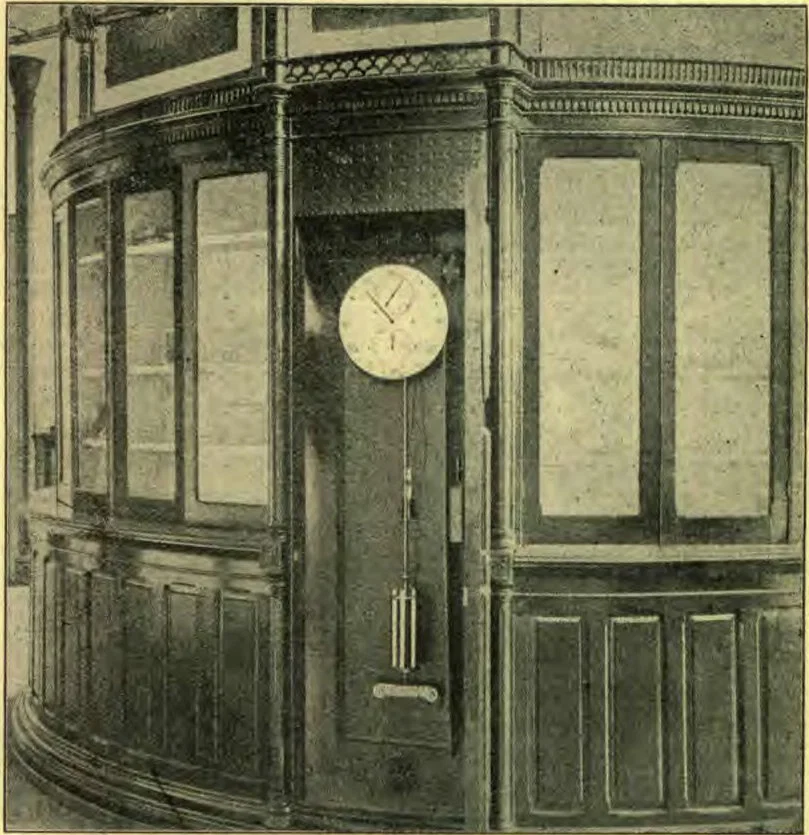
The seconds are slowly ticking away. Above the head of the observer there is a great observatory clock. At precisely two minutes to nine, the wires are switched into a connection with the very clock itself, and all along the eleven thousand miles there is no sound but the tick, tick, tick of the observatory clock.
Something strangely solemn is in one’s thoughts as he stands beside the observer amid the silent seconds while the clock ticks on. Whoever is listening at the wire along its course, waiting to set his watch, whether he be a railroad employee, or some man in a large jeweler’s establishment, where the people go to get their timepieces regulated, knows the system, and knows that there is a sudden pause just before the exact stroke of nine o’clock—a broken beat in the ticking. Then all carefully note their timepieces as the clock in the observatory ticks the nine-o’clock second. They can tell to the second whether their watches are fast or slow or precisely right.
But the best-made clock in the world is not infallible; even our splendidly constructed observatory timepiece has its faults, and so somewhere there must be something to regulate even the regulator. This “somewhere” is the silent clock-setting star in the far heavens,—something that never changes, that has no shadow of variations amid the changes of earth, a second-hand on the dial of God. The astronomer picks out a star chosen from the six hundred. He knows by his catalogue the exact moment the star sweeps over its meridian at a certain time of night. The star has been on time, to the hundredth of a second, these many centuries.
Going into another room, the observer sits down at a telescope of medium size—perhaps five feet in length. It is so mounted that it can not be moved, like one of the great telescopes, but must always be pointed directly at the meridian, through a narrow slit in the roof of the observatory. In the telescope, just back of the eye-piece, is a series of very fine, thread-like wires. The observer has no step-ladder tall enough for him to stand on its top and draw a chalk-mark across the sky, a meridian line for the star to cross, so he must have these wires inside the telescope, serving the purpose of lines on the sky. There are eleven of these wires, and the middle one is the exact meridian—when the star crosses that line, it is the precise instant of its meridian time, the time to a hundredth of a second which is recorded in the catalogue of stars.
The observer holds in his hand, as he sits below the telescope, the telegraphic key attached to a long wire running out into another room, where the wire is attached to a little instrument called the chronograph, that is, time-writer. The chronograph has a cylinder about a foot in length and perhaps six inches or so in diameter. This cylinder is covered with white paper, and when you look at it, you see many lines on it all running parallel to one another. Attached to a tiny framework is a fountain-pen, the point resting on the paper. The cylinder slowly revolves, and as it does so, the pen traces a line upon it. This line would be straight all the way around but for the fact that an electric connection is made with the clock, so that every second time the clock ticks it jars the pen, or interrupts it in its course, and it makes a little jog in the line.
THE OBSERVATORY CLOCK THAT TICKS A MESSAGE FROM A STAR
The clock was set the night before, by the star when it crossed the meridian; but, for one reason or another, it may have lost or gained the fraction of a second. The observer at the eye-piece of the telescope watches the oncoming star with the very closest attention. The instant it comes into his field of vision, just as it begins crawling across the wires, he gives a squeeze to the telegraphic key. At the moment of this squeeze the fountain-pen, attached to the key by the wire, gives a tiny jump, and makes a slight bending in the line. As the star crosses each wire, the observer presses the key, so that there are eleven indentations made as the star crosses the field, and passes out of sight on its celestial way. It has not been stopped a fraction of an inch in its journey through space, but the observer has timed it in transit, and no matter how fast it may have been fleeing through the heavens, it has yet been closely watched by the man at the telescope until he could record its movements. As the star passed the sixth wire, the pressure for that line, its meridian line, registered the precise fraction of a second at which the star crosses the line. Then, as the clock has been marking its own time off on the cylinder second by second, the observer compares the time the clock has been making with the indentation the instrument recorded as the star crossed the meridian. Thus he can tell to the fractional part of a second the gain or loss in the time of the clock, and it is readjusted, or “set,” as we say, to the unvarying time of the star.
The time is taken from this observatory for a large section of the country, reaching as far west as the Pacific Coast, north to Winnipeg, east to Chicago, and southwest to Kansas City, Missouri. The time is sent out each week-day at ten in the morning as well as nine at night. From the Washington University in St. Louis the time is sent out over extensive railroad systems to the south. In the East the Naval Observatory at Georgetown Heights, in the city of Washington, is the center of the time service, and, indeed, time is sent out from this observatory over the whole United States.
The great clock in the Naval Observatory is called the Master Clock. By means of the repeating-apparatus, the time is repeated over eighteen different circuits to the various parts of the country. New York City automatically repeats the time to all points east and north; Chicago and Cincinnati repeat to all points west and southwest; Richmond, Augusta, and Atlanta to all points south. . . .
Truly it is a wonderful time in which we live. All nature joins man in the working of his miracles, and even the eternal stars in their marvelous sweep through the glittering night are willing to give us an answer far down through the infinite spaces of God to our oft-repeated question: What time is it?