Facing the Orient

8%

Review and Herald Publishing Company · Battle Creek, Mich. · May 8, 1902

FromThe Youth’s Instructor, Vol. L., No. 19

Read the full edition

Facing the Orient

II
The trip from Honolulu to Yokohama required about twelve days, including the fictitious day dropped at the “day-line,” and was uneventful throughout. The second day out we became aware that our little son, Stanley, had chickenpox, and we were immediately quarantined. Our boat was scheduled to stop two days in Yokohama, and we had written to Brother F. W. Field at Tokyo, stating that we would spend that time with the workers there; but after an apparently grave consultation, the five Japanese doctors who met the ship at the quarantine station outside the harbor decided that we could not be allowed to land on Japanese soil. In fact, they seemed inclined to quarantine the vessel, and detained it four hours waiting the arrival of a higher official from the city. It was a real disappointment; but my sister, together with Dr. Rosa Palmborg, of the Seventh-day Baptist mission at Shanghai, China, went up to Tokyo; and before we left, all our American workers called to see us.
Yokohama, with a population approaching two hundred thousand, is the seaport of Tokyo, the capital of the empire, contains a population of one and one-half millions, and is one of the leading commercial centers of the East. The two cities are united by an interurban steam-car line. Merchant vessels and war-ships of all nations are always present in the harbor, and the bay literally swarms with smaller crafts.
The curious little sampans, propelled by a single oar from the rear of the boat, may be seen darting about in every direction, seeking to catch patronage in passengers or freights from the larger vessels. These boats often supply not only the means of livelihood to whole families, but afford homes as well; for with a piece of old sail, oilcloth, or other available material patched together to form a tent over the rear end of the boat, and a kettle of coals over which to thaw numb fingers and to boil their rations of rice and fish, the household is provided for.
Sabbath morning we left Yokohama, and Sunday afternoon arrived in Kobe, on the south of Nippon, the largest of the three thousand islands comprising the Japanese empire. Tuesday morning we arrived in Nagasaki, on the southwest of the island of Kiusiu. This was the pleasantest part of the voyage,—down the coast of Japan; out and in among the little islands, in full view of the graceful outlines of snow-capped Fuji Yama, rising twelve thousand three hundred feet above the sea-level; through the still waters and delightful scenery of the far-famed Inland Sea. These cities are among the principal commercial cities of the empire, and were the only points in Japan at which our boat stopped.
Contrary to our fears, the quarantine was raised at Kobe, and we were allowed to land.
Kobe is finely situated on a good harbor at the gate of the Inland Sea. At a distance of about one mile rises a range of hills, some of which attain an altitude of twenty-five hundred feet, whose steep sides are partly covered with pines, and where irrigation is possible, with terraces for the cultivation of rice and vegetables. The city lies along this narrow strip of land between the hills and the sea. It is especially noted for its manufacture of, and trade in, fine porcelains. The shops are built like booths, opening full front onto the narrow walks bordering the comparatively narrower streets. Everywhere are exposed for sale beautifully wrought cloisonnes, charmingly decorated satsuma, and porcelains in endless variety. The city is apparently given up to catering to the caprice of the world in this art; and if one may judge of its life by the appearance of its streets, it is reaping accordingly. Groups of richly attired women, with stiffly oiled hair and highly vermilioned cheeks, crowd the busy streets, keeping time with their chatter to the clack of their wooden shoes on the cobblestone pavement.
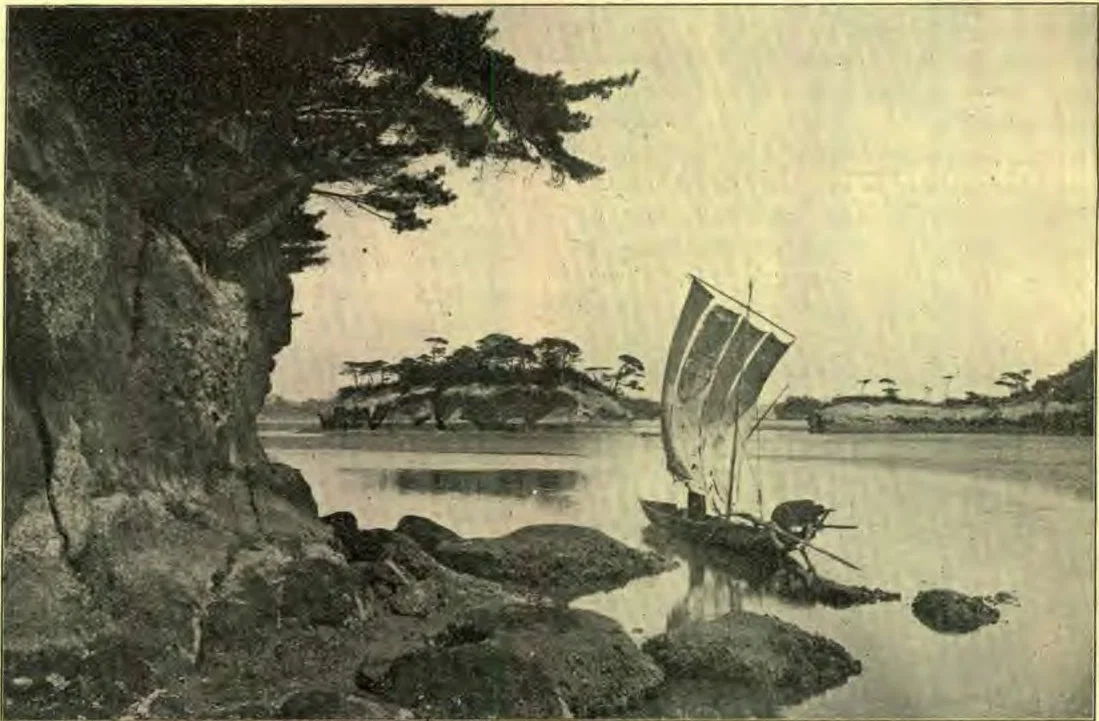
MATSUSHIMA — THE INLAND SEA
Nagasaki is the only place in Japan where the manufacture of real tortoise-shell is carried on to any considerable extent. The factories are not large, but quite numerous. Usually the first floor of the shop is fitted up for a workroom, while the show-room occupies the second floor. The work is done largely by hand. The Japanese also are very skillful in carving ivory and wood. This city is coming to be quite a summer-resort for Europeans, and would afford an excellent location for a sanitarium.
Our slight acquaintance of only six days, and that only with the coast towns, naturally most influenced by Western ideas, would scarcely warrant us in drawing definite conclusions of the Japanese people. What we did obtain might better be called impressions of them as clever in imitating, sharp at bargaining, energetic in business, patriotic and progressive, but fickle and unstable. The empire is in a state of transition, and the government welcomes anything that promises benefit to its people. There certainly can be no more favorable time for the message to work in Japan than the present, and scores of laborers should enter now.
MRS. J. N. ANDERSON.