There were thirty-six plump muskmelon seeds, and Bobbie planted them very carefully, tucking nine in each one of the four mounds of earth his fat hands had heaped, smoothed, and patted down.
“My garden’s to be all melons this year. I’ll have enough to eat, and lots to sell,” he called out, proudly, to Harry Wood.
Now Bobbie and Harry were great friends, though the former was only five years old and recently out of kilts, while the latter wore a stand-up collar, a butterfly necktie, and was even thinking about “putting on long trousers.”
Harry’s tone, though patronizing, was kind as he inquired, “So you really think that you’ll have a big crop of melons?”
“Of course!” and Bobbie’s voice was full of pride. “I mean to take good care of the plants.”
And, indeed, as the weeks went by, Bobbie did tend his melons faithfully, and in spite of many discouragements. For in two of the brown mounds the seeds failed to appear,—whether they had been planted too deep, or whether they had been nibbled by some wandering worm, nobody could tell.
However, the other two mounds soon bristled with luxuriant green plants. These, under Uncle Jed’s advice, Bobbie thinned out carefully, weeded, and watered. Then, alas! one night when the little boy was sound asleep, an evil-minded cutworm sawed away in the moonlight, and when morning came, half the plants lay wilting and dying.
Bobbie would have cried over them, but then, salt water wasn’t good for plants, Uncle Jed said; and so, instead, he did his best to save the rest of his plants. Soot from the kitchen stovepipe, and tobacco from another pipe, routed the cutworms. Then a warm rain, followed by sunshiny days, made the melons grow fast. They got ahead of weeds, bugs, and worms, and began to put forth pert little runners dotted with yellow blossoms.
Then, one woeful day, Mrs. O’Brien’s cow got out of the pasture, and wandered about until she reached the Barker garden; and on her way to reach the dozen rows of young corn, what must she do but place her feet right on his last hill of melons—smashing every trailing vine but one!
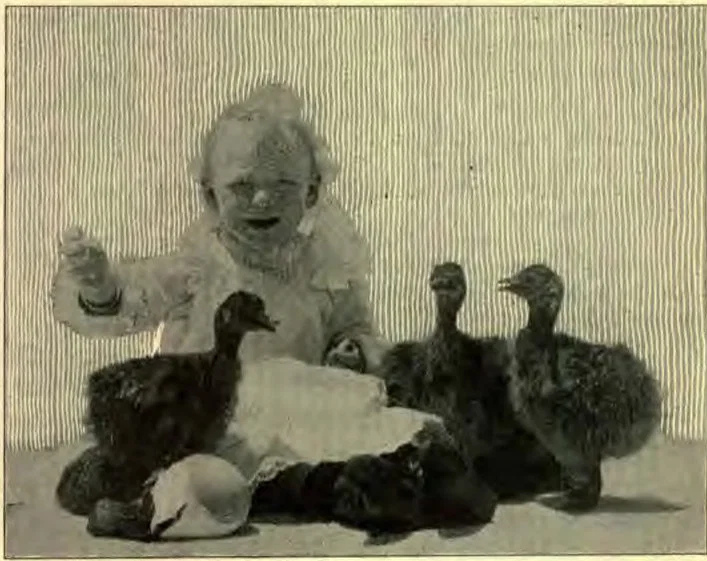
FOUR BABIES AT THE OSTRICH FARM
And this time Bobbie cried. And Harry Wood, who came over to see the extent of the damage, tried to whistle cheerily, as he said, “Well, the old bossie didn’t tread on your very best vine. See, you have one left, and,—I declare, if there isn’t a melon on it as large as my biggest agate marble!”
Now Bobbie hadn’t noticed this, and he was so delighted that he quite forgot his tears.
The one lonely melon grew rapidly until it began to look very well. Then one day, Bobbie and his family being away, the young Plymouth Rock rooster squeezed himself through the chicken-yard palings, and what else must he do but stalk boldly up to that melon, and begin to peck at it! Tap, tap, tap! went his yellow beak, until he broke right into the juicy, salmon-pink heart.
It was Harry Wood who saw him, and drove him back into the hen-yard. But most of the melon rode away in the stomach of the Plymouth Rock.
Harry looked down mournfully at the bits of rind, scattered seeds, and pulp remaining on the melon-hill; then he gathered up the mess, and threw it among the burdocks on the other side of the garden fence. After which his long legs carried him down to the Italian’s fruit-store, and, when he came out again, he bore a bulging paper bag. Hurrying up street, he reached Bobbie’s ill-fated melon-patch, and then—and then!
When the Barkers came home, Bobbie went out to his “garden.” He bent over the brown mound, parted the green leaves, and—oh, wonder of wonders!
“Ma! ma!” Bobbie shouted. “Do come here. Why, my melon has grown lots just while I’ve been gone! And it’s so ripe that it’s loosened itself from the stem. Oh-ee! it’s perfectly lovely!”
The Plymouth Rock stuck his red comb through the chicken-yard fence, and crowed derisively, but Bobbie didn’t notice him.
And Harry Wood was chuckling to himself across the street, as he said, “That quarter I was saving toward my new microscope is gone, but I don’t care. The joke was worth twenty-five cents. And, anyhow, a big fellow kind of ought to look out for a little fellow.”—Sunday School Times.