There were thirty-six plump muskmelon seeds, and Bobbie planted them very carefully, tucking nine in each one of the four mounds of earth his fat hands had heaped, smoothed, and patted down.
“My garden’s to be all melons this year. I’ll have enough to eat, and lots to sell,” he called out, proudly, to Harry Wood.
Now Bobbie and Harry were great friends, though the former was only five years old and recently out of kilts, while the latter wore a stand-up collar, a butterfly necktie, and was even thinking about “putting on long trousers.”
Harry’s tone, though patronizing, was kind as he inquired, “So you really think that you’ll have a big crop of melons?”
“Of course!” and Bobbie’s voice was full of pride. “I mean to take good care of the plants.”
And, indeed, as the weeks went by, Bobbie did tend his melons faithfully, and in spite of many discouragements. For in two of the brown mounds the seeds failed to appear,—whether they had been planted too deep, or whether they had been nibbled by some wandering worm, nobody could tell.
However, the other two mounds soon bristled with luxuriant green plants. These, under Uncle Jed’s advice, Bobbie thinned out carefully, weeded, and watered. Then, alas! one night when the little boy was sound asleep, an evil-minded cutworm sawed away in the moonlight, and when morning came, half the plants lay wilting and dying.
Bobbie would have cried over them, but then, salt water wasn’t good for plants, Uncle Jed said; and so, instead, he did his best to save the rest of his plants. Soot from the kitchen stovepipe, and tobacco from another pipe, routed the cutworms. Then a warm rain, followed by sunshiny days, made the melons grow fast. They got ahead of weeds, bugs, and worms, and began to put forth pert little runners dotted with yellow blossoms.
Then, one woeful day, Mrs. O’Brien’s cow got out of the pasture, and wandered about until she reached the Barker garden; and on her way to reach the dozen rows of young corn, what must she do but place her feet right on his last hill of melons—smashing every trailing vine but one!
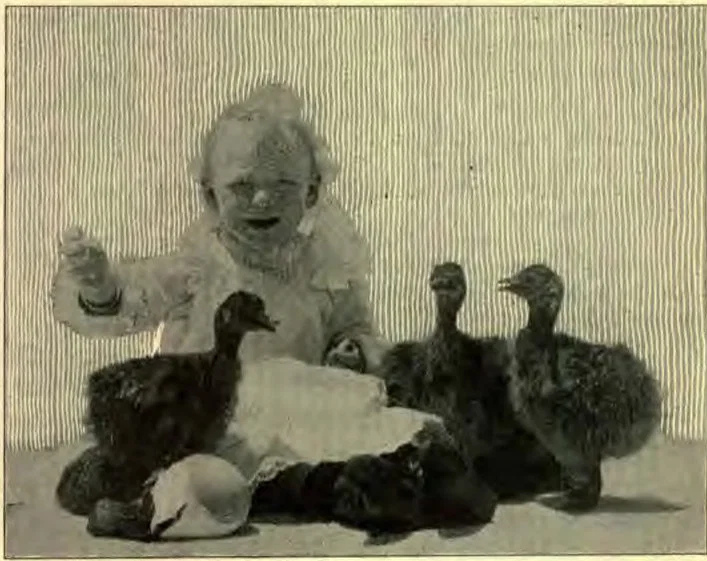
FOUR BABIES AT THE OSTRICH FARM
And this time Bobbie cried. And Harry Wood, who came over to see the extent of the damage, tried to whistle cheerily, as he said, “Well, the old bossie didn’t tread on your very best vine. See, you have one left, and,—I declare, if there isn’t a melon on it as large as my biggest agate marble!”
Now Bobbie hadn’t noticed this, and he was so delighted that he quite forgot his tears.
The one lonely melon grew rapidly until it began to look very well. Then one day, Bobbie and his family being away, the young Plymouth Rock rooster squeezed himself through the chicken-yard palings, and what else must he do but stalk boldly up to that melon, and begin to peck at it! Tap, tap, tap! went his yellow beak, until he broke right into the juicy, salmon-pink heart.
It was Harry Wood who saw him, and drove him back into the hen-yard. But most of the melon rode away in the stomach of the Plymouth Rock.
Harry looked down mournfully at the bits of rind, scattered seeds, and pulp remaining on the melon-hill; then he gathered up the mess, and threw it among the burdocks on the other side of the garden fence. After which his long legs carried him down to the Italian’s fruit-store, and, when he came out again, he bore a bulging paper bag. Hurrying up street, he reached Bobbie’s ill-fated melon-patch, and then—and then!
When the Barkers came home, Bobbie went out to his “garden.” He bent over the brown mound, parted the green leaves, and—oh, wonder of wonders!
“Ma! ma!” Bobbie shouted. “Do come here. Why, my melon has grown lots just while I’ve been gone! And it’s so ripe that it’s loosened itself from the stem. Oh-ee! it’s perfectly lovely!”
The Plymouth Rock stuck his red comb through the chicken-yard fence, and crowed derisively, but Bobbie didn’t notice him.
And Harry Wood was chuckling to himself across the street, as he said, “That quarter I was saving toward my new microscope is gone, but I don’t care. The joke was worth twenty-five cents. And, anyhow, a big fellow kind of ought to look out for a little fellow.”—Sunday School Times.
MARGINS
How mean and stingy and out of proportion would a printed page look without a margin! The finer the book mechanically, up to a certain limit, the broader the white border of its page. A life filled to the very edge with the day’s business, day after day, is as unsightly, as cramped and dwarfed, as the unmargined printed page.
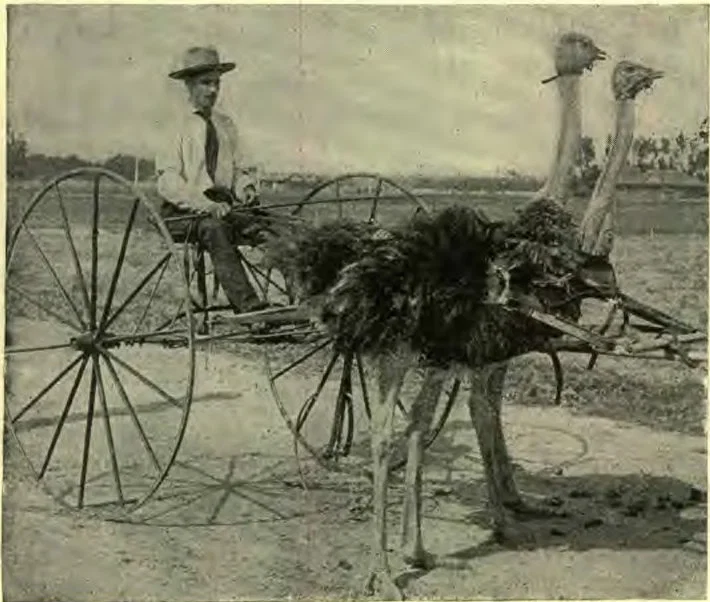
A NOVEL TEAM
To develop beautifully, harmoniously, it needs the margin for rest, for recreation, for the flinging wide of its windows to friendship, to visions of beauty, to the earthly joys that type the purer and more permanent. If “getting a living” is all there is of life, the game is hardly worth the candle.—Selected.
HIDDEN TREASURE
By Edith E. Adams
Not long ago a man living near London bought a parcel of old books at an auction room for a few shillings. Among them was a Bible. One Sunday evening his wife was looking through the Bible, when she discovered that two of the leaves were pasted together. She began at once to separate them, and found a pleasant surprise awaiting her. For between the leaves six five-pound Bank of England notes were hidden, and on the back of one was written: “I have had to work very hard for this, and having none as natural heirs, I leave thee, dear reader, whosoever shall own this holy Book, my lawful heir. July 17th, 1840.”
Here was a hidden treasure that had been lying for many years not sought for, because no one knew it was there. But do you know that you have in your Bible hidden treasure far, far greater than that which this woman found? Perhaps you have not yet begun to seek for it, because you did not know it was there.
In ancient times, men used to bury their treasure86in the earth, because they thought this was a safe hiding-place. But sometimes they would forget where they had buried it, or the owner might die without telling any one about it.
So when Jesus told the people the parable of the hid treasure, he was talking about something that often happened in those days. Do you remember the story?
“The kingdom of heaven is like unto treasure hid in a field; the which when a man hath found, he hideth, and for joy thereof goeth and selleth all that he hath, and buyeth that field.”
No doubt his friends would think him very foolish, and even crazy, to part with his goods for the sake of buying a barren field. But the man himself is joyful; for he knows that he is getting far more than he gives up.
The treasure hidden in the Bible is the precious truth. Jesus said, “I am the Truth;” and in Christ, the Truth, are hidden “all the treasures of wisdom and knowledge.”
Now hear what God tells us about this wisdom that can be found only in Jesus Christ, who gives it to us in his word:—
“The depth saith, It is not in me:
And the sea saith, It is not with me.
It can not be gotten for gold,
Neither shall silver be weighed for the price thereof.
It can not be valued with the gold of Ophir,
With the precious onyx, or the sapphire.
The gold and the crystal can not equal it;
And the exchange of it shall not be for jewels of fine gold.
No mention shall be made of coral, or of pearls:
For the price of wisdom is above rubies.”
This is the treasure that is hidden in the Bible. And if we would find it, we must be willing to dig in this precious mine of truth.
Do you think that the man who found the treasure in the field would think it a hard task to dig for it?—No! he would not rest until he had gone carefully over the whole field; and each piece of gold or silver, each precious gem that he found, would give him fresh zeal to go on with the work.
Yet “the earth itself is not so interlaced with golden veins, and filled with precious things, as is the word of God.” And for any one who will dig in any part of it, there can be no disappointment; for the promise is, “Seek, and ye shall find.”
EDITH E. ADAMS.
THE HOUSE WE USED TO LIVE IN
By Ethelwyn Wetherald
The house we used to live in looks at us
So wistfully as we go driving by;
The wind that makes its near tree murmurous
Flies swiftly after with entreating sigh.
Come back! come back! we hear it low implore;
Lift up the grass-choked gate, the earth-stained door,
And enter in your childhood’s home once more.
Ah, no! let us make merry with light speech
Of newer days, and push the past aside.
Close to that door the baby used to reach
The knob, and play with it — before he died;
He used to sleep on the broad window-sill,
A sunbeam in his curls — no, not that hill —
This level road. Drive fast — oh, faster still!
How small it was! Before the birds are grown,
They lie so warmly in one tiny nest;
But all the world is theirs when they have flown,
And foreign roofs replace the mother’s breast.
Ah, well — God careth. See, before us now
The ampler home beneath a lofty bough.
Lift up the saddened heart and clear the brow;
For in that empty nest beyond the hill
Are blessed pictures for the memory’s ease,—
The sun-crowned baby on the window-sill,
The happy children underneath the trees.
Old house, look not so piteous. Thou art
Of larger lives the very sweetest part,—
The first love of the unforgetting heart.
— Ethelwyn Wetherald, in Youth’s Companion.
Poem: If Thou Hast Named a Joy to Be Mine Own
“If Thou hast named a joy to be mine own,
To-day, to-morrow, when thy love sees best,
I shall not bring it nearer, though I moan
Impatient with the hunger in my breast,
Leaving my work to watch in sharp unrest.”
DIVISION II—PHILOSOPHY;
By Dr. O. C. Godmark
Chapter XXI — Attraction and Repulsion
§ 213. One of the most important factors in our preparatory study of astronomy is the attractive and repulsive properties of electricity. Many things we know to be true, and wonder at the fact; but when we understand the reason for the existing phenomena, we enjoy the satisfaction of seeing the workings of God as would otherwise be impossible. In the attractive and repulsive effects of electric, or magnetic, vibration is the explanation of many of the wonderful manifestations of the workings of God in the celestial and terrestrial fields of study.
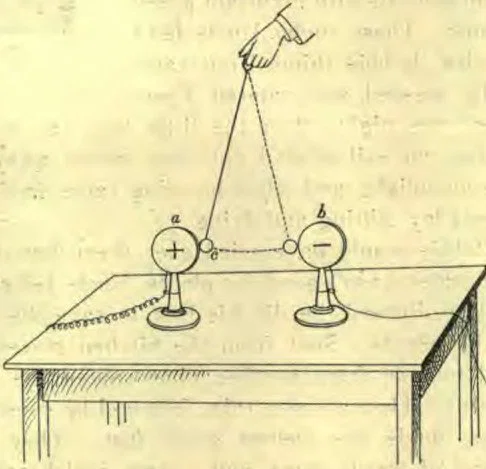
§ 214. To illustrate what is meant by electrical, or magnetic, attraction and repulsion: Place upon your table two copper balls mounted upon insulated stands, as shown in the illustration. The one marked (a) is connected with a battery, and is positively charged with electricity. The one marked (b) is connected by a wire with the ground, and being close enough to (a), which is positive (+), to be under its influence, it becomes negative (—). Now suspend, between the two, by a silken thread, a pith-ball (c), and watch the result.
It is a well-known law of physics that “opposites attract, and likes repel,” and so with these. The pith-ball being placed under the influence of the positive (+) electrode, immediately becomes negative (—), and so is attracted to the positive electrode. The moment it touches it, it becomes positively electrized itself, and being the smaller and lighter of the two, is quickly repelled, or thrown off, from the positive ball. The moment it leaves this positive electrode, it is attracted to the negatively electrized electrode, to which it flies as rapidly as it first went to the positive one, being not only attracted to it, but also driven toward it by the one which it left. But it does not remain long in touch with its negative neighbor; for the moment it gives off its load of positive electricity, it, in turn, becomes negatively electrized; and as likes repel, it is thrown off from this electrode, and driven back to the first, only to repeat the vibration, which is kept up as long as the first electrode is positively charged. This simple experiment will be of value in our future study of astronomy, and we trust that none will neglect it.
§ 215. Now let us review a few of the facts we have learned regarding vibration, and put them to a practical test. The lowest, crudest form of vibration is sound. Strike a large gong, triangle, or bell, and you can actually see the edge vibrate; or if the tone is too high to see the vibrations, you can distinctly feel them. Speak into a tin can or basin, and the bottom will vibrate in exact accord with the varied tones and modulations of the voice. Attach a hard-twisted cord or small wire to the center of the bottom of the can, connect the other end of the cord or wire with a similar can some rods away, and speak into the one, holding the cord taut, and the exact vibrations of the voice will be reproduced in the can at the other end of the cord by the mere vibrations of the bottom of that can. This is the most simple form of telephone; but when properly constructed, will do good service for some distance. Parchment, or even leather, forms an excellent drum for such a telephone.
§ 216. In the magnetic telephone—the one commonly in use—the sound-waves, or vibrations, are carried by magnetic impulses that exactly correspond with the vibrations of the diaphragm against which the person speaks. These impulses are carried over the wire, which becomes an extended magnet; and this by its impulses causes the diaphragm at the other end of the line to vibrate in exact unison with the one into which the person speaks, thus accurately reproducing the sound.
§ 217. The phonograph is, as the name indicates, a machine for writing sound. A sharp needle, or point, is attached to the center of the drum, or diaphragm, against which the operator speaks. The point of the needle is caused to rest lightly upon a rapidly revolving cylinder of wax in such a manner as to trace a spiral thread running round and round from one end of the cylinder to the other in the same manner as the threads are cut in a very fine screw, or bolt. As the tone of the voice causes the diaphragm to vibrate, the needle pricks little holes, or rows of holes, in the rapidly revolving body of wax, each hole representing one vibration, and each group, or row of holes, representing one tone. All that is needed to reproduce the sound is to place the needle back at the beginning of the little line of dots that it has made in the wax, and start the machine in motion. The needle drops rapidly into the punctures that it has before made, and in so doing causes the plate to vibrate, and thus produce the same sound that first caused the punctures.
§ 218. When the higher forms of vibration, such as electricity, are caused to pass over a poor conductor, the resistance is such that the vibrations become slowed down, and manifest themselves in the forms of heat and light. When a moderate amount of electricity is used, the conductor merely becomes warm; but when a stronger current is applied, it blazes out in the form of light. The resistance afforded the current by the platinum wire is sufficient to change the vibrations from that of electricity to light in the glass bulbs that afford us light in our homes and offices. The same is true regarding the carbon points in the arc-lamps that light our streets at night. This merely illustrates the change that takes place in the forms of vibration.
§ 219. The reason the electric light is white, having its full amount of indigo and violet rays, is that it is a higher order of light than is the yellow flame of the candle, or light from a poor grade of petroleum. The more refined and perfect the oil, the whiter the light.
Questions
State a universal law of physics relative to attraction and repulsion. Describe the illustration of the pith-ball. When a conductor of electricity is brought under the influence of a positive electrode, what polarity does the object take on, positive or negative? What polarity have the ground, trees, and buildings over which a heavy thunder-cloud is passing? Dry air being a poor conductor of electricity, when will the rubbing of a cat’s back produce the greater number of electric sparks, before a thunder-storm or afterward? Why? Explain the philosophy of a simple telephone. Why will a phonograph repeat the exact words spoken into it? How is the electric light produced? Why is its light whiter than the light of a candle?87
Note
We are sorry these lessons have been interrupted during the past few weeks, and trust our duties in the future will not be such as to hinder their preparation. Having laid the foundation facts, we are now ready to enter upon that most interesting of all studies, “Bible Astronomy.”
Those who have carefully preserved their INSTRUCTORS will now have an excellent basis for this study, and those who have not, would do well to secure these back numbers if possible, as constant reference will be made to the points brought out in the different sections gone over, all of which have been preparatory to the coming study. From letters constantly coming to us from all over the United States and parts of Canada, we know we shall have a large and interesting class, and we shall gladly do all we can to make this important study so simple and plain that the children, and those who have never studied science at all, can not only understand it, but also teach it to the pupils in their schools and families. DR. O. C. GODSMARK.
2005 Magazine St., Louisville, Ky.
WHAT'S THE NEWS?
What's the news?
Philip Smith has killed himself?
Broker Jones has lost his pelf?
Cashier Brown's embezzlement,
Two eloped, and where they went?
Other plots to kill the czar?
Wars, and threatenings of wars?
Scandals down at city hall?
Mrs. Dazzle's fancy ball?
Three alarms, a fearful fire?
Offices, and who aspire?
Great divorce case, shocking tale?
Jacob Drivum's Bargain Sale?
These, and such affairs as these
You'd palm off as novelties.
They're no news!
This is news:
Doctor Large has saved a life!
Reuben Grim has kissed his wife!
Dives builds a hospital!
Bookworm Rusty makes a call!
Jack and Jim are friends once more!
Tippler passed the bar-room door!
Baby's got a second tooth!
Mrs. Tattle's told the truth!
Here's a man has helped a boy!
There's a youngster shares a toy!
Here is comfort for a tear!
There's a bit of sunny cheer!
Hardened sinners born again!
Christ's new life in worn-out men!
That is news!
—The Christian Endeavor World.
Better to Do One Thing Well
“BETTER to say, ‘This one thing I do,’ than to say, ‘These forty things I dabble in.’”
PARABLE OF THE LABORERS
(March 22)
MEMORY VERSE: “So the last shall be first, and the first last: for many be called, but few chosen.” Matt. 20:16.
When Christ said, “How hardly shall they that have riches enter into the kingdom of God!” the disciples were greatly astonished. They had been taught to look upon the rich as the favorites of heaven, and worldly honor and riches they themselves hoped to receive in Messiah’s kingdom. If the rich failed to enter, what hope would there be for the rest of men? As Jesus repeated his solemn warning, they exclaimed, “Who then can be saved?” Peter was the first to rally from the secret conviction wrought by the Saviour’s words, and, thinking of all that he and his companions had forsaken for the Master, asked what they should receive as a reward for their sacrifice. His question revealed a spirit that, uncorrected, would unfit the disciples to be messengers for Christ; it was the spirit of a hireling. Lest they should lose sight of the principles of the gospel, Christ related the parable of the laborers to show the manner in which God deals with his servants, and the spirit in which we ought to labor for him.
Questions
1. Two questions were asked Jesus, which led to his giving the parable of the laborers; what was the first? Matt. 19:16.
2. When Jesus told the young man how he could be made perfect, what was the result? Matt. 19:22.
3. What did the Saviour then say about riches?
4. Who asked the second question? what was it?
5. What prompted this question? See Synopsis.
6. What kind of spirit did it show? Id.
7. In the parable which Christ then gave, to what is the kingdom of heaven likened?
8. At what time did the householder go out to hire laborers?
9. What did he agree to pay them? How much is a penny in our money? See Bible dictionary.
10. At what other hours of the day did the householder go out to hire laborers?
11. “Early in the morning” means six o’clock: what time is meant, then, by the third, sixth, and ninth hours?
12. When the householder went out at the eleventh hour, what did he say to the men standing in the market-place? What time of day was this?
13. What answer did they give the householder?
14. What did he then command them? What wages were they to receive?
15. When evening came, what did the lord of the vineyard say to his steward?
16. Of the men hired, who were to be paid first?
17. How did their wages compare with those of the men hired early in the morning?
18. When those first hired were paid, what complaint did they make? To whom did they make it?
19. How did the steward uphold his master in what he had done?
20. What conclusion does the parable draw from this experience?
21. In applying it, who is the householder? What is the vineyard? Who are the laborers?
22. What is the basis of the reward which God has to give? Titus 3:5; read Quotation.
Quotation from the Lesson Help
“The householder’s dealing with the workers in his vineyard represents God’s dealing with the human family. It is contrary to the customs that prevail among men. In worldly business, compensation is given according to the work accomplished. The laborer expects to be paid only that which he earns. But in the parable, Christ was illustrating the principles of his kingdom,—a kingdom not of this world. He is not controlled by any human standard. . . . His reward is given, not according to our merit, but according to his own purpose, ‘which he purposed in Christ Jesus our Lord.’ ‘Not by works of righteousness which we have done, but according to His mercy he saved us.’ . . . Not the amount of labor performed, or its visible results, but the spirit in which the work is done, makes it of value with God. . . . It is not the length of time we labor, but our willingness and fidelity in the work, that makes it acceptable to God. In all our service a full surrender of self is demanded. The smallest duty done in sincerity and self-forgetfulness, is more pleasing to God than the greatest work when marred with self-seeking. . . . And however short our service or humble our work, if in simple faith we follow Christ, we shall not be disappointed of the reward. That which even the greatest and wisest can not earn, the weakest and most humble may receive. Heaven’s golden gate opens not to the self-exalted. It is not lifted up to the proud in spirit. But the everlasting portals will open wide to the trembling touch of a little child. Blessed will be the recompense of grace to those who have wrought for God in the simplicity of faith and love.”—Pages 390–404.
WHAT IS GOING ON IN THE WORLD.
Great Ship Canal
It is reported that Russia is contemplating the construction, across her southeastern territories, of an immense ship canal, deep enough for the largest ships of war as well as vessels of commerce. The canal will connect the Baltic and Black seas, following the course of the Dnieper, and its tributary, the Beresina, and entering the Baltic by the Duna. In many places the rivers will have to be deepened, and forty miles of dangerous rapids in the Dnieper must be done away with. Altogether, the undertaking is looked upon as one of the greatest of its kind in the history of the world.
The Meteor Launched
February 25, in the presence of his brother, Prince Henry of Prussia, the German emperor’s new yacht, “Meteor III,” was christened by Miss Alice Roosevelt. The yacht was launched at Shooter’s Island, and in spite of bad weather, the crowds were large, and the affair altogether very brilliant. The people cheered the president, the prince called for cheers for Miss Roosevelt, and everybody cheered the prince. In short, if cheers are to be taken as an evidence, there never would be anything but the warmest good feeling hereafter between the two countries represented on that occasion.
The Anglo-Japanese Alliance
On January 30 an important agreement was signed by the British Foreign Secretary, Lord Lansdowne, and Baron Hayashi, the Japanese Minister to Great Britain, for the purpose of preserving the independence and territorial integrity of China and Korea. It also provides for “securing equal opportunities in those countries for the commerce and industry of all nations. The contracting parties agree that if either should become involved in war with another power because of an attack upon its interests in China or Korea, the other will remain neutral; but that if a second power joins in the attack, the other party to the contract will go to the defense of its ally. It is generally understood that Russia is the power whose possible aggressions the agreement is meant to provide against, and that the alliance has been hastened by the discovery that Russia is pressing upon China two distinct conventions relating to Manchuria, in one of which she seeks to secure, through the agency of the Russo-Chinese Bank, concessions which she dropped from the other. The United States as well as Great Britain and Japan, protested against these conventions.”
The treaty was officially announced on February 11, and caused considerable surprise in diplomatic circles. It is generally thought that in bringing about this alliance, Japan has done very well indeed for herself. But in all these events the student of prophecy will read a deeper meaning.
What Is Meant by the “Open Door”
Now that the new Anglo-Japanese treaty brings the term “open door” prominently into print again, it may be well to explain just what is meant by the words. The New York World recapitulates thus: “The open door means that in all the ports and provinces of China, including Manchuria, the United States, Great Britain, Russia, and all other nations shall be on a footing of exact equality as to tariffs, port dues, shipping regulations, and commercial conditions. It has been assumed, rightly or wrongly, that Russia sought special advantages for herself and her commerce over other nations, especially in Manchuria, which she has been suspected of a design to annex. The ‘open door’ to China’s trade is at present worth a little over $18,000,000 a year as a market for our exports. The total imports of the empire from all countries are valued at $148,383,000 a year.”
A Month of Fires
February was marked by a number of serious fires, which caused a vast destruction of property and considerable loss of life. On the night of the second the town of Waterbury, Connecticut, famous for its manufacture of watches, was visited by a fire which covered about five acres of the business center, and resulted in a loss of $2,500,000. This was followed, on February 8, by a still worse fire at Paterson, N. J., called the “Lyons of America,” because of its position as center of the silk manufacturing interests in this country. Twenty-six blocks of the business part of the city were burned, including practically every important public structure, besides five hundred residences. One thousand persons were made homeless, and upward of ten million dollars’ worth of property was destroyed. On the 22d, in the burning of the Park Avenue Hotel, New York City, nineteen lives were lost, and property to the value of $750,000 was destroyed.
A Gigantic Dam
By order of the State General, and with the approval of the queen, the government of Holland will undertake to reclaim the 2,500,000 acres of the Zuyder Zee. The dam will reach from the north Holland shore to Priaam on the opposite mainland, by way of the little island of Wieringen. It will be twenty-five miles long, will be twenty years in constructing, and is estimated to cost about $42,000,000. A railroad will run along its top from shore to shore. The reclaimed land will be divided into homesteads for farmers.
Life's Journey and the Hope of Heaven
Your life journey leads by a way you know not. It is best you should not know. When you come to the rugged hills, climb them. Enjoy the beautiful landscapes as you pass them. And rest assured that at the end of your journey every good thing that has entered into your aspiration, plan, and purpose will greet you in that world where hope is changed into fruition, and the longing for perfection shall find its realization. Your highest dreams of spiritual purity, exaltation, and blessedness now are sure prophecies of what you shall be then. What you put into your dream here, God will put into your destiny there.—Bishop O. P. Fitzgerald.
SHORTHAND BY MAIL
Your spare time can be well improved by studying shorthand, and this can be done at small expense to you by taking a mail course at your home. We are using “The Rogers Compendium of the Graham System of Shorthand,” a method arranged especially for home study, and giving an epitome of a system of shorthand acknowledged to be the best, the briefest, and the most complete. The only presentation of Standard Phonography in which all shorthand outlines are written as first learned, thus greatly abbreviating the work on the part of the student. A complete course in thirty lessons, illustrated by facsimile notes, with key. The correction of all students’ papers given special attention by experts. Reasonable tuition rates. If interested, write for full particulars. Practicing stenographers wishing to prepare for rapid reporting work should secure the last twenty lessons.
FIRESIDE CORRESPONDENCE SCHOOL, Battle Creek, Mich.
SOLID THROUGH TRAINS OF
WIDE VESTIBULE COACHES and PULLMAN SLEEPING CARS BETWEEN
Battle Creek and Chicago, Buffalo, New York, Philadelphia, Toronto, Montreal, Boston
For time-tables, descriptive matter, and information, apply to any representative of the company.
Toronto, Montreal, Boston
Seeking the Hardest Place in Service
It is not a sign of strength of character to seek an “easy” place or task. We all admire the spirit of that soldier who, in speaking to his general, said: “If you have a post that is harder than any other, send me there.” There has been many a Christian soldier who has been led by the same high spirit to go into the darkest places of earth to minister to the physical and spiritual needs of those in darkness, and that is the spirit that should actuate all who work for the Master. Not the easy places, but the hard, yes, the hardest, places—remembering always that where the need is greatest, there is his Spirit given in greatest fullness.
ANNOUNCEMENTS
By Editor
An attractive series of studies in plant life is begun in this number of the INSTRUCTOR under the general heading, “Plants of Forest and Field.” They are written by Brother B. E. Crawford, instructor in advanced botany in Union College. The paragraphs of the series will be numbered consecutively for the convenience of those who may wish to refer to the different subjects taken up. A large number of pen-and-ink drawings will be prepared by the author fully illustrating the text.
We are also pleased to announce that at the request of the Committee having the general work in charge, Elder Luther Warren has consented to write, for use in the Young People’s Societies, a series of lessons covering the distinctive points of our faith. These lessons are designed to help the young people to give an intelligent reason for their hope, as well as to build them up in the most holy faith. Elder Warren has expressed his wish to make the lessons so simple and plain that the youngest can understand the truths brought out, and yet at the same time present a field for deeper study to all who have the inclination or the time to enter it. The first of these studies will appear next week, in the department devoted to the Young People’s work.
The publication of that long-delayed series of articles on Mexican Horsehair Work, by J. Edgar Ross, will soon be begun. The first three articles of the series were received several weeks ago, but their publication was for a time delayed by the making of the illustrations.