The Barberry Family

5%

Review and Herald Publishing Company · Battle Creek, Michigan · December 25, 1902

FromThe Youth’s Instructor, Vol. L., No. 51

Read the full edition

The Barberry Family

This is a rather small family, and contains but few plants of any special importance. There are two, however, which for various reasons are of considerable interest, and these we will here describe.
All the plants belonging to the family are either shrubs or herbs with alternate or radical leaves, and for the most part with perfect flowers, all the different parts, as calyx, corolla, stamens, and pistils, being present. The blossoms appear in spring or summer, and the fruit usually consists of from one to three carpels or simple pistils, though occasionally there are more. Most of the species are natives of cool climates. The scientific name of the family is Berberidaceae.
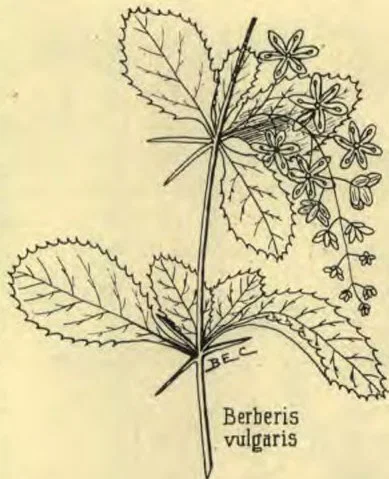
Berberis vulgaris
Berberis vulgaris
The Common Barberry (Berberis vulgaris) is of special interest because of the part it acts in the development and spread of the red and black rust affecting wheat and other grains.
The leaves, which are obovate, with sharp spines all along the margins, occur in clusters in the axils of large, usually three-forked, straight spines. Though apparently simple, botanists consider them compound leaves with one leaflet, because of the joint which is found in the petiole of each leaf.
The yellow, ill-smelling blossoms are produced in drooping racemes from the axils of the leaves. Each has six sepals, six petals, and six stamens. The stamens ordinarily recline upon the petals, but when touched at the base by a bee or other insect in search of honey secreted by the glands at the base of the petals, they straighten up quickly so as to come into contact with the pistil, and some of the pollen falls from the anthers upon the stigma. In this way the fertilization of the young ovules in the ovary is provided for, and after fertilization takes place, they rapidly develop into the mature seeds.
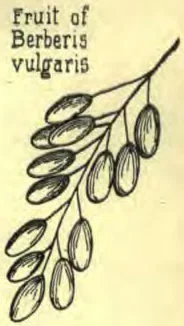
Fruit of Berberis vulgaris
The flowers are followed by clusters of oblong, red, sour berries, each containing two or three seeds. The berries are edible, and sometimes used for food, though the plant is cultivated more for ornament than for the food value of the berries. There are several varieties of the common Barberry cultivated for ornament, the fruits being of various colors, and the foliage sometimes purple.
It is a rather dangerous plant to cultivate, however, as it is now known to be a prominent factor in the spread of the red and black rust of wheat, oats, and other grains, as well as various species of grasses.
The rust appears in the spring upon the leaves of the Barberry, there developing microscopic spores of a yellowish color, which are carried away by the winds. Later in the season the rust appears upon the leaves, and soon afterward upon the stems, of wheat, oats, etc., forming pale yellowish or whitish spots. After a few days, long lines of spores of an orange-red color break through the epidermis. Still later in the season there is produced a third kind of spores, which appear in long black lines, sometimes upon the leaves, but more often upon the stems.
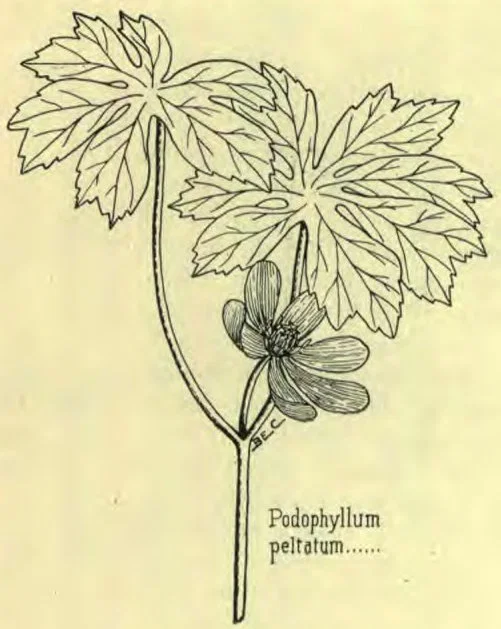
Podophyllum peltatum......
Ordinarily the first stage of the rust can develop only upon the Barberry leaves, so that if the farm and surrounding country are kept free from Barberries, the rust is not likely to occur. Rusts are interesting plants to study, and we will perhaps give a more detailed description of them at another time.
The other member of the Barberry family which we will mention is the May Apple or Mandrake (Podophyllum peltatum), a common plant of rich, moist woods, and often found in meadows.
It spreads by means of rhizomes (underground stems), which sometimes attain a length of twelve feet or more. Each year a bud develops from the growing end of the rhizome, and sends up a stem bearing the leaves and a single flower. The plant usually grows from twelve to eighteen inches high.
The leaves are large, and parted into from five to nine lobes, with each lobe drooping more or less, thus giving the leaf somewhat of a resemblance to an umbrella, both when folded and when expanded.
Some of the plants are without flowers, and such have only one leaf, while those that bloom always have two leaves, which are attached opposite each other at the apex of the stem, with the solitary flower borne upon a drooping stalk between them.
The calyx consists of six sepals of a greenish color, but these drop off during the unfolding of the flower, so that the calyx is seldom found after the flowers are fully opened. The corolla is of a creamy white color, consisting of from six to nine rather large, thick petals. The flowers open in May, which fact has given to the plant the name of May Apple.
The fruit is yellow when ripe, which is some time in August, and about the size of a plum. It has a sweetish taste, which is pleasing to some persons, and it is sometimes eaten, though it is likely to leave unpleasant after-effects except when taken only in small quantities. On account of its shape and color the fruit is in some places known as “wild lemon.”
The rhizomes and leaves are poisonous, and largely used in medicine.

Questions

What are the general characteristics of the Barberry family? Why is the common Barberry of special interest? What peculiarity is exhibited by the stamens? Describe the fruit of the common Barberry. Why is it a dangerous plant to cultivate? Where is the May Apple, or Mandrake, most likely to be found? Describe the leaves and the flower. What is the size, color, and nature of the fruit? B. E. CRAWFORD.