We can scarcely understand how much the flood changed the appearance of the earth. Before the flood, most of its surface was land, so it was all in one great body. It was made this way in order that all of it might be inhabited; for, “He created it to be inhabited.” But God would have it inhabited by righteous beings.
When men delighted only in evil, this arrangement was changed; and when the earth was broken up by the flood, about three fourths of it was covered with water. The larger bodies of water, as we have learned, are called Oceans. Name them. The other fourth was left in large bodies, or masses, of land. These are connected on opposite sides of the world, and form two great bodies, often called the Old World and the New World, or the Eastern Hemisphere and the Western Hemisphere.
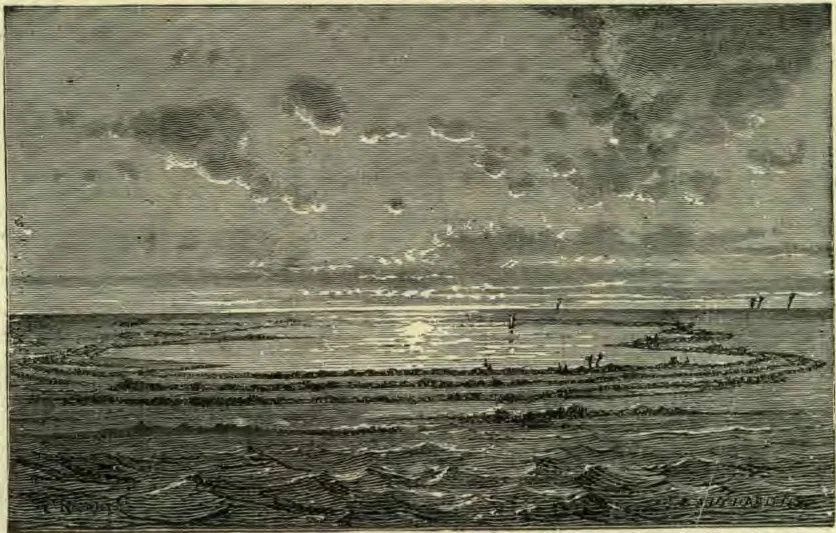
A CORAL REEF
Both hemispheres are divided into irregularly shaped masses called Continents. In the eastern hemisphere there are three continents. Their names are Europe, Asia, and Africa. A narrow strip of land that connects two continents is called an Isthmus. The Isthmus of Suez joins Africa to Asia.
In the eastern hemisphere is another continent called Australia. It lies in the Pacific Ocean, far from the other continents. Australia is the smallest of the continents.
In the western hemisphere there are two continents. We call them North America and South America. They are connected by the Isthmus of Panama.
Of course in the breaking up of the earth, the shore-line did not break straight. In many places the land projects into the water, and in others the water runs into the land. But “He hath compassed the waters with bounds, until the day and night come to an end.” “Will ye not tremble at my presence, which have placed the sand for the bounds of the sea by a perpetual decree, that it can not pass it?” So while the shore of the sea may change, God has made it, and he alone can change it.
In some places the land runs out into the sea for miles and miles, and is often narrower where it joins the mainland than it is out in the ocean. We call such a strip of land a Peninsula. Where these jutting points are smaller, and are only a point of land extending into the sea, they are called Capes. A cape is also called a Headland. Many peninsulas are very large, containing thousands of square miles of land.
In many places, arms of the water extend into the land. These are sometimes large and sometimes small. We call them Seas, Gulfs, Bays, etc. There seems to be no rule for naming them. They are really all alike.
REVIEW.—How much of the earth could be inhabited when it was first created? What has changed it so much? How much of the earth’s surface is now covered with water? Into how many great masses is most of the land divided? What do we call these? Name the continents in the old world. What is an isthmus? What isthmus joins Asia and Africa? Name the continents in the New World. What isthmus joins them? Who formed the seashore? Describe it. What is a peninsula? What is a cape? What are seas? Gulfs? Bays?
Lesson X
You have often played on the bank of a river after the water has been high, and have noticed how the banks have been washed away. Here you will find a place where the ground was hard, or perhaps there were stones to turn it aside, and it projects out into the river. A little farther along, the current has struck the bank, and has washed in till it has made an arm of water into the land. If you will look along the bank for a few rods, you will see little capes, bays, gulfs, peninsulas, and, in fact, all the forms of land and water we have spoken about. If there is no river near, follow along some creek or brook, and you will see the same things.
If you look far enough, you will find places where the water has washed around some land, and has left it entirely surrounded by the water. Such a body of land is called an Island. As the oceans were forming after the flood, large bodies of land were often broken from the coast in this way. Usually there are several islands near one another, forming a group. Since the flood the winds and waves have often formed islands by breaking capes and peninsulas from the shore. Some islands are low, and have had a great deal of sand washed over them.
Places that were the most wicked, suffered the most during the flood. Where men had built their grandest cities and palaces, and had brought gold and silver to worship their false gods, there are now the most desolate places. Many of them lie in the bottom of the ocean. Where there were mountains, their tops sometimes rise out of the water in the very middle of the ocean, and form islands. We call such islands Oceanic Islands.
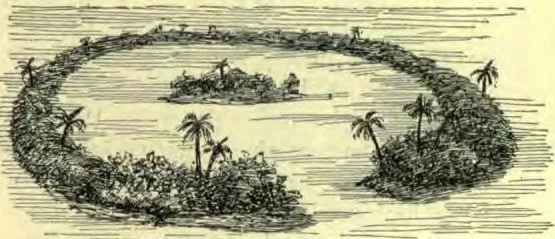
CORAL ATOLL AND ISLAND
Sometimes these mountains were entirely covered with water; but millions of tiny animals, each making a little limestone shell called Coral, lived on them; and as, year after year, new shells were added, the top of the mountain finally rose above the water, and became an island. Such359islands are often horse-shoe shaped, or even ring-shaped. We call them Atolls. The waters wash sand and soil over them, and seeds of palm-trees and other plants have taken root, and grow there. Most coral islands are found in the Pacific Ocean.
But we must not think that everything now is just as it was when the waters of the flood dried away. Since then the winds have uprooted trees, torn great rocks from their places, and driven sand and pebbles against rocks till their sides are worn in peculiar shapes. In storms at sea, the waves beat against the shore, and wear away the hardest stone. In some places these have been broken and carried into the sea, till it is dangerous for a ship to come near the shore. As we near the end, we may expect these storms and winds to increase.
REVIEW.—Where can we find capes, bays, peninsulas, etc.? What is an island? How were the islands along the shore of the ocean formed? Why do we sometimes find islands far out at sea? What are coral atolls? How were they formed? How have the winds and the waves changed the earth since the flood? FLOYD BRALLIAR.