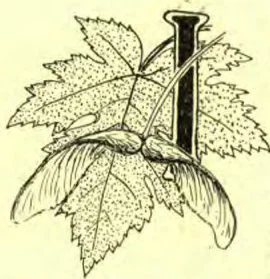
I was a tiny seed, with two wings. The wind whisked me off the twig where I had been growing, bowing and bending with every breeze, and carried me far from my Mother Maple. I fell in a soft, mossy spot on a sunny bank sloping toward the great river. The sky was not always bright, though, nor the bank always sunny; for soon it began to rain,—oh, how it rained!
“A WHITE FOOT INTO THE EARTH”
If I had not been caught between the roots of a wild rosebush, I should certainly have been washed down into the river. Then I knew the rainy season, of which Mother Maple had told me, had begun. After a while the nights grew colder, and I thought I would surely freeze. But a soft, white blanket was spread over me, and I slept, warm and snug, for a long time.
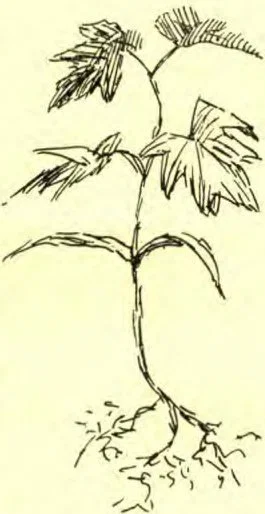
When I woke, I began to stretch myself, and presently sent a white foot down into the earth, and a crumpled, green hand up into the air.
The sun was shining, and all the land was sweet with spring. It seemed a happy thing to be alive, and I lifted up my fluttering hands in praise. I was a Little Tree.
How I loved sweets! I reached about with my tiny root-mouths, and supped up all the sweetness I could find. I loved to live by the rosebush; for she, too, was sweet, and when she was covered with bloom, the bees and butterflies hovered about her all day.
“MIGHT HAVE NIPPED ME OFF”
Then, too, if it had not been for the protection of her sharp thorns, some hungry creature might have nipped me off, and I should never have grown up to tell this story.
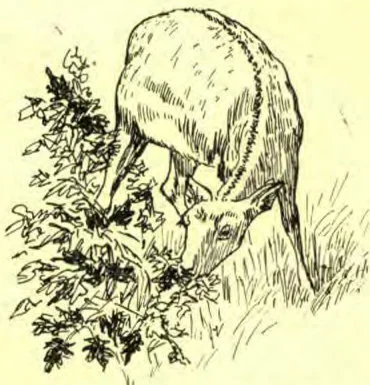
But by and by I grew taller than the bush, and then the deer used to browse my leaves and tender twigs in the spring; but I did not care, for I knew they could not harm me, and soon I was a great Forest Tree.
“SAWED INTO LOGS”
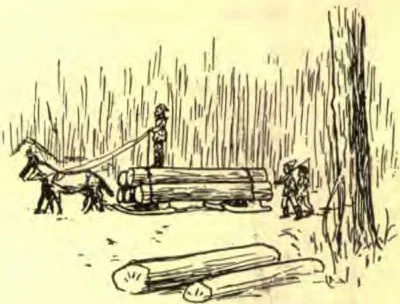
Years and years I grew on the beautiful river bank, and host after host of winged seeds I had sent out, until I stood in a grove of soft maples. At last I was cut down, sawed into logs, rolled into the river, and floated downstream to a great, noisy mill, where I was cut into pieces two and one-half feet long, sawed into thin boards that tapered from the center toward the ends, bound with hoops, had two heads put in,—and I was a Barrel.
“Now,” I thought, “I wonder what I shall be used to hold. I hope it will be sweet, or, at least, pure and good. I would be willing to carry flour or salt, but if I should be filled with rum or beer, I should feel terribly.”
I had quite a while to think of it; for I was loaded, with hundreds of others just like me, upon a ship that sailed off down the Pacific Coast. By and by I came to a factory full of sweet smells, where I was filled, and to my joy, I was a Barrel of Sugar.
Away, away to the north and east I was sent, to a place so cold that it would have frozen the sap in my veins, if it had not long ago dried out of me. Here, after lying for some time in a warehouse, I was taken into a store, where parcels of sweetness were dealt out from me to dozens of people. As the grocer weighed out the last pound for a pleasant-faced young lady, I asked myself, “What next?” As if in answer to my question, she said to the grocer,— “And, please, Mr. Jones, send up an empty barrel.”
So her parcels were packed into me, and I was carried to her house, and set in a corner of her kitchen. “What in the world will she use me for?” thought I. “I shall never again carry anything so good as my last load, I am sure.” And this remark shows how little an empty barrel may know.
But what I did not know, I was soon to find out. It was dusk when I was taken from the kitchen to the dining-room. I knew it was the dining-room, though I had never been in one before, by the pretty round table and the shining dishes in the cabinet. But if the table was “set,” it seemed that I was the one to be fed—such a queer meal, and so much of it—parcels and packages of every shape and size.
“You’ll never be able to get all these things in that barrel, Patty,” said a gray-haired lady, doubtfully, looking first at the table and then at me.
“Huh! I should say not!” cheerfully echoed her young brother, sniffing with undisguised longing the neat little packages of wholesome sweets that formed a pyramid on one corner of the table.
“AND THEN THE UNPACKING BEGAN”
“Here, you rascal!” cried Patty, gaily, “you’re not to touch, taste, nor handle, sir!” whisking the goodies out of reach. “Bring some old papers, please, and the hammer and nails, and we’ll proceed to show how everything’s going to find a place. Everything must,” she added, soberly, to her mother; “there isn’t a thing here that these children or their dear mother can spare. I only wish there were twenty times as much.”
Patty worked while she talked, and one by one the bundles were being placed in me. Sometimes they had to come out again, and once every single398thing was taken out, and all packed in again, more closely than before.
“Dear old Barrel!” said Patty, as she and the Boy put in the last things, squeezed them down, and nailed the head in place,—“dear old Barrel! you don’t look very stout, and you have a heavy load and a long journey; but you’ll be very careful, won’t you, and not fall apart, but take everything safely to the mother and her boys and girls?”
So I was packed, until, what with the parcels, what with the love and good wishes patted down among them, and especially, what with the happiness I was to carry to that pioneer family I had heard so much about, I was sure my hoops would burst. And then I was a Christmas Barrel.
As I was loaded on a west-bound train, “Dear me!” thought I, “I do believe this is the sweetest load I’ve carried yet; and I’m sure somebody is going to be very glad to get me.” At last I was rolled from the cars, at the depot of a city very near the spot where I had grown long before; and the very next day I was put on a wagon, and carried out into the country.
It was dark when I was taken from the wagon, at the door of a little cabin that reminded me of the homes of the settlers who built about me when I was a Little Tree.
Here I was met by an expectant group of boys and girls, whose jubilant spirits could hardly be held in check until the owner of the team had driven off.
“O, what a big barrel!”
“It won’t come in at the door!”
“Yes, it will, too! There was no room to spare though.”
“Please open it right away, papa!” came a chorus of voices, as the door closed.
“Papa is cold and hungry, children; wait till he has had his supper,” said their smiling mother.
So I stood in the middle of the floor, greatly admired and wondered over, while the father ate his supper, which was much shortened out of regard for the impatience of the young folks. Perhaps, too, he might have been a little curious himself to see what I held.
“Here’s the hammer, papa!” cried one of the boys.
“Here’s the ax, papa!” cried the other.
“It is pretty late; don’t you think we might wait until morning? The children really ought to be in bed,” said mama.
“Ah, well, Christmas comes but once a year,” said papa; “and such a Christmas as this is not apt to come that often. I think we had better open it to-night;” and he looked questioningly at mama, who was smiling mischievously, for she was only trying them.
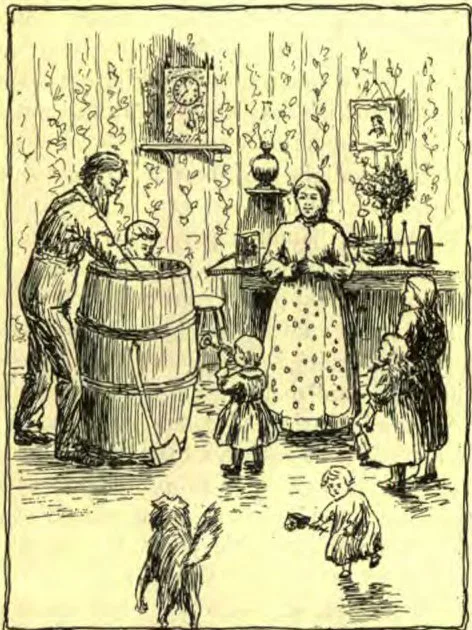
So they all stood around me while my head was taken out; and then the unpacking began,—and what was there they didn’t find in me! School-books, story-books, picture-books, song-books, paper and pens and pencils, pins and needles and thread, toys and games for the boys, dolls and silk scraps for the girls, dishes, quilts, and (relief for that burden of the pioneer mother’s heart), clothing, were taken out amid delighted “oh’s” and “ah’s” from the children, while the mother looked as if she didn’t know whether to laugh or cry.
But the chief delight and admiration of young and old seemed to be a pretty, green-enameled, iron doll-bedstead, with its mattress, blankets, sheets, and cunning little pillows. And oh! the dolls that were to occupy it! They were enough to satisfy the heart of any little girl-mother, especially the blue-eyed beauty in really, truly, long baby-clothes.
Well, all good times must come to an end, and so did theirs, for that night; for the children had to go to bed at last, with shining eyes, and tongues that could hardly keep still, while the happy father and mother put my contents away,—not all back in me again, for they never have been all back in me, although I still stand, as a table, an honored article of furniture in the cabin.