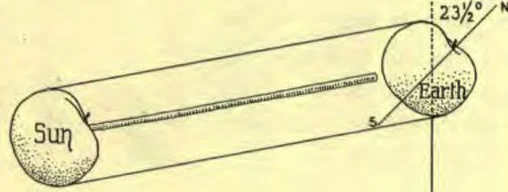
Since there has been a change in the earth's axis, there have been four seasons in the temperate zones. This is because there is more light on some parts of the earth at certain times than at others. To illustrate: Place a pencil through an apple; then put the apple on an upright stick, so that the pencil is tipped twenty-three and one-half degrees from the perpendicular. (See illustration.) This apple, we will say, represents the earth, and the pencil represents the earth's axis.
Now put another apple on the table to represent the sun. Light moves only in straight lines; so we will put a straight stick in this apple, reaching from it to the first apple, to represent the rays of light that come from the sun to the earth, and reach past the other pole. Of course, there are many rays from the sun, but one stick may be used to represent all of them. Move the stick to any position on the apple that represents the sun, and notice that the results are the same.
The apples should have been placed so that the north pole is pointing away from the sun. Now we have winter north of the equator and summer south. Move the earth-apple one fourth of the way around the sun, taking care that its axis points in the same direction all the time. Now you will see that the sun's rays fall on all the earth every day. When the real sun's rays fall on the earth in this way, it is spring north of the equator and autumn south.
Now, move the apple another quarter of the way around, and notice that the sun's rays reach only one end of the earth-apple. When this is so, it is summer north of the equator and winter south.
Again move the earth-apple another fourth of the distance around the sun-apple. Now, the sun shines again on all the earth, and it is fall north of the equator and spring south. Then move the earth-apple the rest of the way around the sun-apple. Now the sun falls as it did at first, and we have winter again.
As this change in the position of the earth's axis took place at the flood, and will not be righted till the earth is made new, God tells us that as long as the earth stands, summer and winter shall not fail to come in their season.
REVIEW.—In what zones do we have four seasons? Name these seasons. Tell what causes them.
NOTE TO TEACHERS.—It is intended that this lesson should be made largely an oral one. Use the illustration given, or some other simple arrangement of objects, till the idea is grasped. Do not attempt to enter too much into detail in this grade.
Lesson XVII
We learned in our last lesson that there has been a change in the position of the earth's axis since creation. This change causes a difference in temperature on different parts of the earth's surface. And this, in turn, makes the seasons, and also causes the winds to blow.
Try to drop a piece of tissue-paper or a bit of down on a hot stove. What happens? What causes it to rise? In the same way the hot air in the torrid zone rises. There the sun shines straight down, and makes the air very warm, and this warm air rises. The air at the poles is always cold and heavy. This is because the sun does not shine straight down there, and part of the year it does not shine there at all. When the rays of the sun do touch the poles, they shine at an angle of twenty-three and one-half degrees; so the earth there never gets quite warm.
If you try to take a can out of a pail of water, you know how the water will run in to fill the place where the can was. So the cold air at the poles flows in to fill the place where the hot air in the torrid zone rises. As it is always hot in the torrid zone, the cold air from the poles always flows toward the equator. There are so many things on the land to stop those winds that they are usually found only on the ocean. “The wind goeth toward the south, and turneth about unto the north; it whirleth about continually, and the wind returneth again according to his circuits.”
If you have ever been standing in a wagon when the team started up quickly, you will remember that you found it hard not to be thrown down, because you399could not start so quickly. So the cold air at the poles is not moving very fast toward the east. As it comes south to where the earth is moving very rapidly, it can not keep up. So these winds, instead of blowing south in the northern hemisphere, blow southwest; and in the southern hemisphere they blow northwest. These winds we call Trade-winds. They blow in the temperate zones, and in the same direction all the year.
The hot air that rises in the torrid zone sinks to the earth again, just as your piece of tissue-paper fell to the floor as soon as it was away from the heat of the stove. So the air flows back again to fill up the place where the cold winds came from. These winds nearly always blow on the ocean, usually from the northeast. They are called Counter Trade-winds, and have a great effect on the climate. So it is plain that Solomon understood how the Lord makes the wind blow to keep some parts of the earth from getting too cold, and other parts from getting too hot.
REVIEW.—What effects have been made on the earth by the change in position of the earth's axis? Why is it warm in the torrid zone and cold at the poles? What are trade-winds? From what directions do they blow? What are counter trade-winds? In what zones do they blow?
NOTE TO TEACHERS.—Do not attempt to be too technical in this lesson. It is intended to teach that God has provided a way to regulate the temperature in the earth. See that the pupils are able to explain the cause of winds, and know in what direction they blow, as well as their names. F. Bralliar.