THOUGH this family of plants is not a large one, its members are by no means small or unimportant, all of them being either trees or shrubs, and some even giants of the forest. In this respect, they differ widely from the members of the Crowfoot Family, which we have been studying for several months past, and among which we found not a single tree nor shrub.
We love the small plants for their delicate beauty, their fragrance, and many of them for their usefulness in various ways, but in the trees we find qualities not possessed by the tender herbs. We admire them for their majestic stature and enduring qualities. We love them for their dense, spreading foliage, in whose cooling shade we may find shelter from the burning rays of the sun, as well as for their practical value in providing us with fuel, shelter, furniture, and other necessaries of life.
To this small family of plants, botanists have given the long scientific name Mag-no'li-a'ce-a. They all have bitter, aromatic bark, alternate, simple, mostly entire leaves, and usually large, showy flowers. Some are highly prized as ornamental trees, not only for their flowers, but for their foliage as well.
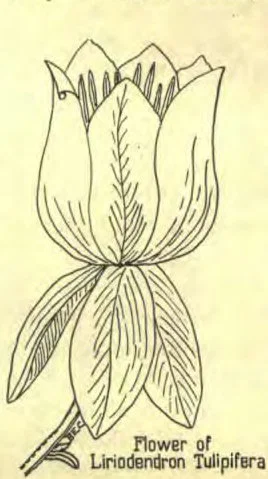
The flowers are solitary, and the sepals and petals of a similar color. The stamens are numerous, and the pistils two or more. In fruit the carpels cover an elongated receptacle, forming a sort of cone, with only one or two seeds in each carpel. As stated in a previous lesson, a carpel is a simple pistil; that is, a pistil having but one cell, or cavity, in which the seeds are produced.
Among the most interesting members of the family are the many species of Magnolias. Some of these are called “umbrella trees,” because of the manner in which the leaves are crowded in umbrella-like clusters at the ends of the branches. Others are called cucumber trees, from the resemblance of the young fruit to a cucumber.
Magnolia grandiflora, the Great-flowered Magnolia of the South, is perhaps one of the best known and most highly prized species. It is a splendid tree, with coriaceous (leathery), oblong or obovate, evergreen leaves, shining above, and usually of a rusty cast below. The flowers, which appear in spring, are white, from six to nine inches across, and very fragrant. The Magnolia is said to be the only perfectly evergreen species.
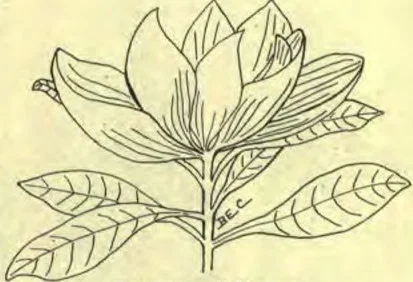
The wood is soft, spongy, and of little value.
Another interesting member of the group is the Tulip Tree (Liriodendron Tulipifera), a tall, handsome tree growing in rich soil, more abundant in the West than in the East. It is often planted for ornament, and is probably the most widely distributed member of the Magnolia Family.
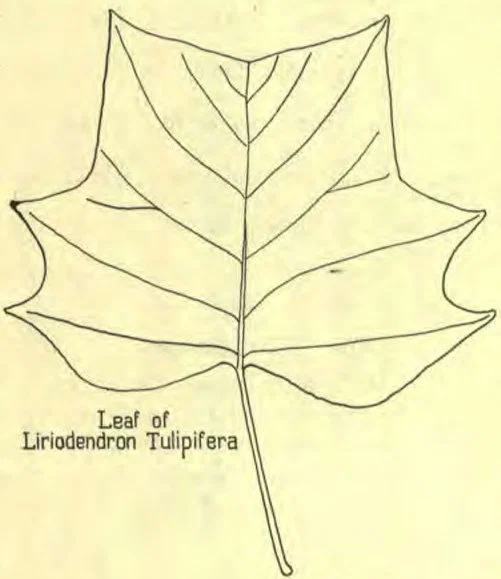
The leaves are of a peculiar shape, appearing as if cut off at the end, and cordate, or heart-shaped, at the base. The flowers are green, yellow, and orange, fragrant and very showy, in shape closely resembling the common garden tulip flower. The sepals are three in number, the same as in the Magnolias, but they are reflexed, as will be seen from the illustration. The blossoms appear late in spring.
The tulip tree is much valued for its timber, from which is produced a white, soft lumber, much used for inside work and for cabinet making. The tree itself and the lumber made from it, are called “whitewood,” and sometimes, but erroneously, “poplar” or “white poplar.”
B. E. CRAWFORD.