THE year 1896 was an eventful one in the history of our Matabele mission. During the first three months one calamity followed another in quick succession. First came the expedition of Dr. Jameson into the Transvaal, which threw South Africa into a fever heat; then followed drought, which checked the development of the crops; then a cattle plague, carrying off hundreds of cattle in the section of the mission, while many more were killed to prevent the spread of the disease; then swarms of locusts, devouring the few green things that had escaped the drought. It would seem as if all this were sufficient; but these experiences sank into insignificance in the face of a far greater disaster,—the uprising of the natives. On account of this our workers were compelled to leave their homes on the farm, and take refuge in Buluwayo early in April. Indeed, at that time conditions had become so serious that an armed escort was sent from Buluwayo to accompany them to the city, where fortifications had been thrown up for protection.
The natives were very savage in their warfare. Although illy prepared for battle, having few guns and little ammunition, they congregated in such large numbers that the white men were not able to cope with them until reinforcements arrived. The native policemen were well armed, and led their countrymen in this rebellion.
The Lord certainly preserved his servants in a remarkable manner during these trying times. They afterward learned that the very night after they left the farm for Buluwayo, a small company of natives had reached there, planning to kill all the white workers. And once while on the way to Buluwayo, they were compelled to retrace about five miles of their journey, in order to meet the escort that had been sent to conduct them safely. Had they driven forward one hour from the place where they turned back, they would have been surrounded by the hostile forces. After arriving in Buluwayo, they discovered that an army of natives followed them on their way to the city, intending to attack them; but for some reason did not find them. One of the sentinels reported having heard their signal whistles as they passed near where the camp was sleeping, between 2 A. M. and daylight, their usual time of attack.
The farm had been deserted but four days when the Matabeles visited it, carrying away all the cattle, something more than one hundred, and threatening to return later to burn the buildings, and kill the natives who refused to join them against the whites.
Six months passed, and the workers, almost prisoners in Buluwayo, one day hoping to return to their station, and the next day disappointed because of the increasing hostility on the part of the natives, were compelled to wait. But during all this trying experience their faith in God and his power to cause even this experience to bring blessing, did not waver. Early in September they were back at the farm. Peace was now restored, and they went immediately to work to gather together what had been scattered abroad. In all that territory our mission station was the only one that was not burned or completely ruined. All the natives on the farm remained loyal; and although they had to flee from the rebels to save their lives, they kept safely all the mission property that had been intrusted to them.
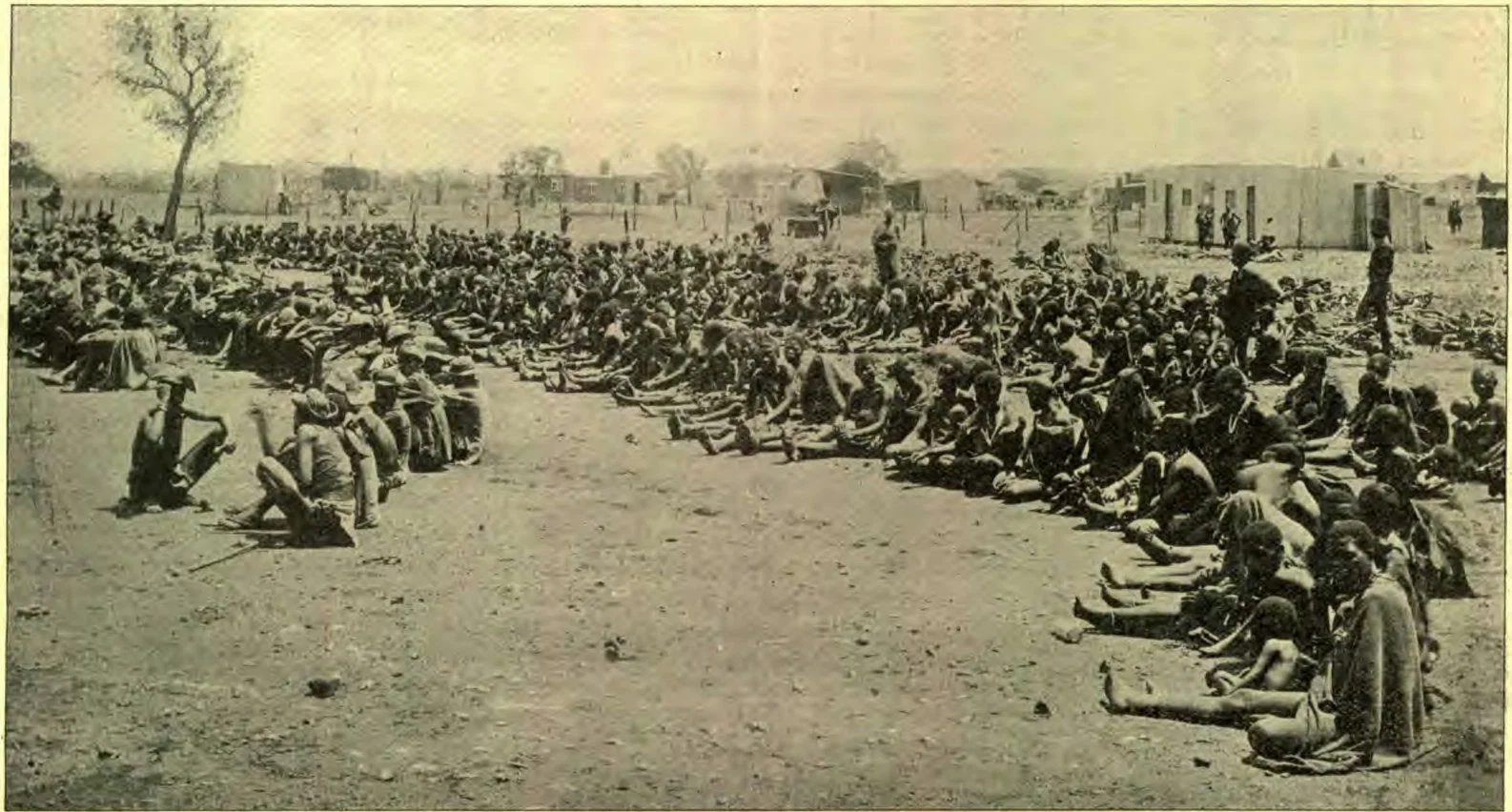
NATIVES WAITING FOR FOOD NEAR BULUWAYO DURING THE FAMINE
Ten oxen and about twenty-five bags of corn was the extent of their wealth when the workers returned to the farm after the close of the war. And very soon these oxen died of rinderpest, so that the mission was without a team for several months. During this time all the soil prepared for crops was cultivated by hand with a hoe. But the evil effects of the war were yet to be felt more seriously. The natives who had taken part in the rebellion not only had had their homes destroyed, but their crops as well, and now starvation faced them. There was no grain for food nor to plant. The mission supplied more than one hundred natives with seed. But this was a trifle, compared to the need. Soon famine, with all its attendant horrors, was rife. The road to Buluwayo was dotted with the bodies of those who had started there in search of food, but, strength failing, had perished by the way. Children and old people especially suffered. For a long time our missionaries had believed that a good work might be wrought for the natives by taking their children and training them, but they made very slow progress when the children were in the school only during the day, returning to their homes at night. Now parents came to the workers, and begged them to take their little ones and save them from starvation. Often children would be found who had been deserted by their parents—not because they were heartless, but because they thought in this way to put an end to their suffering.
Several of these children had been buried alive, but were recovered before death had claimed them. They were gathered in until a company of thirty-six had found a home. Some of these, however, did not live. Others were returned to their parents after the worst of the famine was over, until the family of little ones numbered thirty, ranging in ages from four to eight years. They were bright, quick to learn, and were soon able to express their appreciation for the kindness shown them. At the close of each meal, before leaving the table, they would thank their benefactors for their food. One day Brother Anderson was compelled to leave the table before the family had finished their meal, and about an hour later a little five-year-old came to him and thanked him. He asked him for what he was thanking him, and he said his dinner.
At one time, when breakfast had been finished, there was not enough grain left in the house for the next meal. The children were much concerned to know where more would come from. But together the workers laid the matter before the Lord, and then assured the children that their God would provide. When dinner came, they had three hundred and eighty-five pounds of corn in the house, a gift from the government to the children. Their exclamations of joy were great, and the seeds of faith and trust thus sown in the hearts of these boys and girls have later grown up and borne fruit in their lives.
One year from the time the workers were able to return to the mission farm from Buluwayo, Brother and Sister Armitage joined them. This reinforcement was greatly appreciated, as our missionaries were becoming much worn by the constant strain which the war and famine had brought upon them. But never a word of complaint had come from their lips. All their letters betrayed that grace and Christian fortitude which marks the missionary called of God, standing at his post. E. H.