At the State camp-meeting of the California Conference, held at Oakland, June 4-16 of the present year, it was recommended that Brother T. H. Watson and family, with the writer and his family, go to Alaska to open up the work.
On the ninth of July we were ready for the journey, and took the train for Seattle, Wash. The next day we much enjoyed the Shasta scenery. The clear, rippling waters of the Sacramento River, as we followed it through its various windings to its source, and the snow-capped peaks of Mt. Shasta and Castle Craig, were truly grand.
We reached Shasta Springs at 9:45, and the five minutes’ stay there was improved by all on the train in an eager endeavor to get a drink of the famous Shasta water, which comes rushing and tearing down the steep mountain-side. The delightful ride through the Rogue River and Willamette valleys, dotted with farms of growing grain and fruit, was a pleasant feature of the day’s journey.
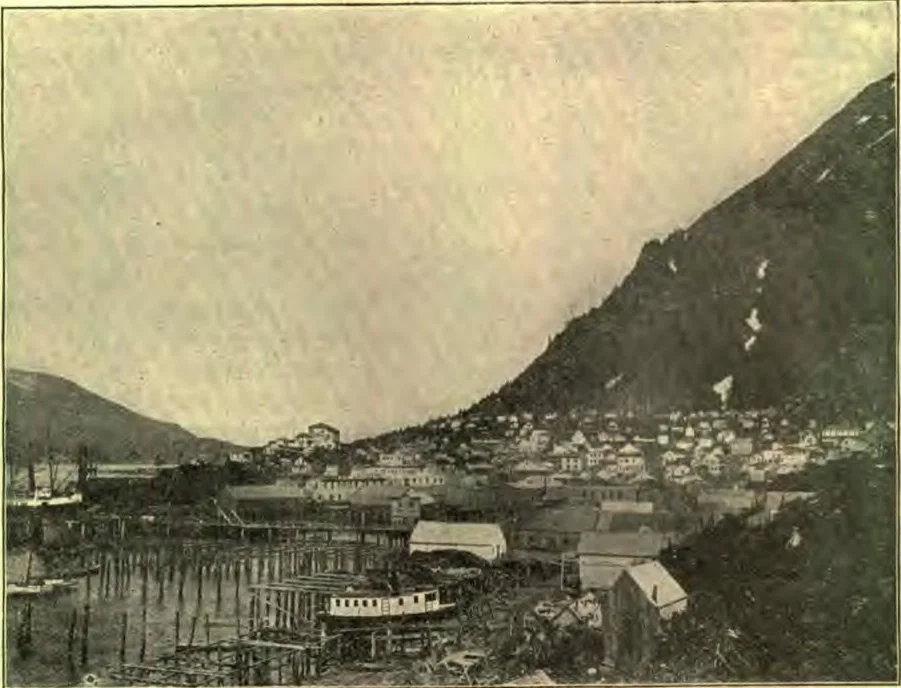
JUNEAU, ALASKA
We reached Seattle at four in the afternoon of the eleventh. The next day we began looking for a ship on which to finish our trip. The “Dirigo,” sailed by Captain Hunter, was at last chosen, not because she was better or faster than others, but because she stopped at many places along the route, and would thus give us an opportunity to become better acquainted with our new field of labor.
We sailed away on the evening of the sixteenth, and hilly Seattle, with her many lights, presented a beautiful sight as we left her glimmering in the darkness. The night of the seventeenth found us only a short way on our journey; for our ship took much of her load at Tacoma, Everts, Port Townsend, and Ladysmith,—places only a short distance from Seattle,—so it was not till nearly noon of the eighteenth that the sailors began to make things fast from bow to stern in preparation for the trip proper.
The first point of interest from Ladysmith was the wreck of a large vessel, the “Miame,” loaded with three thousand tons of coal. The captain, ever ready to make our trip pleasant, gave us a view of her through his glass, and told us how all on board stayed one day on the hurricane deck before they were rescued.
We sailed through channels, sounds, and gulfs, seeing the ocean only three times during the entire trip, and then only for a few hours at a time. We felt a little out of our latitude when they told us that we were in the Gulf of Georgia.
Sometimes the passages were very narrow, so much so as to make them dangerous. One of these places, Dodds Narrows, is only eighty yards wide, with sixty fathoms of water. We threw a piece of coal ashore as we rushed through this place. The tide rushes with tremendous speed through these narrow places, and ships can pass through only with the tide, and in the daytime.
It was about dark the evening of the nineteenth that I noticed a few of the sailors as they stood talking together, much interested in the course we were taking. A few minutes later I happened up by the pilot’s room, and saw the captain anxiously giving his orders, and two men at the wheel. We were passing the last harbor, and entering Seymour Narrows, a very dangerous point, about two hours late. There have been several wrecks here. One English vessel went down with two hundred souls on board. All were lost, and the vessel was never heard of again. An American “man of war” was wrecked here, but no lives were lost. There are whirlpools to be avoided as well as rocks. The captain said that should the ship get her nose into one of these whirlpools, she would become uncontrollable.
The mountains, covered thickly with trees, sloping up from the narrow channel through which we were passing around rocks and whirlpools at the rate of about twenty miles an hour,—for the tide took us about nine knots, and the power of the ship the same; the short, sharp orders of the captain, which spoke to us of danger; the slush of the water against the ship; the stillness and dark shadows of night,—all made an impressive picture.
Soon the face of the captain brightened with a look of relief, as he said, “All right now.” We had passed the dangerous point, and he left the ship in charge of the man at the wheel. He said it would have been suicidal to attempt the passage a half-hour later.
On the morning of the twenty-first we reached Metlakahita Island, where William Duncan has spent the last forty years with the natives, with results that are truly marvelous. We had on394board a large engine for the fish-cannery at this place, and our stop here gave us an excellent opportunity to look around the island. The natives have built a large church and a good school building. Many of them are well educated.
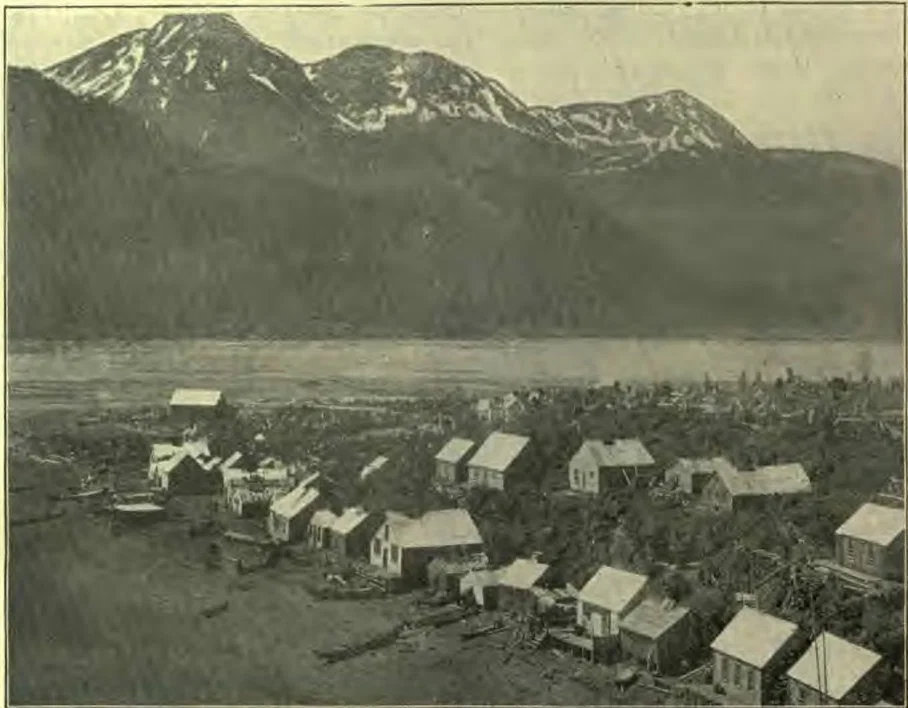
INDIAN VILLAGE, JUNEAU, ALASKA
Monday, the twenty-second, was an eventful day. Early in the morning we sailed into an uncharted harbor. We were gliding cautiously along in the smooth waters, when suddenly there was a bump, a grind, a slight pitch, and we were anchored. We were going carefully, but a thousand-ton ship, heavily loaded, does not strike gently at the slowest. The tide was going out, and it would not rise high enough to lift us off the rock till late in the afternoon. When we went to breakfast, a scene of confusion met our eyes. Things were tipped over in the staterooms and on the dining-table, and we ourselves could hardly stand erect. You see, we struck a rock on the outgoing tide, and as the water lowered, our ship, except that portion which rested upon the rock, followed it, and left us tipping. A leak was sprung, and the pumps were soon at work; but owing to the angle at which the ship rested, the water came in at the port-holes also, and threatened more than the pumps could handle. A boat was lowered, and sailors started in it, with the end of a large rope, for a near-by island. They made fast the end of the rope to a great rock, and the other end was fastened to the mast of the ship. Two or three more ropes were placed in the same position, and there we hung, with about two hundred feet of water at the rear of the ship, and five feet in the engine-room. The captain was advised to throw some of the freight overboard, but did not think it necessary. While there was some danger of losing the ship, there was little of loss of life, as the island was so near. Nevertheless the situation was not very pleasant.
A man at that harbor, for whom we had freight, had a scow and a small tug-boat. The captain sent for him, and the passengers all left the ship, and boarded the scow. The crew with the scow had some small boats, which they kindly gave us the use of, so we had the pleasure of a trip ashore.
As the tide came in, the ship began to right herself, but it was a question whether the tide would lift her or not. High tide was at five o’clock, and when, at half-past four, we were still there, it looked as if we might be doomed for quite a stay; for it was two days before a higher tide. Fifteen minutes to five we were still there; but at precisely five o’clock the boat moved, and all were in high spirits. We struck another rock in getting turned around, but we soon got off, and again on our way.
Several fish-canneries were passed, but the largest was at Petersburg, which we reached the morning of the twenty-third. At this place they can as many as forty-eight thousand cans in one day. The work is done almost entirely by Chinese and native Indians, with a few Japanese. We timed a Chinaman who was cleaning fish, and saw him cut off the fins, heads, and tails, and take out the entrails, of six salmon in one minute.
From Petersburg we passed some beautiful glaciers, from which the captain said there would sometimes fall thousands of tons of solid ice into the water, and cause the ships to rock as in a great storm.
On the morning of the twenty-fourth, at ten o’clock, we sailed into the harbor at Juneau, and bade farewell to the good ship “Dirigo,” with her friendly captain and crew.