One writer has said of a seed that it is a plant packed away for transportation. This is literally a fact. First we note that in it is wrapped up the germ of life, placed there by the Creator of all things; and when the conditions laid down in his laws are met, he causes it to germinate and grow. The third day of creation the Lord spoke all manner of good plants into existence; and though we may till the soil and plant the seed, it still is the Creator who causes it to spring forth and grow.
There are different means by which the various seeds are distributed. Some, like those of the willow, poplar, thistle, and cotton plant, are enclosed in fiber or down, and are easily caught up and carried long distances by the wind. Others, such as seeds of the ash, elm, and maple, are furnished with thin appendages, like wings, by which they are carried about from place to place. Birds eat many berries, and thereby carry their seeds far and near. Still other seeds, such as the “beggar’s lice,” hoarhound, and the various burs, become attached to animals or persons, and in this way are carried to different localities. Nuts, fruits, and grain are largely distributed by rodents and man.
Within the seeds are stored albumens and starches, besides the germ of life; and when the plant begins to grow, these materials feed it until it gets root and top enough so it can draw sustenance from soil, water, sunlight, and air.
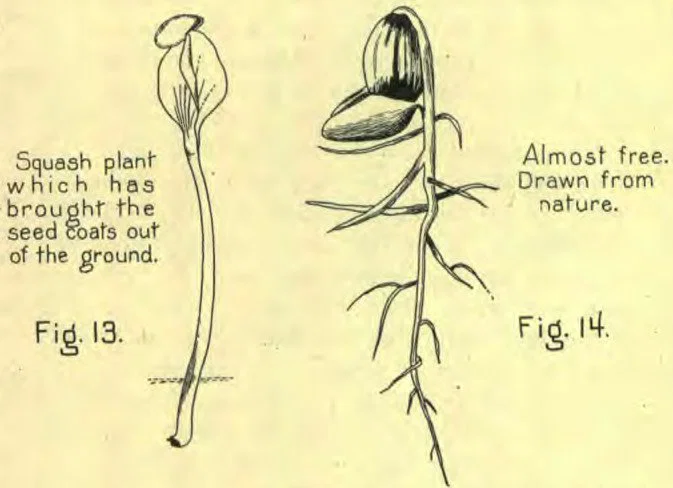
Squash plant which has brought the seed coats out of the ground. Fig. 13. Almost free. Drawn from nature. Fig. 14.
Many of our plants are annuals; that is, they grow from the seed, reproduce new seeds, and die the same year. Others, such as our shrubs and trees, are perennials—living for many years. Some of our herbs have perennial roots, while the tops die down each season. Others, again, are termed biennials because they grow from seed one year, and produce a flesh root, like the parsnip, turnip, or onion; or a fleshy head, like the cabbage, which, if preserved through the winter, will produce seed the following year, when the old plant will die. Certain plants are seldom grown from seed, except to obtain new varieties, but are propagated by planting the tuber, or plants raised from it each year, such as the potato, sweet potato, and Jerusalem artichoke. Some of our onions we grow from “sets,” and the onions replanted the following year to raise more sets; others are grown from seed, and these in turn produce seeds.
These tubers, bulbs, and fleshy roots are of different forms. The parsnip, beet, and radish are usually fusiform, or spindle-shaped. Others are napiform, like the turnip and certain beets and radishes. Carrots are usually cone-shaped. These, too, store away within their thickened roots, starch or farinaceous matter for the future use in the exhausting process of fruit-bearing in its second year.
Shall we not be students of nature, and learn lessons from the plants? For you know that Christ, who made all these things, also said, “Consider the lilies of the field, how they grow.”