The Isle of Wight

5%

Review and Herald Publishing Company · Battle Creek, Michigan · June 25, 1903

FromThe Youth's Instructor, Vol. LI, No. 25

Read the full edition

The Isle of Wight

While looking for a suitable site for a sanitarium for Great Britain, the writer had the opportunity of spending a short time in the Isle of Wight, which lies just south from England, and is separated from the mainland by the Solent.
This little isle is undoubtedly one of the most beautiful spots in Great Britain, and is a favorite health and pleasure resort. It is best known to Americans as having been the home of England’s most beloved sovereign, the late Queen Victoria, who spent her last days at Osborne House.

Osborne House

Osborne House is about half a mile from Cowes. Since the death of the queen, her son, King Edward, has presented the property to the British government as an asylum for aged, infirm, and wounded officers of the British army and navy. He has definitely stipulated, however, that the grounds and the queen’s private rooms shall forever be open to the British public.

Whippingham

About half a mile south of Osborne House is Whippingham, the beautiful little church where Queen Victoria and other members of the royal family often attended service. It is a charming chapel, embowered among stately trees, vines, and ornamental shrubs, and surrounded by well-kept hedges. These are shown quite distinctly in the accompanying picture.
The church was founded in 1066; but the original structure has been removed. The present church, shown in the illustration, was designed by Albert, the prince consort, and built by Queen Victoria in 1851. It was in this little chapel that Princess Beatrice was married to Prince Henry of Battenberg. Prince Henry, who for several years was governor of the Isle of Wight, was a great favorite with the queen. He died of fever in 1896, and was buried at Whippingham. His tomb, which occupies the whole of the north side of the chancel opposite the reserved seats for the royal family, was erected to his memory by Queen Victoria.

Carrisbrooke Village

From Whippingham we paid a brief visit to Carrisbrooke Village, once the capital of the island. The most interesting feature of the village is the old church, erected in 1088. Considering its great age, it is in a remarkably good state of preservation.
In the garden of the vicarage are distinct remains of an old Roman villa, probably built between 40 and 50 A. D. This villa can be accounted for by the fact that the Isle of Wight was conquered for the Romans by Vespasian in the reign of Claudius, 43 A. D. Probably it was built about that time.

Carrisbrooke Castle

CARRISBROOKE CASTLE
CARRISBROOKE CASTLE
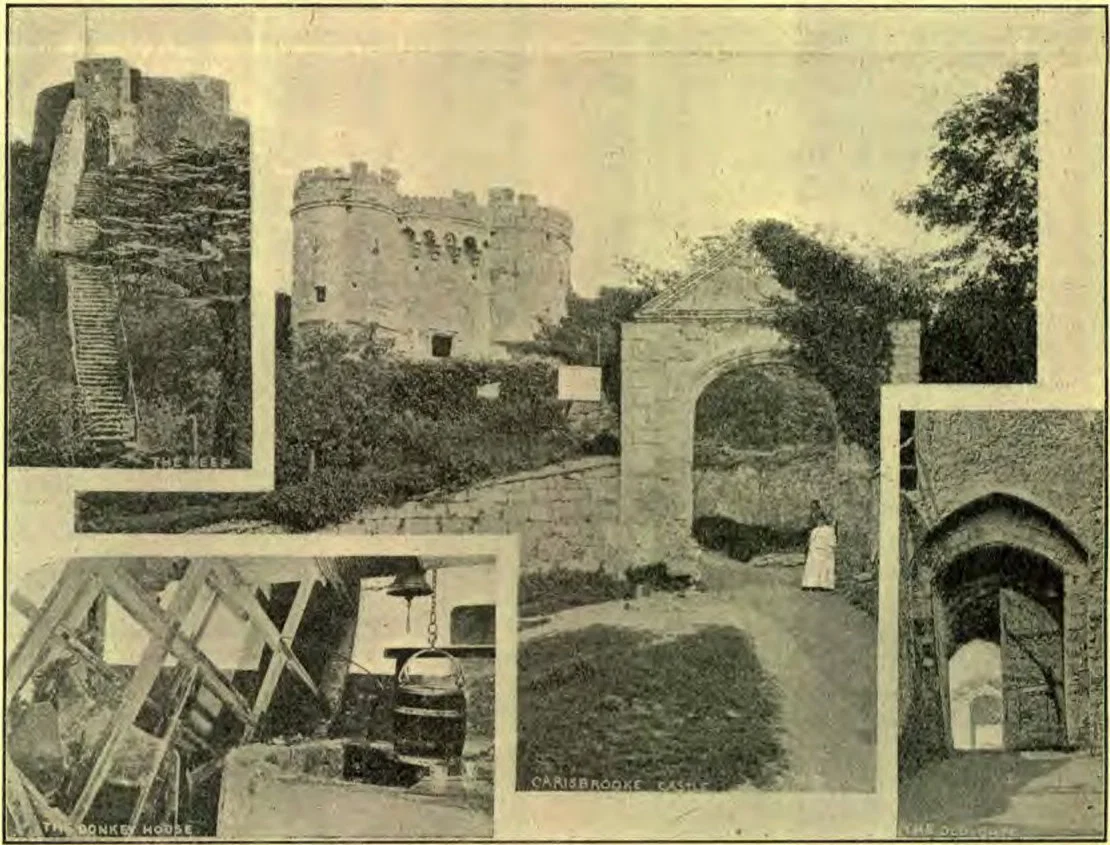
Beautifully situated on the slope of a prominent hill near by is Carrisbrooke Castle, the most picturesque feature of the surrounding landscape. This is one of the most interesting and famous old castles of Great Britain. It is best known in history as having been one of the prisons of Charles I. The keep, which is shown in the upper left-hand corner of the picture, is in an excellent state of preservation. Here the ruins of the apartments occupied by Charles I during his confinement may be distinctly seen. Even the window through which the monarch attempted to escape is pointed out. This attempt to regain his liberty was made during Christmas week of 1647; but his enforced idleness at the castle had made him too stout to slip through the window, and there he stuck, “most unkinglike,” until his keepers found him in the morning, and extricated him from his laughable as well as rather unpleasant position.
In the keep was a well, which is said to have been three hundred and ten feet deep; but it has long since been filled up.
In the garden there is another well, which forms one of the greatest curiosities of the island. Its depth is one hundred and forty-four feet, with thirty-seven feet of water, which is drawn by a wheel turned by a donkey. The donkey drawing water may be seen in the lower left-hand corner of the picture. Every visitor drinks a glass of water from this well, unless, as in our case, the visit is made on Sunday, when the donkeys are turned loose in the garden. We were quite disappointed that we could not see the donkeys draw the water, or obtain a drink from the well, the water of which is remarkable for its coolness; but, as we went away, the two donkeys came to the edge of the great fortress, looked down between the vines in a sympathetic way, and brayed at us, as if to say, “At your service on week-days.”
The many ivy-clad ruins of the ancient castles and strongholds of England are among the most charming features of its varied landscapes. They may be seen on the hillsides in nearly all parts of Great Britain, and they form one of the strongest links binding the present with an interesting history of long ago.

Stratford-on-Avon

When on our way from London to Leeds, England, with the purpose of attending the camp-meeting at that place, we stopped off overnight at Birmingham. Early the next morning we took a flying trip down to Stratford-on-Avon, the birthplace, home, and resting-place of Shakespeare, which is about thirty miles south of Birmingham. Stratford is only a little country village, and its chief business seems to be to show visitors the places made sacred to them by their association with the world’s greatest poet. The people of many nationalities besides the English pay their tributes of respect to this place; during the year 1901 it was visited by people from forty-three different countries. The house where Shakespeare was born would be recognized at once from the familiar picture, which many of you have seen. It is built of a heavy wooden framework filled in with cement. Although nearly four hundred years old, many parts of the house are well preserved. The room in which Shakespeare was born is in the best condition. The “Great House,” or “New House,” as it is often called, where the poet lived and did much of his work, has decayed. Only the foundation and well remain. These are covered with glass and wire netting.
The church in which Shakespeare and his wife are buried is very old. It was dedicated in the tenth century. Parts of it, including the roof and several pillars, have been rebuilt; but much of it is the original, and bears on its quaint pillars and arches the crumbling marks of time. The church has one striking peculiarity. It is built in the form of a cross; but the head of the cross bends to the left several feet. This inclination is supposed to represent the recline of the Saviour’s head upon the cross. The grave of Shakespeare is in the floor; and upon the slab is the following peculiar epitaph, probably written by himself:—
“Good frend, for Iesvs’ sake forbeare, To digg the dvst enclosed heare; Blesst be ye man yt spares thes stones, And cvrst be he yt moves my bones.”
In the above lines v is used in the place of u; ye is the; and yt is that. E. R. PALMER.