Aquilegia Canadensis

6%

Review and Herald Publishing Company · Battle Creek, Mich. · August 14, 1902

FromThe Youth’s Instructor, Vol. L., No. 33.

Read the full edition

Aquilegia Canadensis

Wild Columbine

The Wild Columbine is one of our most common wild ornamental plants, growing freely on or about rocks in damp woods, especially on the hills and mountainsides.
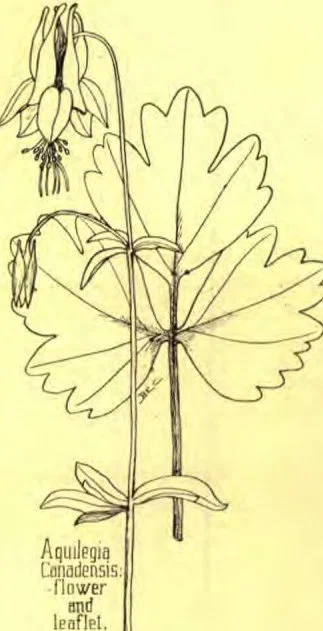
It is a perennial, branching considerably in herb, varying size, being usually from one to four feet high. The leaves, which are quite characteristic of the plant, are always once, twice, or more times ternately compound, often assuming that form known as ternately decompound; a decompound leaf being one that is more than three times compound, or in which the degree of division is variable.
Aquilegia Canadensis: Flower and leaflet.
The leaves bear quite a close resemblance to those of the meadow-rue, yet there are differences that are readily discerned by one well acquainted with both plants; so that the leaves alone tell in unmistakable terms to which plant they belong. It is true of many other plants, perhaps of the greater number, that the experienced botanist can recognize them by the leaves alone; but this ability can be acquired only by careful and accurate study and observation.
Nature in her multitudinous forms offers the best advantages for the development of the mind, especially the observing faculties, and he is wise who gives diligent heed to her teaching.
The handsome pendulous, or drooping, flowers of the Columbine are about two inches long, of a scarlet and orange color, and often light-yellow inside. There are five petals, each with a long, slender, straight, ascending spur. These spurs are filled with a honey-like substance called nectar, which fact has given to this plant the appellation “Honeysuckle,” though it differs from the plant properly known by this name.
The sepals are five in number, and the same color as the petals. Pistils five, in fruit forming narrow pods having somewhat the appearance of small pea-pods. The stamens and pistils project some distance beyond the corolla. The blossoms appear in spring and early summer.
Now, let us carefully pick one of the flowers to pieces. Removing the sepals and petals, we find a circle of numerous stamens surrounding the five pistils at the center. If we remove one of these, and view it through a small magnifying glass, we shall notice that it looks very much like A in the illustration. B shows the same more highly magnified, with a portion of the pistil cut away to show the interior.
Some of the pollen grains produced by the anthers at the tip of the stamens fall upon the moist, spongy tissue of the stigma at the tip of the style, and each gives rise to one or more minute, hair-like tubes, which pass downward through the loose tissue of the style, and come in contact with the ovules in the ovary. As soon as this takes place, the ovules grow rapidly, and in a short time develop into the ripened seeds.
The process by which pollen is conveyed from the anthers to the stigmas is known as pollination; while the growth of the pollen-tubes and their contact with the ovules constitute the process of fertilization. Each ovule that comes to maturity must first be fertilized by one of the pollen grains. The same process takes place in all the flowering plants. In the large number of plants, each pollen grain gives rise to but one pollen-tube, though the number varies, and is said to be as high as twenty or more in some cases.
The pollen is conveyed to the stigma in a variety of ways in the different plants. Sometimes it simply falls from the anther to the stigma, frequently it is carried by the wind; and in many instances it is conveyed by insects of various kinds that visit the flowers to gather pollen or nectar, or perhaps to gather both, as is the case with honey-bees and bumblebees. While thus supplying their own needs, they carry the pollen from the anthers to the stigmas, and from one flower to another.
Many plants are dependent upon the aid of insects, without which they could produce no seed. He who made both the flowers and the insects knew how to adapt them to each other’s needs, so that some flowers seem made for insects, and some insects for the flowers.
A few species of Columbine are cultivated in flower gardens. Of these, the most common is Aquilegia vulgaris. It is greatly changed by cultivation, the flowers being of various colors, and often more or less double.

Questions

  1. Where is the Wild Columbine most frequently found?
  2. Describe the leaves and flower.
  3. Where is pollen produced?
  4. What purpose does it serve?
  5. What is pollination? In what ways is it effected?
  6. Describe the process of fertilization.
  7. How are insects useful to plants?
B. E. CRAWFORD.