THE empress dowager of China, now about sixty-nine years of age, of whom so much is said and written in these days, and to whose account is laid the Boxer uprising of 1900, is by birth a Manchu, born of a noble family, well educated, and by nature decidedly capable and clever. She became the secondary wife of Emperor Hien Fung, and to her own and his great joy, gave birth to an heir to the throne. On account of this the emperor raised her to the rank of empress, the other, sonless wife holding a nominal precedence, and occupying a palace on the east, while the present empress dowager was given a palace on the west.
Upon the death of the emperor, the two wives exercised a joint regency in the name of this son; but the mother was then, and still continues to be, the ruling spirit. This son having been made emperor, died suddenly in 1875, in the eighteenth year of his age, failing to designate his successor to the throne (each sovereign is allowed to appoint his successor, either his son or some other person); hence the present occupant, Kuang Su, a nephew of the empress dowager, in consequence of palace intrigue directed by the dowager in concert with Prince Chun, was declared emperor.
Emperor Kuang Su was born in 1871, became emperor in 1887, and was married Feb. 26, 1889, to Yeh-ho-na-la, a niece of the empress dowager. A palace revolution took place, Sept. 21, 1898, and the empress again assumed the regency, ostensibly on the ground of the emperor's ill health. This gave her even more power than she had held before, since she was now sole regent, the eastern dowager having died in 1881.
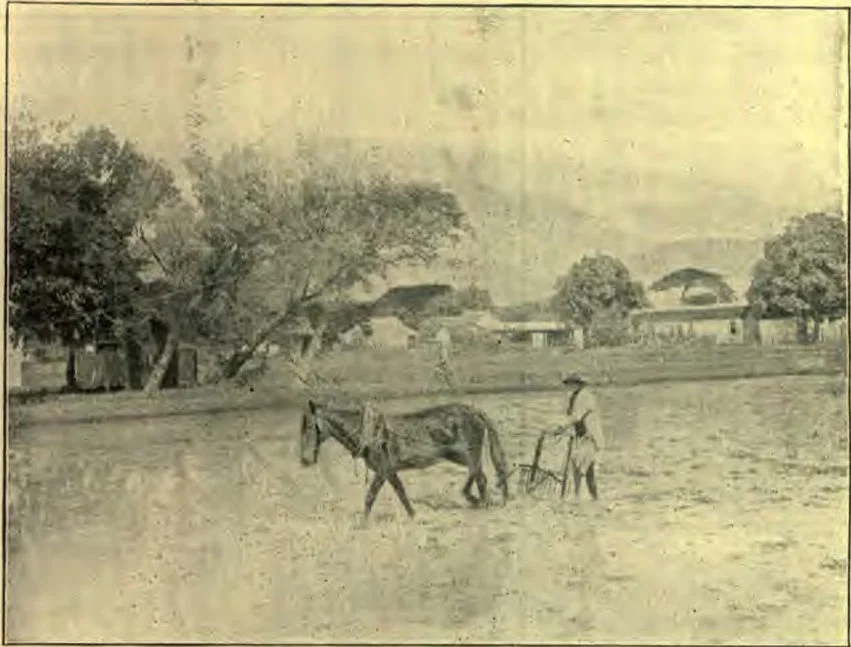
PLOWING IN CHINA
This unseating of the emperor, and the assumption of power by the empress dowager, are generally held to be the first step leading to the Boxer uprising of 1900, when northern China was convulsed by an insane hatred of everything foreign. How much the dowager was personally responsible for this, may always remain a matter of uncertainty. It is said that there was a plot laid to assassinate her, and that the knowledge of it served to fill her with a desire to crush all opposition. The very man who had been sent with secret orders to take the life of Yu Lu, a main supporter of her cause, suddenly changed his mind, and became one of the dowager's most trusted favorites.
About the time of the occupation of Peking by the allied army, the empress and her court fled to the interior, where she remained until late last year. Then she returned to the capital, when, after the enthronement of the deposed emperor, she has in a most clever way sought to make matters appear right.
By most Europeans she is distrusted, and259looked upon as the direct instigator of all the recent troubles in China. The same conviction is entertained by many Chinese, while others look upon her as the helpless victim of a corrupt and intriguing court. But since we are in no way responsible for her deeds, nor is it in our power to grant her final acquittal, or to pass upon her her last judgment, we need not stop to inquire into her personal guilt. In common with the rest of mankind, she must answer to God for what she has done or failed to do. Our part is to do right, and hold high the banner of truth for all.
It may be of special interest to the INSTRUCTOR family, and at the same time assist them to remember this very distinguished woman, if I give her full name, which is Tsze hi Toanyn Kanzi Chaoyn Chang Cheng Shokung Chinhien Chung seh. J. N. ANDERSON.