UNLIKE the practice of most mechanical arts, the braiding and weaving of horsehair requires no tools. The necessary materials can generally be obtained without cost by those who live in the country; and so little hair is required to keep one busy during his spare moments that the horses that furnish it will never miss it.
The Mexicans usually obtain the hair by pulling it from the unfortunate horse’s tail; but this is a cruel and quite unnecessary practice. The object sought is to secure only the long hair, but the same end may be as easily attained without pain to the horse. The hair of a horse’s tail generally hangs in many small bunches that are quite separate from one another, though the hair of each bunch is twisted and snarled together almost beyond hope of untangling. If one of these bunches is cut entirely off, it is liable to leave a noticeable mark; besides, in that way the greater part of the hair secured would be too short. A better way is to take hold of the long hair in one of these bunches, and, holding it taut with one hand, with the other draw a knife across the entire bunch close to the roots. In this way only the hair that is held taut will be severed, while the remainder of the bunch will be uninjured.
Those who live in the city may find it necessary to buy their material from a dealer in horse-hides or from a tannery; but the cost will be very slight.
A mixture of white and black hair is most effective, though plain black should be used if something inconspicuous is desired. Sorrel hair also yields beautiful results; and as it is itself variegated, usually ranging in color from gray to dark-brown, it will need no mixture, though white may be used with it quite effectively. Sorrel hair, however, is quite rare. Most horses have black manes and tails; consequently black hair is not hard to get. White hair is not so common, and, when secured, the ends are often a pale-yellow. This part must not be used, as the contrast between it and the pure-white would be too marked for pleasing results.
The hair will vary considerably in length, but the cut ends should be as even as possible. When a sufficient quantity has been secured, the bunch may be bound together by tying a string around it a few inches from the end. This will keep it from becoming tangled while being washed.
The hair should be thoroughly washed in strong soapsuds, and then rinsed in clean water, to remove all impurities. Otherwise it will hardly be fit to handle.
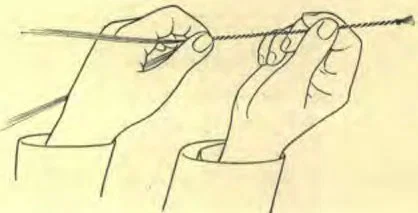
The next step is to twist the hair into threads, or strands. For our present purpose these should contain eight or ten hairs each. Take the tips of the required number of hairs, the longest in the bunch, between the thumb and forefinger of the right hand, and gently draw them from the bunch while the latter is firmly grasped in the left hand at the point where it is bound with the string. If these directions are carefully followed, the hair will never become tangled, nor will that removed draw other hair with it. These hairs must now be bound together by a knot at one end. Consider the hairs a thread, and tie a knot on the end of it, just as you would knot the end of a thread with which you intended to sew on a button. Next separate the thread into two strands of equal size, and while it is held between the thumb and forefinger of the left hand (as shown in the illustration), twist the thread between the thumb and forefinger of the right hand. When the end is reached, tie another knot to prevent the thread from untwisting, and proceed with another till the required number have been twisted.