In our study for March, we learned that those planets lying nearer the sun than we, travel more rapidly than the earth; also that those lying farther from the sun travel more slowly. By comparing this diagram with the one in the INSTRUCTOR of February 27, this may be readily seen.
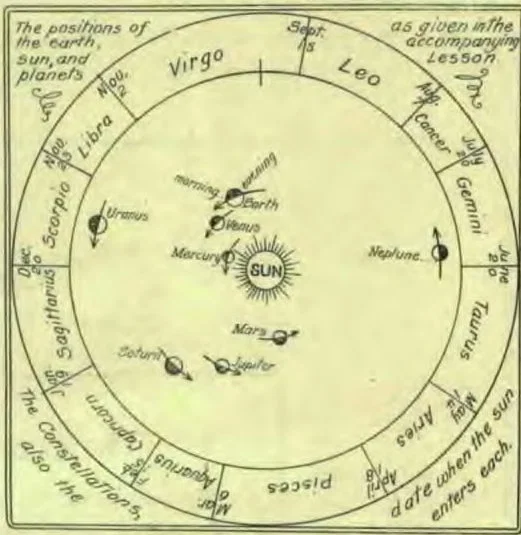
During March the earth made one twelfth of its yearly journey around the sun. Venus has outrun us, and is now nearly out from between us and the sun; while Mercury, the fleet, has outdone all the others, and completed about one fourth of his annual journey. Mars has made noticeable progress; but with the others so small a fraction of their yearly circle has been passed as to be scarcely noticeable on so small a diagram. Jupiter, the most rapid of this class, has gone only one one-hundred-and-forty-fourth part of his journey around the sun. These planets, therefore, appear stationary.
How many of our readers were up the mornings of March 15, 16, and 17, on the sharp lookout for Mercury? Those who were had no trouble in locating Venus, which reached her brightest point as morning star about March 20. If you saw Mercury at all, you caught him much nearer the point of sun-rising than was Venus.
As far as our solar system is concerned, all our work during the coming spring and early summer will have to be done in the early morning; for six of our planets are now morning stars. Can you tell by the diagram which they are? Let me help you a little. In imagination place yourself on the dark part of the earth, marked “morning,” just at the point where the earth is rotating out of darkness into the light of day; and then see how many planets are above your horizon.
Mercury and Mars will both be morning stars; but so nearly in line with the sun as to be invisible. Jupiter and Saturn may be seen; but will appear small, owing to their great distance from us, being nearly on the opposite side of the sun. Uranus, also, is so far distant that we shall not be able to detect him with the unaided eye; but Venus will be beautifully clear among the stars that deck our morning skies, though constantly growing dimmer as the season advances.
The three planets, Venus, Jupiter, and Saturn, may be easily distinguished from the other stars by their more ruddy color. They will be not far from the point of the sun-rising. Venus will be the brightest star of the east, and will be quite low; a little higher up will appear Jupiter; and the next higher will be Saturn. Fix these in mind, and then watch them during the coming season.
In view of what we have already learned in these studies, how many can tell why Venus will constantly grow less brilliant, while Jupiter and Saturn will continually grow brighter, during the coming months? Why is it so difficult to see Mercury? Will Mars continue to be a morning star? or will he shift to the evening sky?
DR. O. C. GODSMARK.