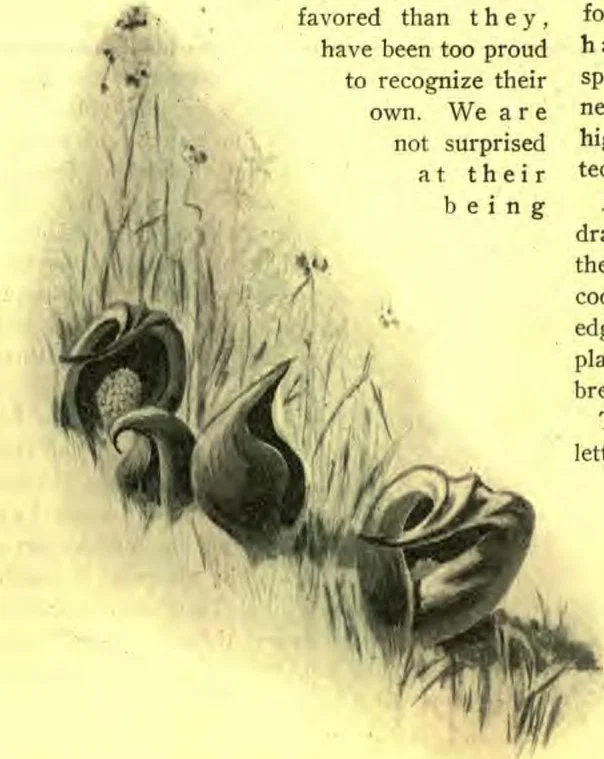
THE Skunk Cabbage has been called the courier of the spring. He leads the procession of the flowers. He is so far ahead of the other plants that he dwells alone, the hermit of the bog. Already the honey-bees have found him, and we follow them to the low places to “welcome the prophet that pierces the snow, the pioneer that lifts the banners of ice to tell us of the message he has received from mother-earth, long before the wood flower hears it in the south wind, or the lisp of the bluebird tells it to the trees.”
The Skunk Cabbage is the “poor relation” of the spotless Calla Lily and the cheerful Jack-in-the-Pulpit. Of course they hate to own it, and have been quite successful in keeping the secret from the rest of the world. And, by the way, this is not the first time that creatures even more favored than they, have been too proud to recognize their own. We are not surprised at their being ashamed of the odorous, homely, livid-colored Cabbage, they form with it so great a contrast.
Who ever named the Adder's-tongue, I wonder? I doubt if more contradictions were ever put into the title of a thing before. The only thing I know of that in any wise resembles it is the calling a black man Snowball, or giving a white man the title of Mr. Black.
Adder's-tongue, or Dog's-tooth Violet! It is not a violet in shape or color; it is really a lily, and the blossom is usually a russet-yellow. You will find nothing about it that looks like an adder's tongue, though there is a slightly snaky look to the leaves, due to their mottled appearance; but then you will find some specimens that bear not the slightest trace of this mottled color. Further, the only possible resemblance any part of the plant bears to a dog's tooth must be in the root, which is usually in the ground, out of sight, and this resemblance is nine tenths imagination. Mr. Burroughs has suggested for this plant the appropriate name of “fawn lily,” or “trout lily,” and it would be well to call it so.
The Anemones and the Bloodroot are among the frailest of the spring flowers. The juice of the Bloodroot is orange-red, and is said to be a specific for coughs and colds. I have observed beautiful specimens of this plant nearly eighteen inches high in the sunny and protected Minnehaha Valley.
As children, how we watched for the Mandrakes, though that is not the name we gave them. If, perchance, after walking through some cool stretch of woodland, we came, just at the edge of the trees, upon a host of these stately plants, how we all cried out, in glee, “The umbrellas are out! The umbrellas are out!”
Truly, the times we spend with nature are red-letter days. Unfortunate, indeed, is he who can not conjure up memories “of lush green tangles, of water-weeds and lily-pads, of rippling brooks and dipping oars; placid lakes, cool forest glades, and meadows redolent with bloom.” All that nature has been, she still is, and ever will be, and with her there is healing for failing bodies and rest for tired nerves. We may “go forth under the open sky, and list to nature's teachings.”